Digestive / VISUAL EXPLAINER
How Does a Cavity Start in a Tooth?
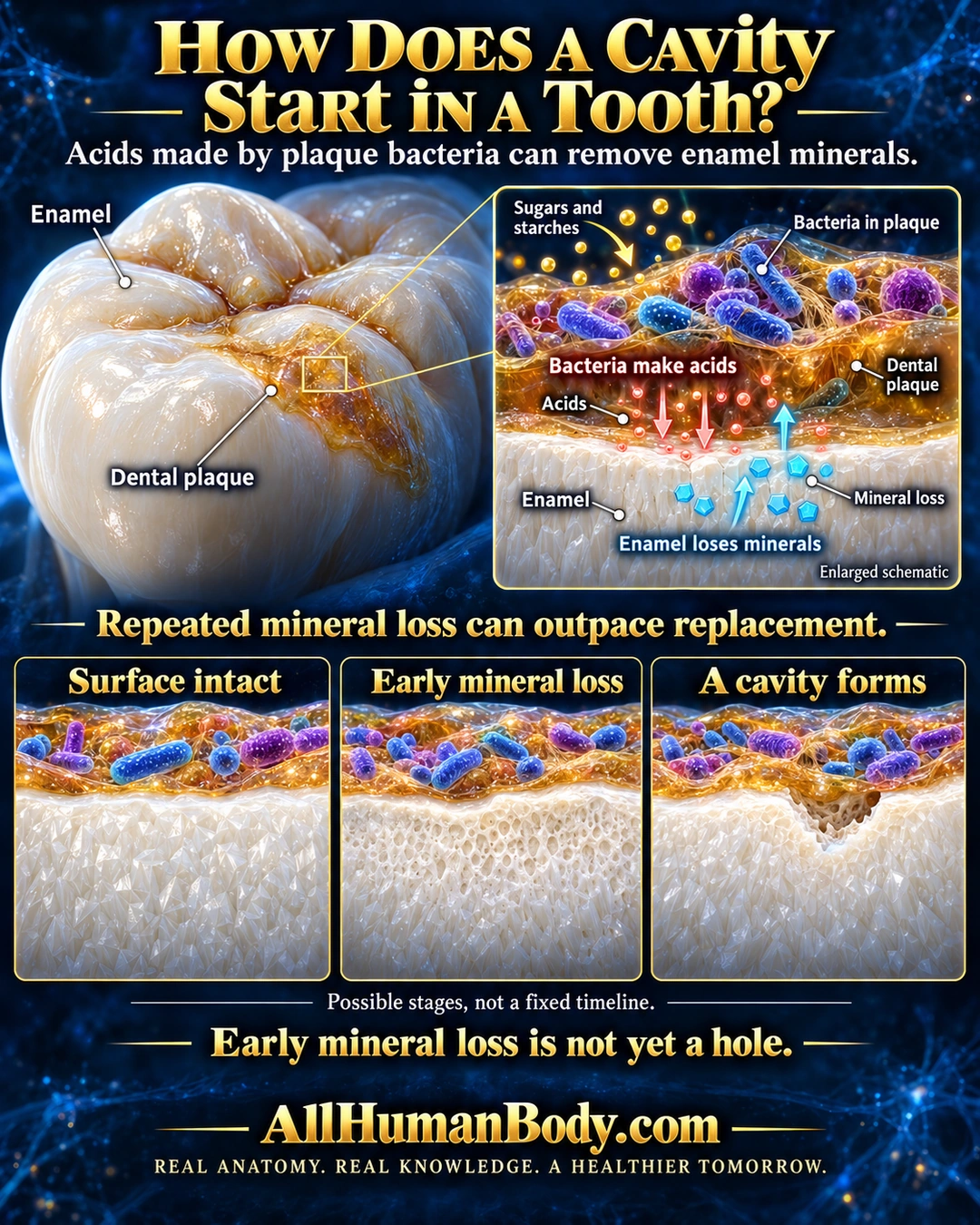
Plaque bacteria can make acids from sugars and starches. Repeated mineral loss may outpace replacement and weaken enamel, but early mineral loss is not yet an established cavity.
READ THE IMAGE
What the illustration shows
Navy-and-gold poster titled “How Does a Cavity Start in a Tooth?” A large ivory molar crown at left has a small amber dental-plaque patch. Two gold magnification lines connect it to an inset with blue and purple bacterial shapes above white enamel. Gold dots labelled sugars and starches enter the plaque; coral acid dots and downward arrows approach enamel, while blue mineral symbols and upward arrows leave enamel. The inset is labelled enlarged schematic. Three lower enamel cross-sections show surface intact, early mineral loss under a continuous surface, and a small cavity opening. Text says repeated mineral loss can outpace replacement, the panels are possible stages rather than a fixed timeline, and early mineral loss is not yet a hole. Gold AllHumanBody.com and the complete slogan appear at the bottom.
How to interpret this poster
- Possible stages, not a fixed timeline or inevitable progression. Not sugar drilling directly, a treatment plan or a claim that an established hole regrows.
- AI-assisted educational illustration; not physician certification, microscopy, a diagnosis or individualized medical advice.
- Fine annotations need enlargement; the full description provides an accessible text alternative.
- Display the full uncropped illustration; do not trim titles, legends or boundary annotations.
AI-assisted educational illustration, adapted into web-sized images without changing its composition. This is general education, not an individual diagnosis or treatment recommendation.
EVIDENCE / CONTEXT
Sources and what they support
- NIDCR official dental education ↗
Bacterial acids from sugars/starches, enamel mineral loss, early reversible phase and later cavitation.
- Mayo Clinic dental education ↗
Plaque-associated bacteria generate acids that remove enamel minerals and lead to holes; progression occurs over time.