Integumentary / VISUAL EXPLAINER
Where Does Underarm Odor Really Come From?
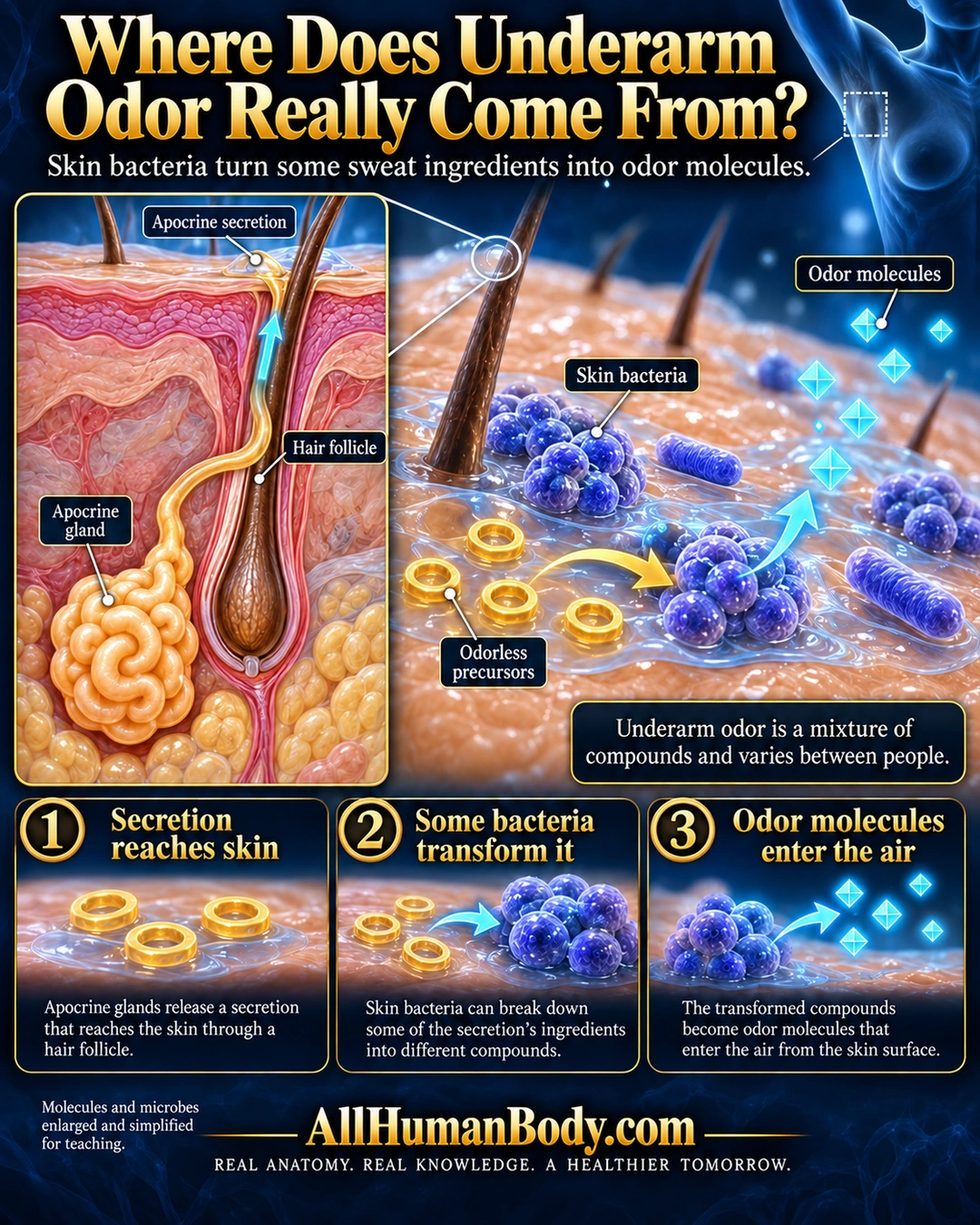
Some skin bacteria convert ingredients in underarm secretions into volatile odor molecules. The mixture and amount vary between people; sweat quantity alone does not define odor.
READ THE IMAGE
What the illustration shows
Navy-and-gold English poster titled “Where Does Underarm Odor Really Come From?” A small blue torso locator marks the underarm. At left, a skin cutaway shows a coiled apocrine gland, its duct bending into the upper hair-follicle channel, and a cyan arrow indicating secretion moving beside the hair shaft toward the surface. The larger scene shows a wet peach skin surface with hairs and enlarged blue-purple bacterial clusters and rods. Gold rings labeled odorless precursors lead toward one bacterial cluster; cyan diamonds labeled odor molecules rise away from it. A box states that underarm odor is a mixture of compounds and varies between people. Three lower panels repeat secretion reaching skin, some bacteria transforming ingredients, and odor molecules entering the air. A qualifier says molecules and microbes are enlarged and simplified for teaching. Gold AllHumanBody.com and the complete slogan appear below.
How to interpret this poster
- Not every bacterium produces odor; no hygiene blame, ancestry claim, pheromone conclusion or deodorant advice. Molecular symbols are not real geometries.
- AI-assisted educational illustration; not physician certification, microscopy, a diagnosis or individualized medical advice.
- Fine annotations need enlargement; the full description provides an accessible text alternative.
- Display the full uncropped illustration; do not trim titles, legends or boundary annotations.
AI-assisted educational illustration, adapted into web-sized images without changing its composition. This is general education, not an individual diagnosis or treatment recommendation.
EVIDENCE / CONTEXT
Sources and what they support
- Primary biochemical and structural study, Scientific Reports 2020 ↗
Bacterial conversion of odorless precursors to thioalcohols; context identifies multiple volatile odor compounds. One enzyme mechanism is not all body odor.
Evidence correspondence is limited to the abstract. - Mayo Clinic patient education, updated 2025 ↗
Apocrine secretion becomes odorous with skin bacteria; natural odor varies between people.