Special Senses / VISUAL EXPLAINER
Why Can Chopping Onions Bring on Tears?
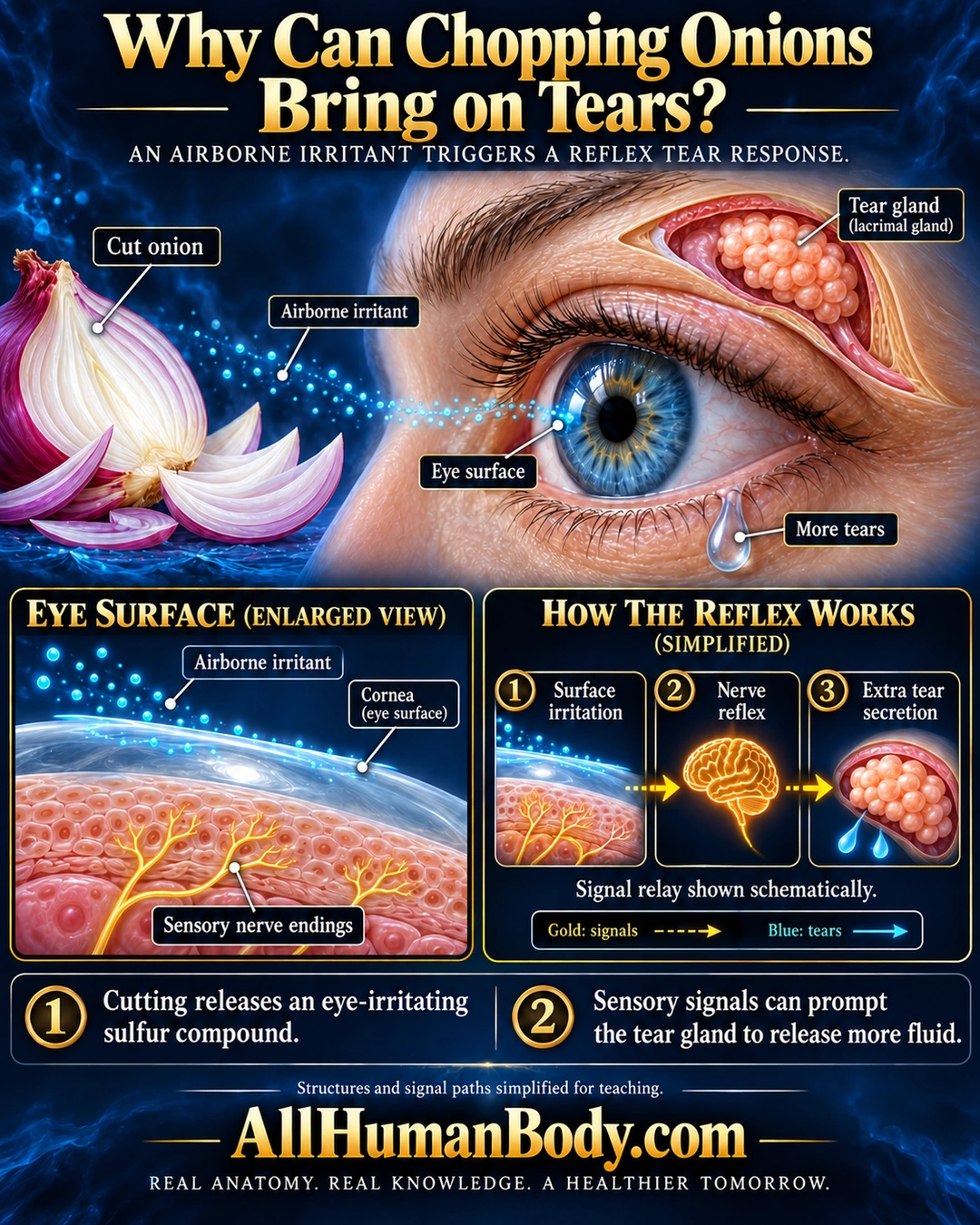
Cutting an onion releases an airborne sulfur-containing irritant. Contact with the eye surface can activate sensory reflexes that increase tear secretion.
READ THE IMAGE
What the illustration shows
Navy-and-gold English poster titled “Why Can Chopping Onions Bring on Tears?” A cut red onion at left sends symbolic cyan dots toward the exposed surface of a large blue eye at right. A small cutaway above the outer upper eyelid reveals a peach lobulated tear gland. One tear sits outside the lower eyelid. Labels identify the cut onion, airborne irritant, eye surface, tear gland and more tears. Below, an enlarged corneal-surface illustration shows irritant dots over pale epithelial tissue and gold sensory nerve branches. A separate three-stage panel links surface irritation, a brain-shaped schematic nerve relay and extra tear secretion using gold dashed arrows; blue droplets below the gland symbolize tears. Text explains that cutting releases an eye-irritating sulfur compound and that sensory signals can prompt more fluid. The signal paths are explicitly simplified. Gold AllHumanBody.com and the complete brand slogan appear at the bottom.
How to interpret this poster
- No sulfuric-acid claim, exact receptor map or exposure experiment. Chemical-stimulation study is not an onion trial; gland ducts are not reconstructed.
- AI-assisted educational illustration; not physician certification, microscopy, a diagnosis or individualized medical advice.
- Fine annotations need enlargement; the full description provides an accessible text alternative.
- Display the full uncropped illustration; do not trim titles, legends or boundary annotations.
AI-assisted educational illustration, adapted into web-sized images without changing its composition. This is general education, not an individual diagnosis or treatment recommendation.
EVIDENCE / CONTEXT
Sources and what they support
- National Capital Poison Center educational article ↗
Cut onion tissue forms a sulfur-containing lachrymatory factor associated with irritation and tearing. Do not reuse its simplified enzyme sequence.
- Mayo Clinic institutional explanation, 2017 ↗
Cell disruption releases volatile chemicals; eye contact leads to tear-gland response. Its kitchen tips and evolutionary explanation are outside scope.
- National Eye Institute research-program explanation ↗
Ocular anterior-segment nerves regulate tear production. Supports general neural involvement, not an onion-specific receptor claim.
- Primary biochemical mutagenesis study, Masamura et al., 2012, DOI 10.1271/bbb.110652 ↗
Cutting onion bulbs evokes irritation from propanethial S-oxide; enzymatic formation of lachrymatory factor. Only the broad cutting-to-irritant claim is used, not a detailed pathway.
- Primary human sensory-stimulation study, Acosta et al., 2004, DOI 10.1167/iovs.03-1366 ↗
Chemical corneal stimulation increased reflex tear secretion in six subjects. Not an onion exposure experiment; used only for sensory-reflex physiology.
Evidence correspondence is limited to the abstract.