Respiratory / VISUAL EXPLAINER
Why Do You Breathe Harder When You Run?
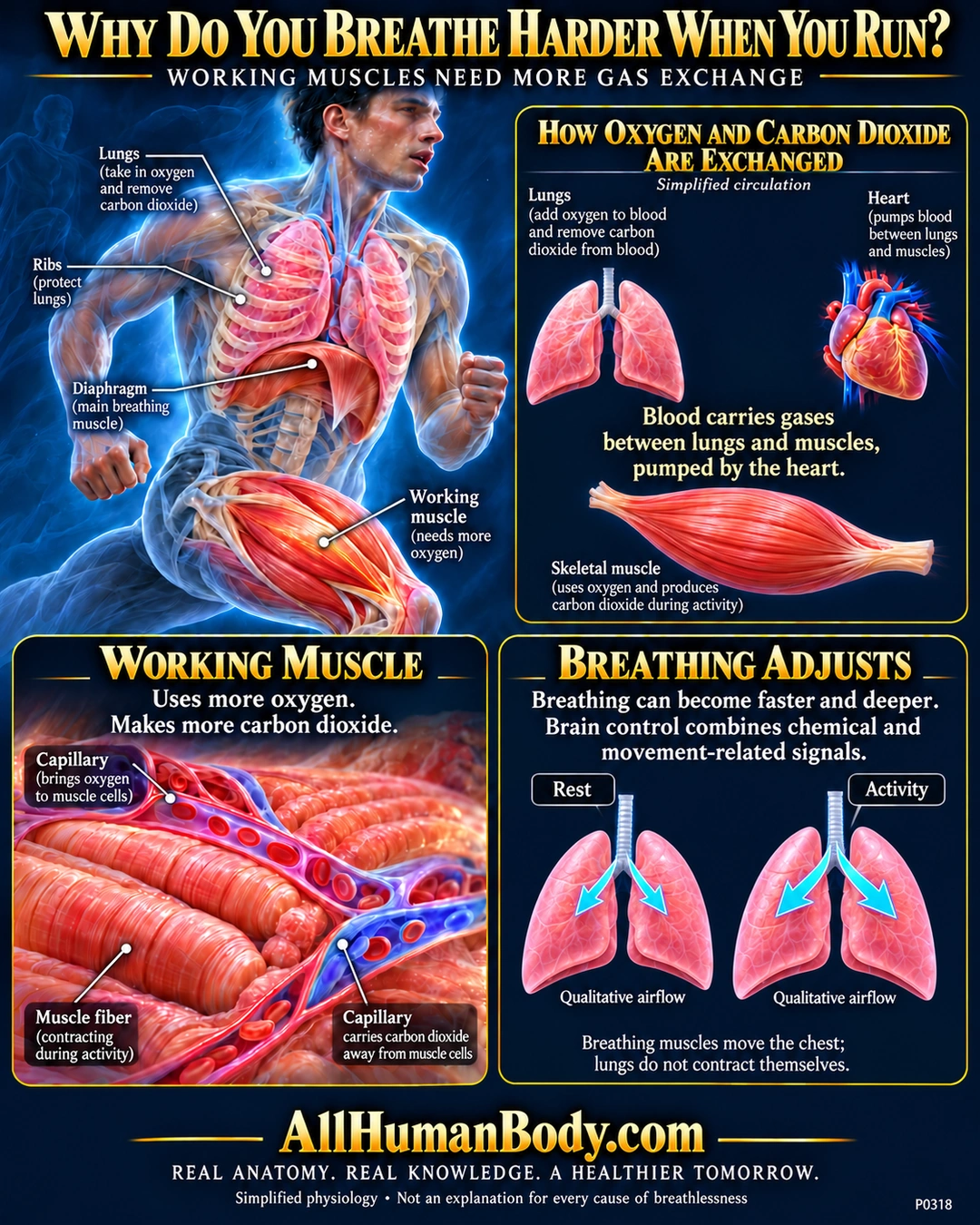
Working muscles use more oxygen and produce more carbon dioxide. Breathing can become faster and deeper as control systems integrate chemical and movement-related signals.
READ THE IMAGE
What the illustration shows
Navy and gold poster titled Why Do You Breathe Harder When You Run? A runner has translucent ribs, visible lungs and diaphragm, and highlighted thigh muscle. An upper-right inset displays separate lungs, heart and skeletal muscle icons with text explaining gas transport by blood pumped by the heart; no route arrows connect them. Lower panels show striated muscle and capillaries, then rest and activity lung silhouettes labeled Qualitative airflow with larger inward airflow arrows during activity. Text says working muscle uses more oxygen and makes more carbon dioxide, and breathing can become faster and deeper under chemical and movement-related control. The plain navy footer with gold AllHumanBody.com carries the complete slogan and a breathlessness caveat.
How to interpret this poster
- Not every cause of breathlessness; no exercise prescription or measured breathing rate. No claim arterial oxygen must fall or carbon dioxide must rise.
- AI-assisted educational illustration; not physician certification, microscopy, a diagnosis or individualized medical advice.
- Fine annotations need enlargement; the full description provides an accessible text alternative.
- Display the full uncropped illustration; do not trim titles, legends or boundary annotations.
AI-assisted educational illustration, adapted into web-sized images without changing its composition. This is general education, not an individual diagnosis or treatment recommendation.
EVIDENCE / CONTEXT
Sources and what they support
- European Lung Foundation expert-reviewed education ↗
Exercise increases oxygen use, carbon dioxide production and ventilation.
- NHLBI physiology education ↗
Activity changes breathing; chemical and muscle/joint sensory signals contribute.