Respiratory / VISUAL EXPLAINER
Why Does Dust Make You Sneeze?
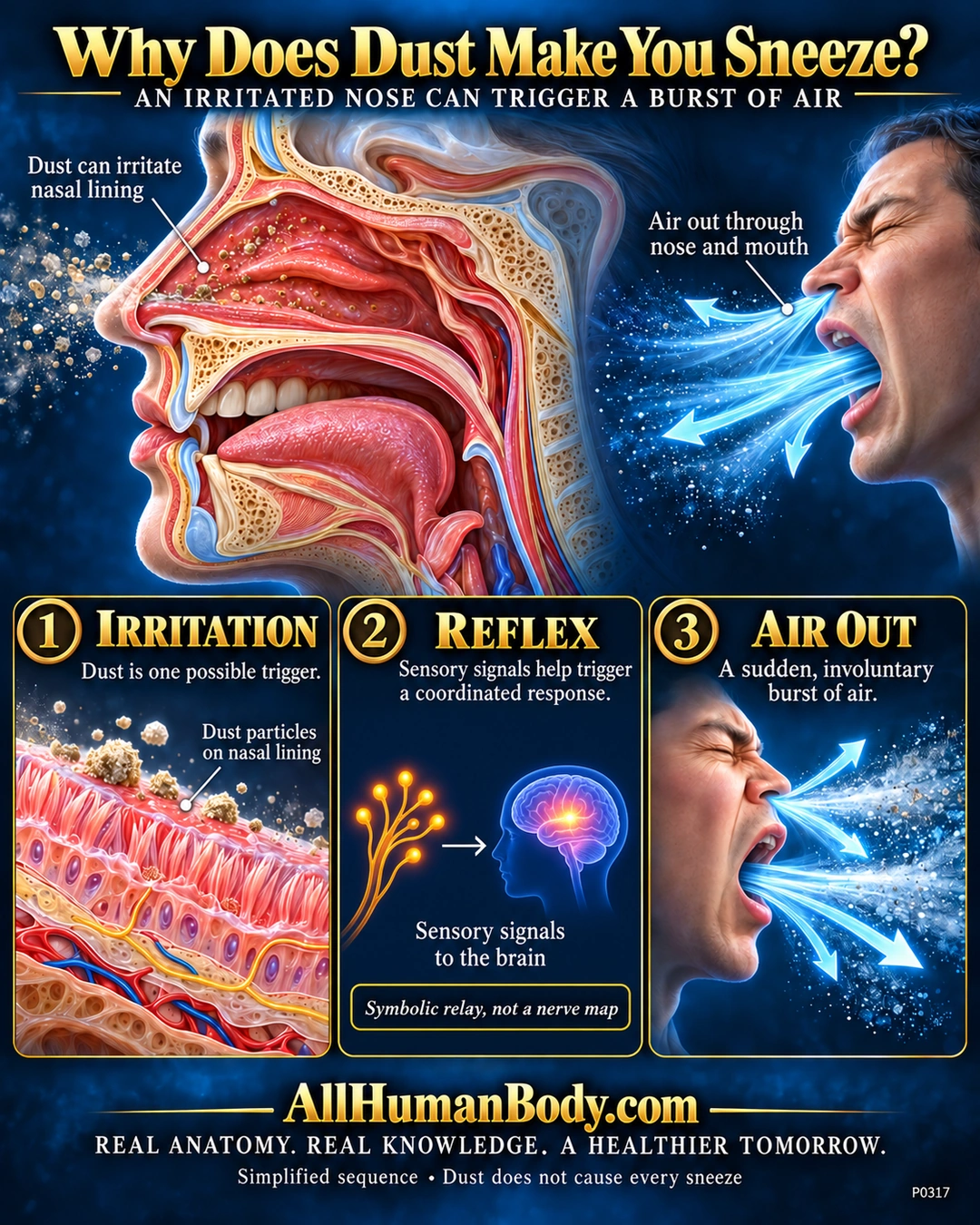
Dust can irritate nasal lining and trigger a coordinated sneeze, sending air out through nose and mouth. Dust is only one possible trigger, so a sneeze alone does not identify its cause.
READ THE IMAGE
What the illustration shows
Navy and gold medical poster titled Why Does Dust Make You Sneeze? A large sagittal head cutaway shows dust along the nasal lining above the palate. Beside it, cyan arrows leave a person’s nose and open mouth. Three lower panels show particles on nasal lining, a separate sensory-ending icon pointing toward a brain icon, labeled Symbolic relay, not a nerve map, and air expelled in a sneeze. Text describes irritation, a coordinated reflex, and a sudden involuntary burst. The footer notes that dust does not cause every sneeze and displays AllHumanBody.com and the full brand slogan.
How to interpret this poster
- Particles, glow and airflow are illustrative; no exact nerve trajectory, mandatory eye closure, measured speed or guaranteed clearance.
- AI-assisted educational illustration; not physician certification, microscopy, a diagnosis or individualized medical advice.
- Fine annotations need enlargement; the full description provides an accessible text alternative.
- Display the full uncropped illustration; do not trim titles, legends or boundary annotations.
AI-assisted educational illustration, adapted into web-sized images without changing its composition. This is general education, not an individual diagnosis or treatment recommendation.
EVIDENCE / CONTEXT
Sources and what they support
- NLM MeSH definition ↗
Upper-airway mucosal irritation and involuntary nose-and-mouth air expulsion.
- NLM-hosted medical encyclopedia ↗
Dust is among possible triggers; nose or throat mucosal irritation. General facts only; no copied wording or images.
- NHLBI respiratory control explanation ↗
Sensory signals and irritant-triggered sneeze; not a detailed human neural circuit.