Nervous / VISUAL EXPLAINER
Why Do You Feel Cold When a Fever Starts?
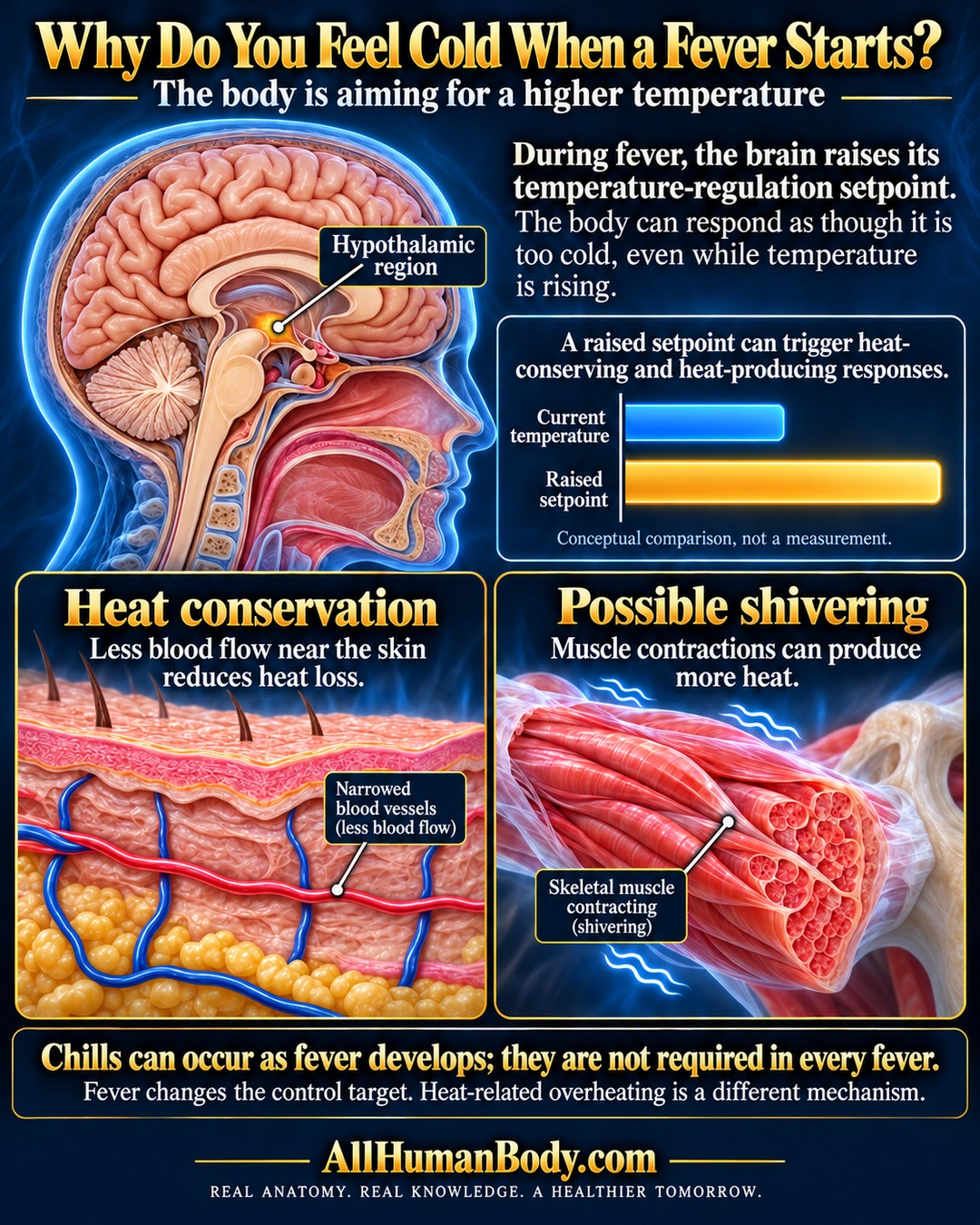
When fever raises the body’s temperature-control target, the body can respond as though it is too cold. Reduced skin blood flow conserves heat, and shivering can generate more heat; chills are not required in every fever.
READ THE IMAGE
What the illustration shows
Gold-on-navy poster asks why you feel cold when a fever starts. A sagittal head cutaway marks the hypothalamic region. Unequal blue and gold bars compare current temperature and a raised setpoint, explicitly labeled conceptual rather than measured. A skin cutaway illustrates narrowed blood vessels and reduced heat loss. A skeletal-muscle cutaway illustrates possible shivering and heat production. Text states chills are not required in every fever and heat-related overheating has a different mechanism. Gold AllHumanBody.com branding and the complete slogan appear below.
How to interpret this poster
- Bars are not measurements; chills are not required in every fever. Not a diagnostic or treatment guide, and heat-related overheating is different.
- The hypothalamic highlight is a broad locator, not a traced control circuit. Vessel and muscle illustrations are qualitative, not measurements of flow, temperature or heat production.
- AI-assisted educational illustration; not physician certification, microscopy, a diagnosis or individualized medical advice.
- Fine annotations need enlargement; the full description provides an accessible text alternative.
- Display the full uncropped illustration; do not trim titles, legends or boundary annotations.
AI-assisted educational illustration, adapted into web-sized images without changing its composition. This is general education, not an individual diagnosis or treatment recommendation.
EVIDENCE / CONTEXT
Sources and what they support
- NLM patient education ↗
Chills may accompany onset/rise of fever and muscle contractions generate heat.
- OpenStax Microbiology: Inflammation and Fever ↗
Fever can raise the hypothalamic control target; skin vasoconstriction conserves heat and shivering produces heat.
- OpenStax Biology: Homeostasis ↗
Hypothalamic target regulation links a raised target to heat-conserving and heat-producing responses.
- Cleveland Clinic: Heat-related illness, fever distinction ↗
Heat-related overheating differs from fever: heat overwhelms cooling rather than a raised hypothalamic target.