Integumentary / VISUAL EXPLAINER
Why Do Bruises Change Color?
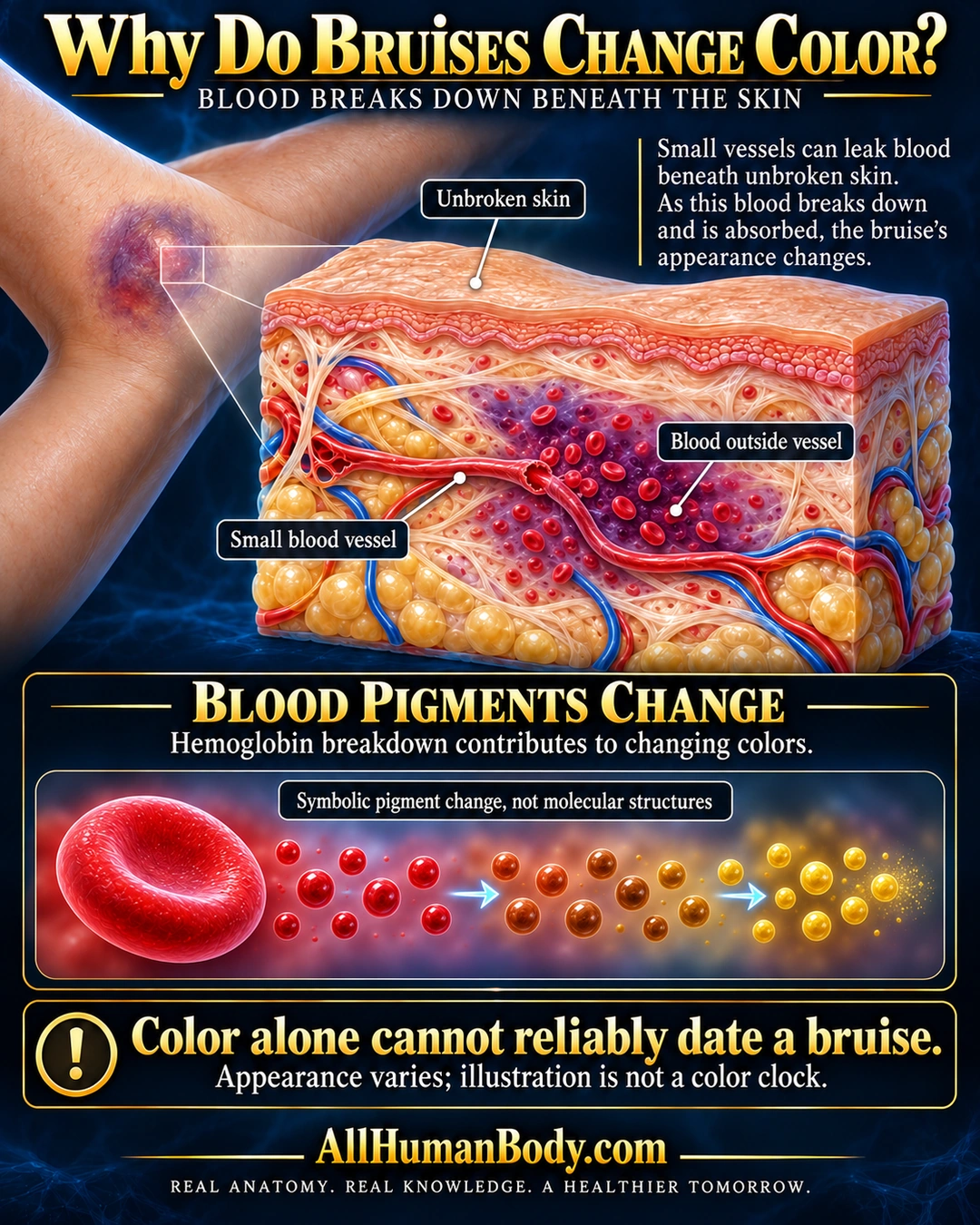
A bruise can form when blood escapes small vessels beneath unbroken skin. Breakdown and absorption change its appearance, but color alone cannot reliably establish its age.
READ THE IMAGE
What the illustration shows
Navy-and-gold English poster titled Why Do Bruises Change Color? A bruised arm is linked to a skin cutaway. The intact upper surface is labeled Unbroken skin. Beneath it, a narrow red vessel with a focal wall opening lies beside escaped red cells in pale peach tissue. Leaders identify Small blood vessel and Blood outside vessel. The lower panel shows a red-cell symbol and smooth red, brown and gold pigment symbols connected by arrows, explicitly labeled symbolic pigment change, not molecular structures. Text links hemoglobin breakdown to changing colors. A prominent warning says color alone cannot reliably date a bruise and appearance varies. Gold AllHumanBody.com and the complete slogan finish the poster.
How to interpret this poster
- Not a timed color sequence, forensic assessment or proof that a bruise is harmless. Pigment symbols are not molecular structures.
- AI-assisted educational illustration; not physician certification, microscopy, a diagnosis or individualized medical advice.
- Fine annotations need enlargement; the full description provides an accessible text alternative.
- Display the full uncropped illustration; do not trim titles, legends or boundary annotations.
AI-assisted educational illustration, adapted into web-sized images without changing its composition. This is general education, not an individual diagnosis or treatment recommendation.
EVIDENCE / CONTEXT
Sources and what they support
- NIH public health education ↗
Blood beneath unbroken skin and breakdown/reabsorption as bruise fades.
- MedlinePlus medical encyclopedia ↗
Hemoglobin breakdown contributes to color changes; do not adopt fixed timing from illustrative sequence.
- Anatomy teaching source ↗
No scientific basis for reliably estimating bruise age from color; evidence reviewed in children, used only as caution against dating.