Digestive / VISUAL EXPLAINER
Baby Teeth vs Adult Teeth: What Changes?
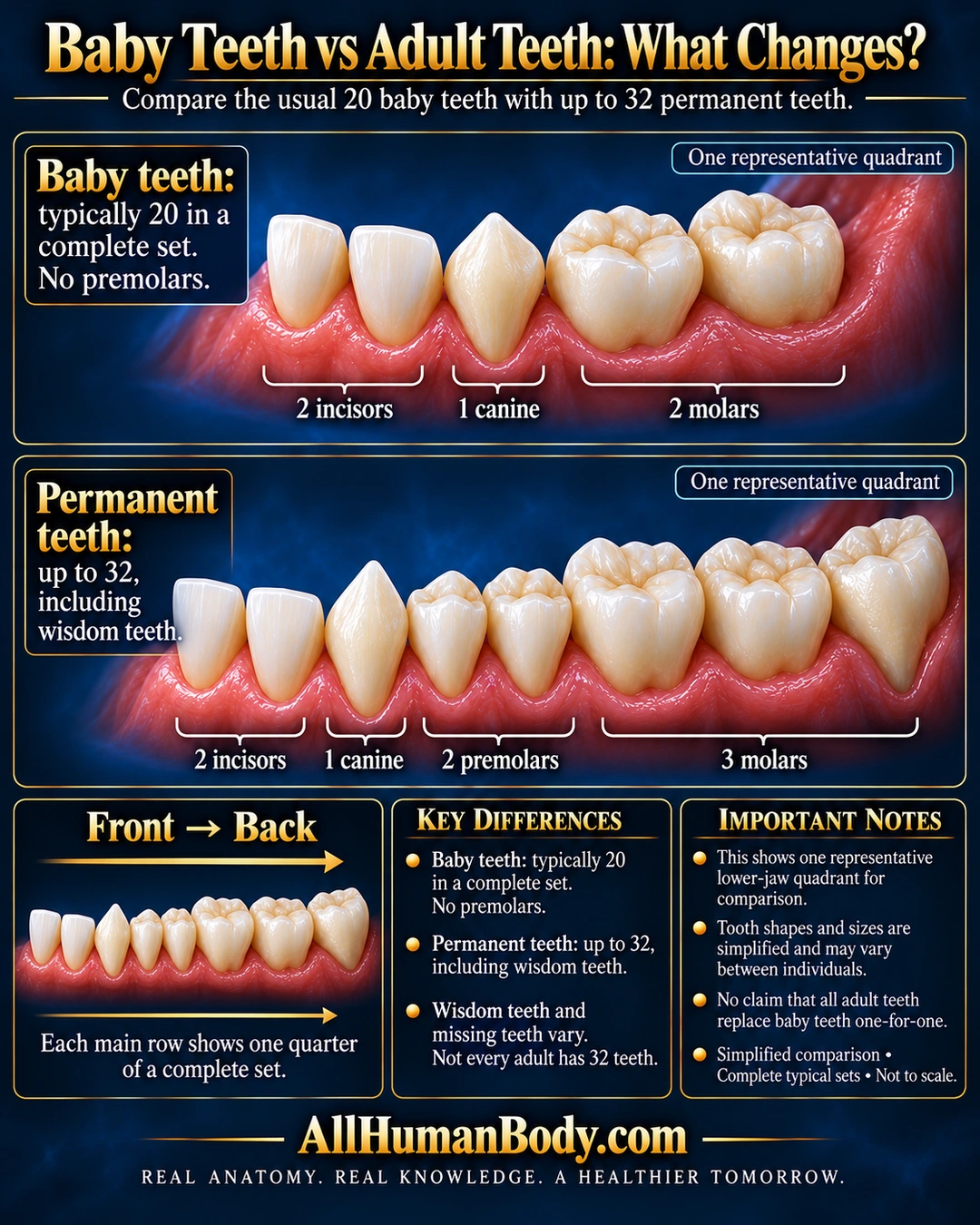
A typical complete set of baby teeth has 20 teeth and no premolars. A complete permanent set can have 32, including wisdom teeth; the comparison shows one representative quadrant of each.
READ THE IMAGE
What the illustration shows
English poster titled “Baby Teeth vs Adult Teeth: What Changes?” on navy. Upper representative lower-jaw quadrant has five ivory teeth: two incisors, one canine and two molars, grouped by brackets. Lower quadrant has eight: two incisors, one canine, two premolars and three molars. Gold headings describe typical20 baby teeth and up to 32 permanent teeth including wisdom teeth. A small lower-left adult-quadrant repeat shows front-to-back orientation. Lower text states shapes and sizes vary, each main row is one quarter of a complete set, missing and wisdom teeth vary, and not all adult teeth replace baby teeth one-for-one. Gold AllHumanBody.com and full slogan are below. Shapes are schematic, no eruption age or treatment recommendation.
How to interpret this poster
- Complete typical sets only; tooth shapes, missing teeth and wisdom teeth vary. No eruption schedule or claim of one-for-one replacement.
- AI-assisted educational illustration; not physician certification, microscopy, a diagnosis or individualized medical advice.
- Fine annotations need enlargement; the full description provides an accessible text alternative.
- Display the full uncropped illustration; do not trim titles, legends or boundary annotations.
AI-assisted educational illustration, adapted into web-sized images without changing its composition. This is general education, not an individual diagnosis or treatment recommendation.
EVIDENCE / CONTEXT
Sources and what they support
- American Dental Association ↗
Primary and permanent dental charts and typical totals.
- OpenStax anatomy textbook ↗
Two dentitions, primary total and permanent premolar/molar categories.