Cell Biology / VISUAL EXPLAINER
How Do Molecules Cross the Boundary of a Cell Nucleus?
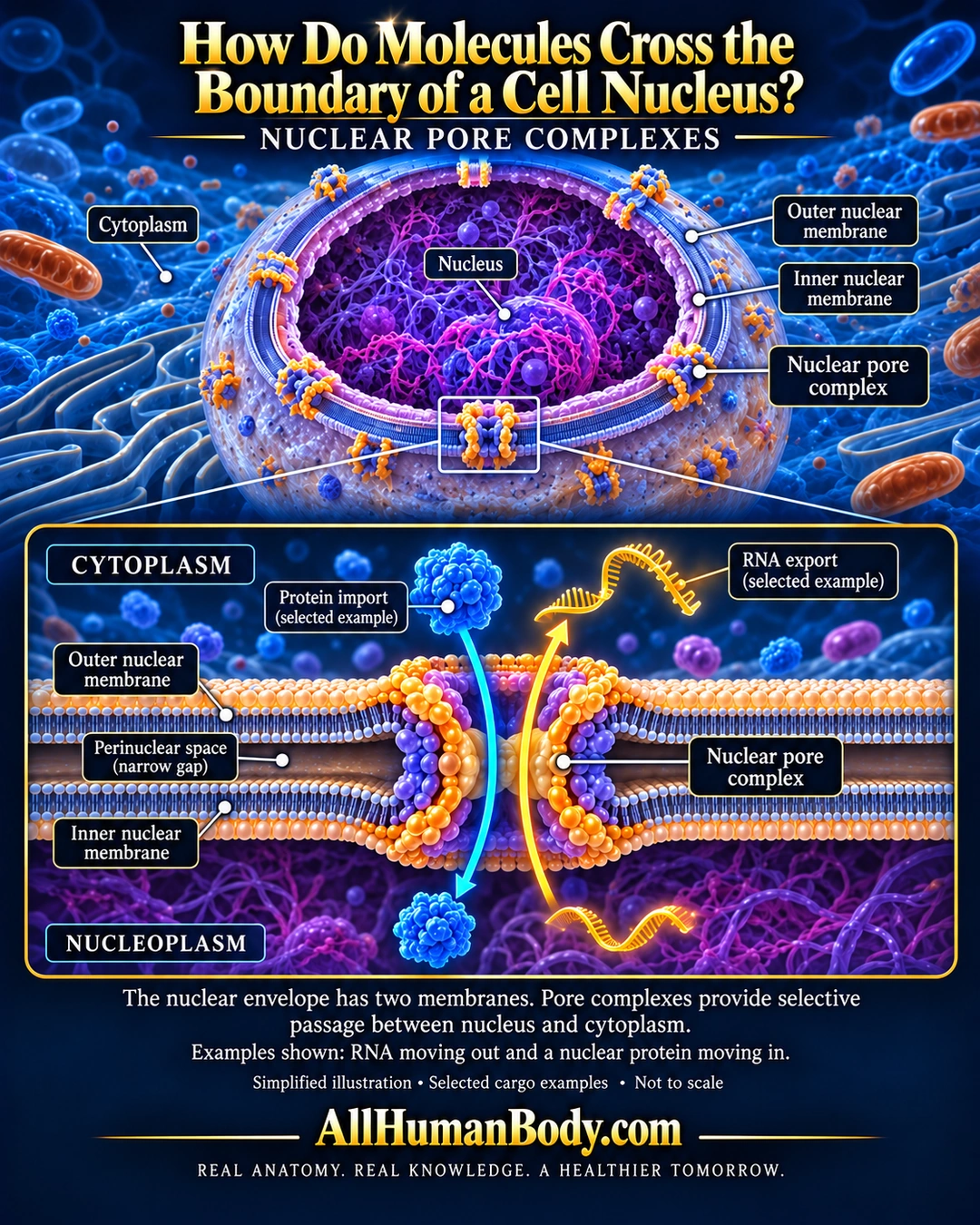
Nuclear pores are selective passages through the double nuclear envelope. The illustration distinguishes selected protein entry from RNA exit without suggesting that all molecules cross freely.
READ THE IMAGE
What the illustration shows
English cell-biology poster on navy. A round opened nucleus contains purple chromatin within a blue double membrane. Gold-purple pore complexes cross the envelope; labels distinguish nucleus, cytoplasm, outer and inner membranes and pore. Lower enlarged side section shows cytoplasm above and nucleoplasm below, with two membranes separated by a perinuclear gap and a central pore complex crossing both. A blue arrow points down through the pore for selected protein import; gold arrow points up for selected RNA export. Single-stranded gold RNA symbols and blue protein symbols appear on each side as example positions. Text emphasizes selective passage and selected examples, not scale. Gold AllHumanBody.com and full slogan below.
How to interpret this poster
- Cargo shapes and pore architecture are symbolic; not a molecular reconstruction, complete cargo inventory or quantitative transport model.
- AI-assisted educational illustration; not physician certification, microscopy, a diagnosis or individualized medical advice.
- Fine annotations need enlargement; the full description provides an accessible text alternative.
- Display the full uncropped illustration; do not trim titles, legends or boundary annotations.
AI-assisted educational illustration, adapted into web-sized images without changing its composition. This is general education, not an individual diagnosis or treatment recommendation.
EVIDENCE / CONTEXT
Sources and what they support
- NHGRI NIH glossary ↗
Selective nucleic acid and protein passage.
- NHGRI NIH glossary ↗
Double membrane and selective pores.