Endocrine / VISUAL EXPLAINER
What Fills the Tiny Follicles in Your Thyroid?
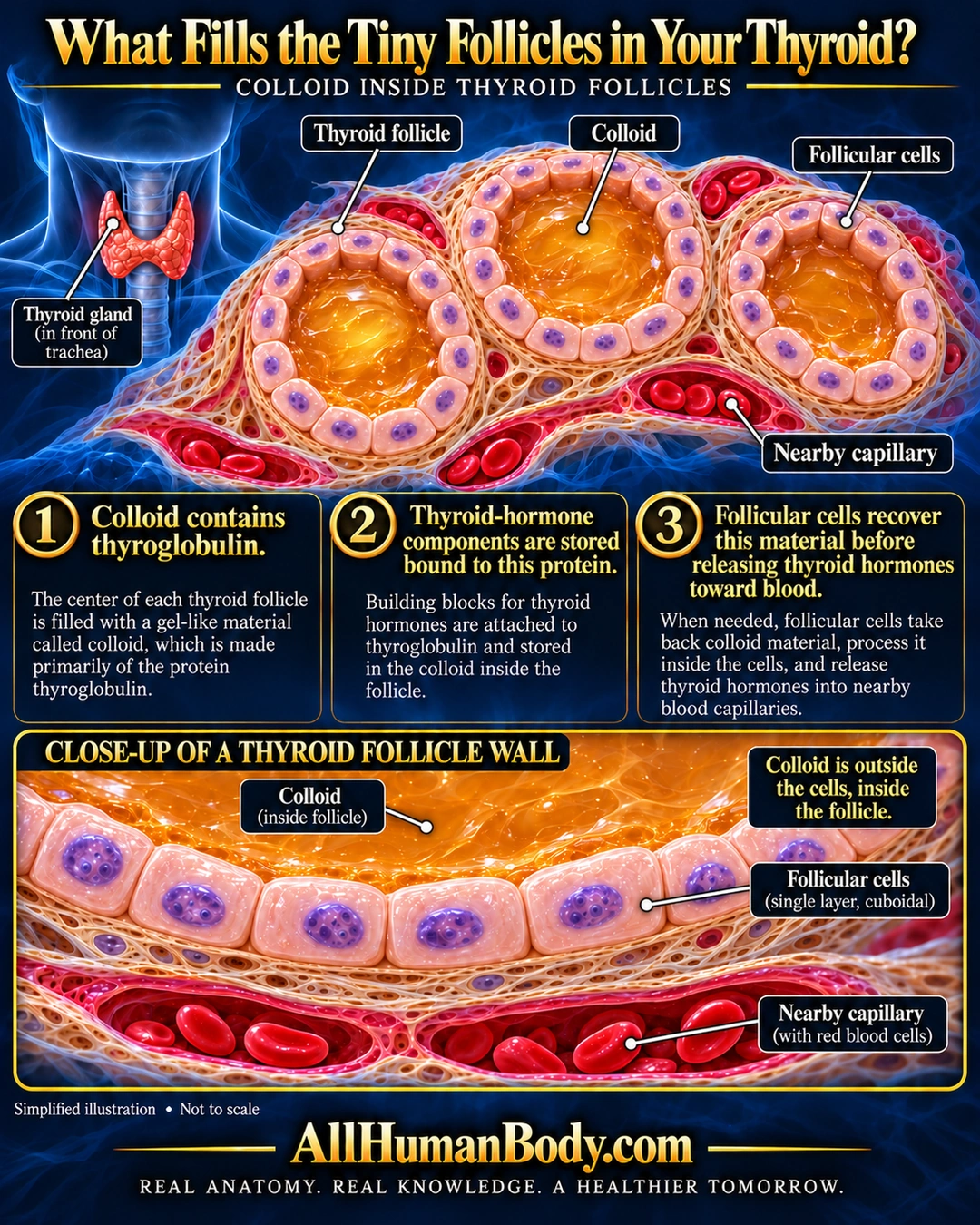
Thyroid follicles contain colloid rich in thyroglobulin, surrounded by follicular cells. Hormone components are stored bound to that protein; cells recover and process the material before releasing thyroid hormones toward nearby blood vessels.
READ THE IMAGE
What the illustration shows
English medical poster titled What Fills the Tiny Follicles in Your Thyroid? On a navy background, a small blue neck locator shows a coral thyroid in front of the trachea. Three enlarged follicles each have amber colloid enclosed by a single ring of pale peach cuboidal cells with violet nuclei. Red-cell capillaries run outside the follicular rings. Three numbered text panels explain thyroglobulin-rich colloid, bound hormone components, and cellular recovery before release toward blood. A lower enlarged wall shows amber colloid above one layer of cells, connective tissue below and an external red-cell capillary. Labels identify colloid, follicular cells and nearby capillary. Gold AllHumanBody.com and full slogan appear below. Colors and relative sizes are illustrative, not microscopy.
How to interpret this poster
- Colloid is not pure free hormone, blood or an abnormal cyst. Cell height, vessels and sizes are schematic; no biopsy interpretation, iodine supplement or dosing advice.
- AI-assisted educational illustration; not physician certification, microscopy, a diagnosis or individualized medical advice.
- Fine annotations need enlargement; the full description provides an accessible text alternative.
- Display the full uncropped illustration; do not trim titles, legends or boundary annotations.
AI-assisted educational illustration, adapted into web-sized images without changing its composition. This is general education, not an individual diagnosis or treatment recommendation.
EVIDENCE / CONTEXT
Sources and what they support
- OpenStax anatomy textbook ↗
Follicle architecture, thyroglobulin storage and recovery/release sequence.
- University of Leeds histology guide ↗
Colloid within epithelial follicles, extracellular storage and recovery to surrounding tissue.