Musculoskeletal / VISUAL EXPLAINER
Why Is the Sacrum Counted as One Bone and Five Vertebrae?
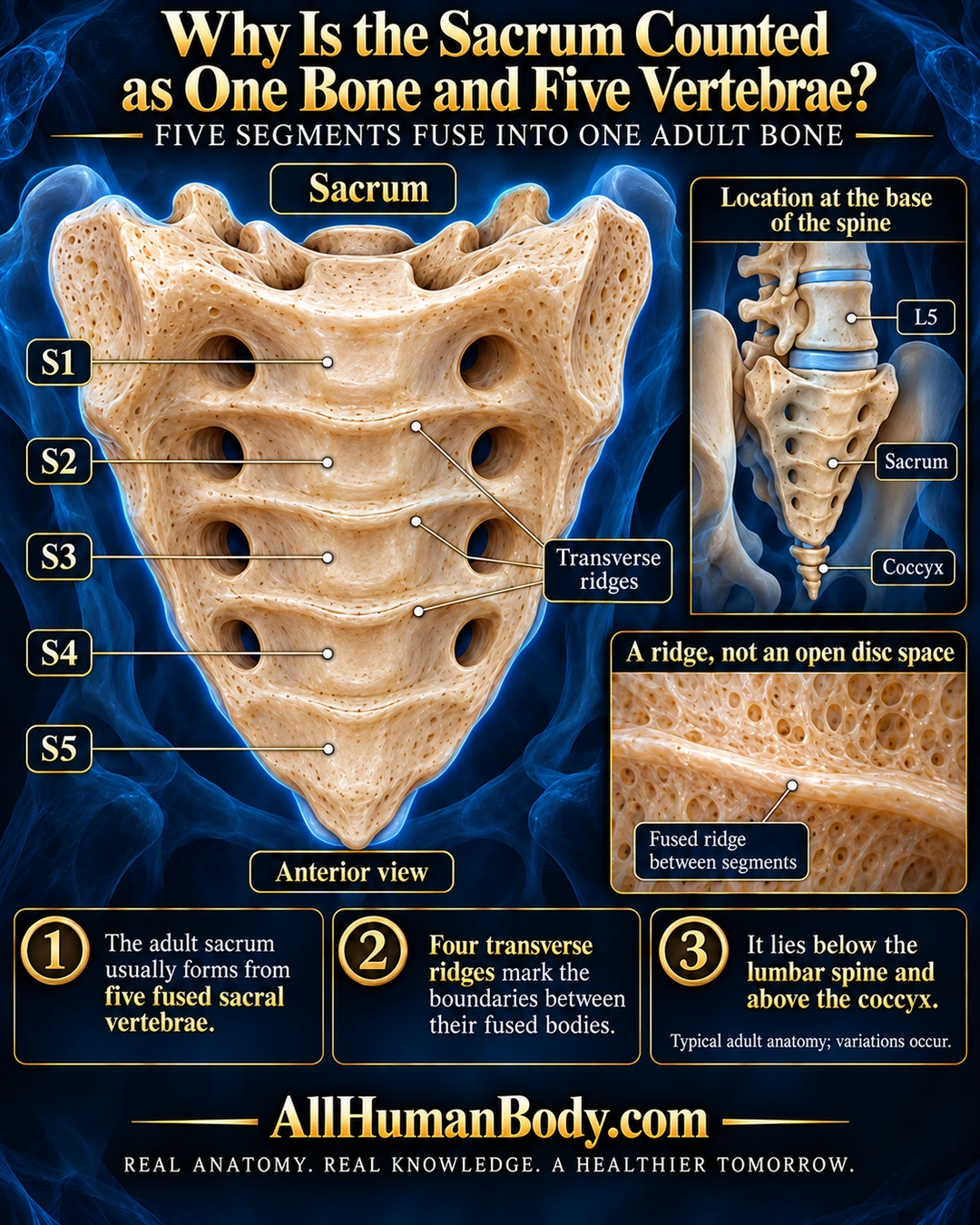
The adult sacrum usually forms when five sacral vertebrae fuse. Four transverse ridges mark boundaries between their bodies, and the resulting bone lies below the lumbar spine and above the coccyx.
READ THE IMAGE
What the illustration shows
Navy-and-gold anatomy poster with a large anterior ivory sacrum. S1 through S5 label five fused body regions, separated by four transverse ridges. Four pairs of large anterior foramina are visible, with a solid lower S5 region. A spine-base inset labels L5, sacrum and coccyx. A close-up shows a continuous fused ridge rather than an open disc gap. Text qualifies this as typical adult anatomy with variations. Gold AllHumanBody.com and the project slogan form the footer.
How to interpret this poster
- Typical adult pattern, with transitional variation; no fixed fusion age or retained thick discs at fused levels. Generated pores are not anatomical openings to count.
- AI-assisted educational illustration; not physician certification, microscopy, a diagnosis or individualized medical advice.
- Fine annotations need enlargement; the full description provides an accessible text alternative.
- Display the full uncropped illustration; do not trim titles, legends or boundary annotations.
AI-assisted educational illustration, adapted into web-sized images without changing its composition. This is general education, not an individual diagnosis or treatment recommendation.
EVIDENCE / CONTEXT
Sources and what they support
- OpenStax anatomy textbook ↗
Five fused sacral vertebrae, four anterior transverse ridges, relationship to lumbar spine and coccyx.
- Cleveland Clinic patient education ↗
Lumbar spine lies above the triangular sacrum formed from five fused bones; not used for precise fusion age.