Musculoskeletal / VISUAL EXPLAINER
What Is the Tip at the Bottom of Your Breastbone?
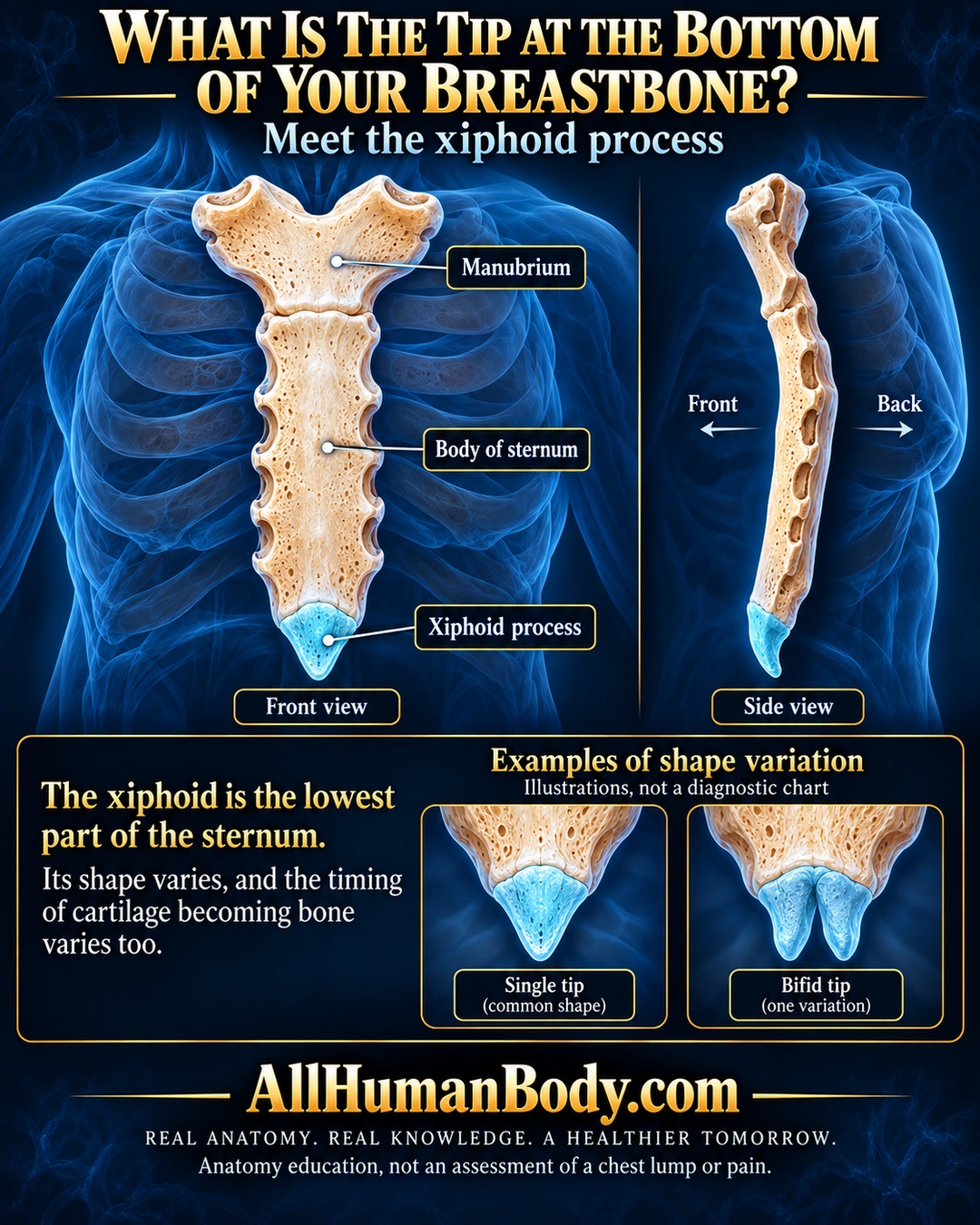
The xiphoid process is the lowest part of the sternum, below its body and manubrium. Its shape varies, and cartilage-to-bone development does not follow one universal timetable.
READ THE IMAGE
What the illustration shows
Dark navy English anatomy poster titled “What Is the Tip at the Bottom of Your Breastbone?” A large luminous ivory sternum is shown from the front over a translucent blue chest silhouette. Leaders identify the broad upper manubrium, long body of sternum, and small blue-highlighted xiphoid process at the bottom. A narrower side view appears at right with front and back direction arrows. Two lower closeups show single and bifid xiphoid tips as examples of shape variation, not a diagnostic chart. Text says the xiphoid is the lowest part of the sternum and that shape and the timing of cartilage becoming bone vary. Blue identifies the region rather than tissue state. Gold AllHumanBody.com branding and the full project slogan appear below. The poster says it is anatomy education, not an assessment of a chest lump or pain.
How to interpret this poster
- Blue marks a region, not cartilage state; shape examples and bone texture are illustrative. No lump assessment, chest-pain reassurance, CPR landmark or fixed ossification age.
- AI-assisted educational illustration; not physician certification, microscopy, a diagnosis or individualized medical advice.
- Fine annotations need enlargement; the full description provides an accessible text alternative.
- Display the full uncropped illustration; do not trim titles, legends or boundary annotations.
AI-assisted educational illustration, adapted into web-sized images without changing its composition. This is general education, not an individual diagnosis or treatment recommendation.
EVIDENCE / CONTEXT
Sources and what they support
- OpenStax anatomical textbook ↗
Sternal regions and inferior xiphoid location.
- Cleveland Clinic medically reviewed anatomy page ↗
Normal variation of xiphoid shape and timing of ossification.