Musculoskeletal / VISUAL EXPLAINER
What Lies Between Your Shoulder Blade and Ribs?
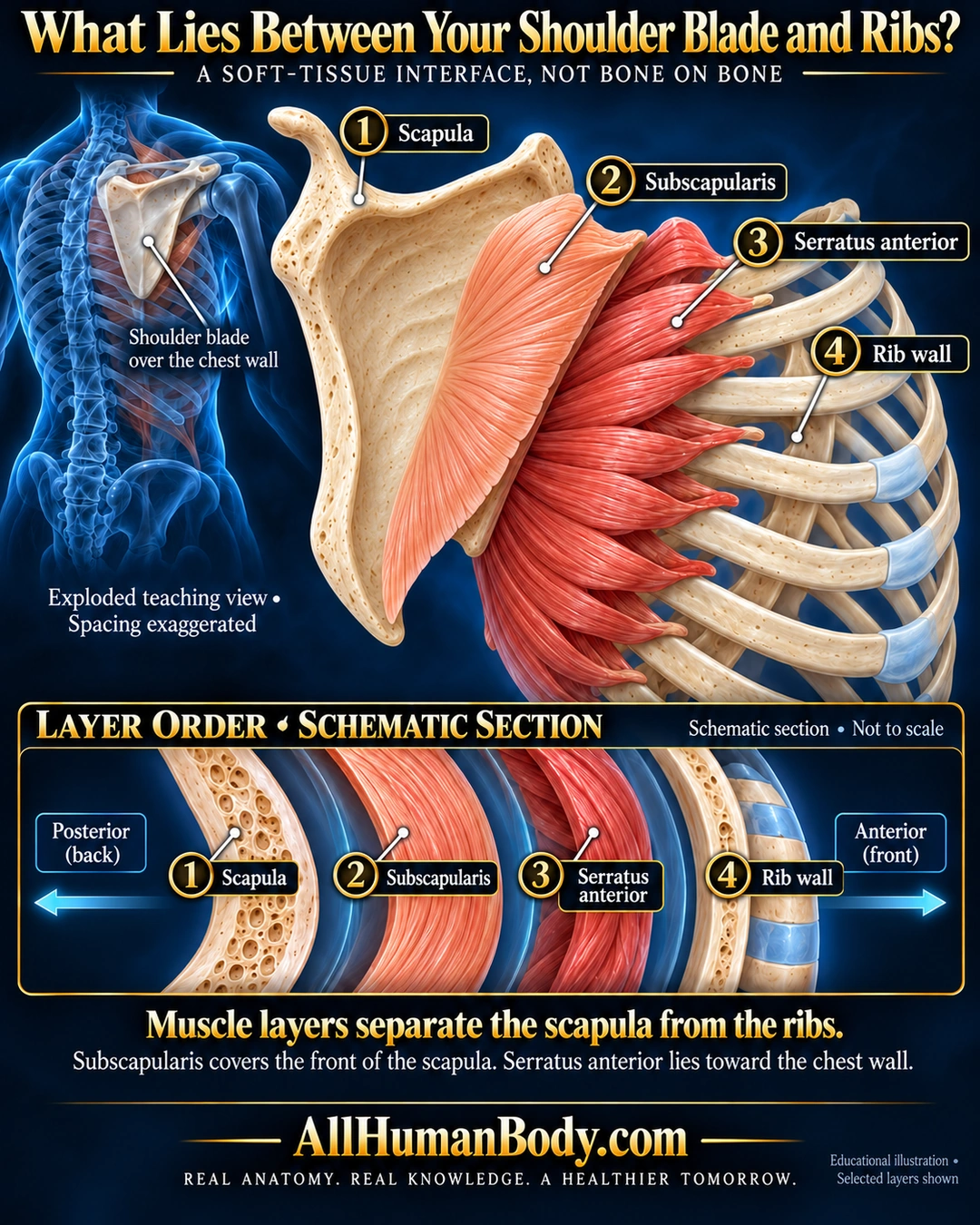
Muscle layers separate the shoulder blade from the chest wall. Subscapularis covers the front of the scapula, with serratus anterior farther toward the ribs, creating a soft-tissue interface rather than direct bone-on-bone contact.
READ THE IMAGE
What the illustration shows
English anatomy poster on dark navy. A small blue posterior torso at upper left locates the shoulder blade. The main exploded illustration presents four numbered layers: ivory scapula with a concave front surface, peach subscapularis, coral serratus anterior and ivory rib wall. Text states that spacing is exaggerated. A lower schematic section repeats the order from posterior at left to anterior at right, with orientation arrows and a not-to-scale note. The takeaway says muscle layers separate the scapula from the ribs. Gold AllHumanBody.com and its full slogan sit at the bottom.
How to interpret this poster
- Exploded gaps and muscle slips are schematic, not measured bursae or a complete attachment map. Cadaver-study support is abstract-only; no diagnosis or movement ratio.
- AI-assisted educational illustration; not physician certification, microscopy, a diagnosis or individualized medical advice.
- Fine annotations need enlargement; the full description provides an accessible text alternative.
- Display the full uncropped illustration; do not trim titles, legends or boundary annotations.
AI-assisted educational illustration, adapted into web-sized images without changing its composition. This is general education, not an individual diagnosis or treatment recommendation.
EVIDENCE / CONTEXT
Sources and what they support
- American Academy of Orthopaedic Surgeons ↗
Chest wall articulation distinct from three named shoulder joints.
- Johns Hopkins institutional record of primary cadaveric study; Ruland et al. 1995, DOI 10.1016/0749-8063(95)90088-8 ↗
Relative subscapularis, serratus anterior and chest wall spaces.
Evidence correspondence is limited to the abstract.