Cardiovascular / VISUAL EXPLAINER
Which Neck Openings Carry the Vertebral Arteries?
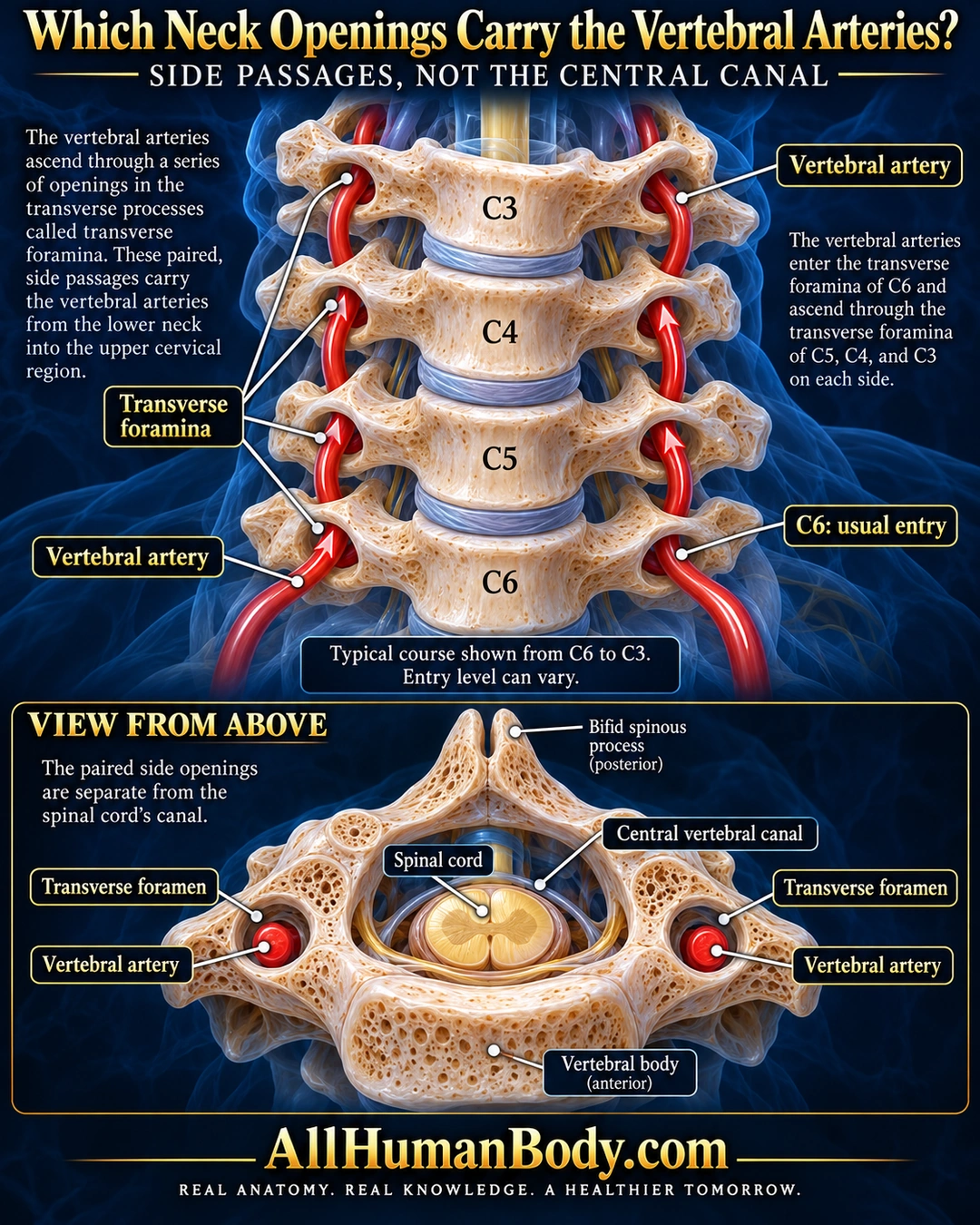
The vertebral arteries usually enter paired openings in the cervical transverse processes at C6 and ascend through the neck. These side openings are separate from the larger central passage containing the spinal cord.
READ THE IMAGE
What the illustration shows
Portrait anatomical poster titled “Which Neck Openings Carry the Vertebral Arteries?” On a deep navy and blue background, four ivory cervical vertebrae are labeled C3, C4, C5 and C6 from top to bottom. Red vertebral arteries enter paired side openings at C6 and ascend through transverse foramina; arrows point upward. Text notes this is the typical C6-to-C3 course and entry level can vary. A lower superior-view inset shows a single vertebra with the body anteriorly, bifid spinous process posteriorly, two lateral transverse foramina containing red arterial cross-sections, and a separate larger central canal containing a gold spinal cord cross-section. Gold AllHumanBody.com branding and the slogan “REAL ANATOMY. REAL KNOWLEDGE. A HEALTHIER TOMORROW.” appear below. This is a simplified dimensional educational illustration, not a scan.
How to interpret this poster
- Typical C6-to-C3 segment only; entry level varies and upper loops are omitted. No manipulation safety, stenosis diagnosis or exact vessel dimensions.
- AI-assisted educational illustration; not physician certification, microscopy, a diagnosis or individualized medical advice.
- Fine annotations need enlargement; the full description provides an accessible text alternative.
- Display the full uncropped illustration; do not trim titles, legends or boundary annotations.
AI-assisted educational illustration, adapted into web-sized images without changing its composition. This is general education, not an individual diagnosis or treatment recommendation.
EVIDENCE / CONTEXT
Sources and what they support
- Academic medical center anatomy ↗
Paired arteries, usual C6 entry and cranial ascent.
- OpenStax publisher anatomy textbook ↗
Vertebral arch defines cord-bearing central foramen; cervical transverse processes have distinct transverse foramina.