Respiratory / VISUAL EXPLAINER
Where Are the Air Spaces Around Your Nose?
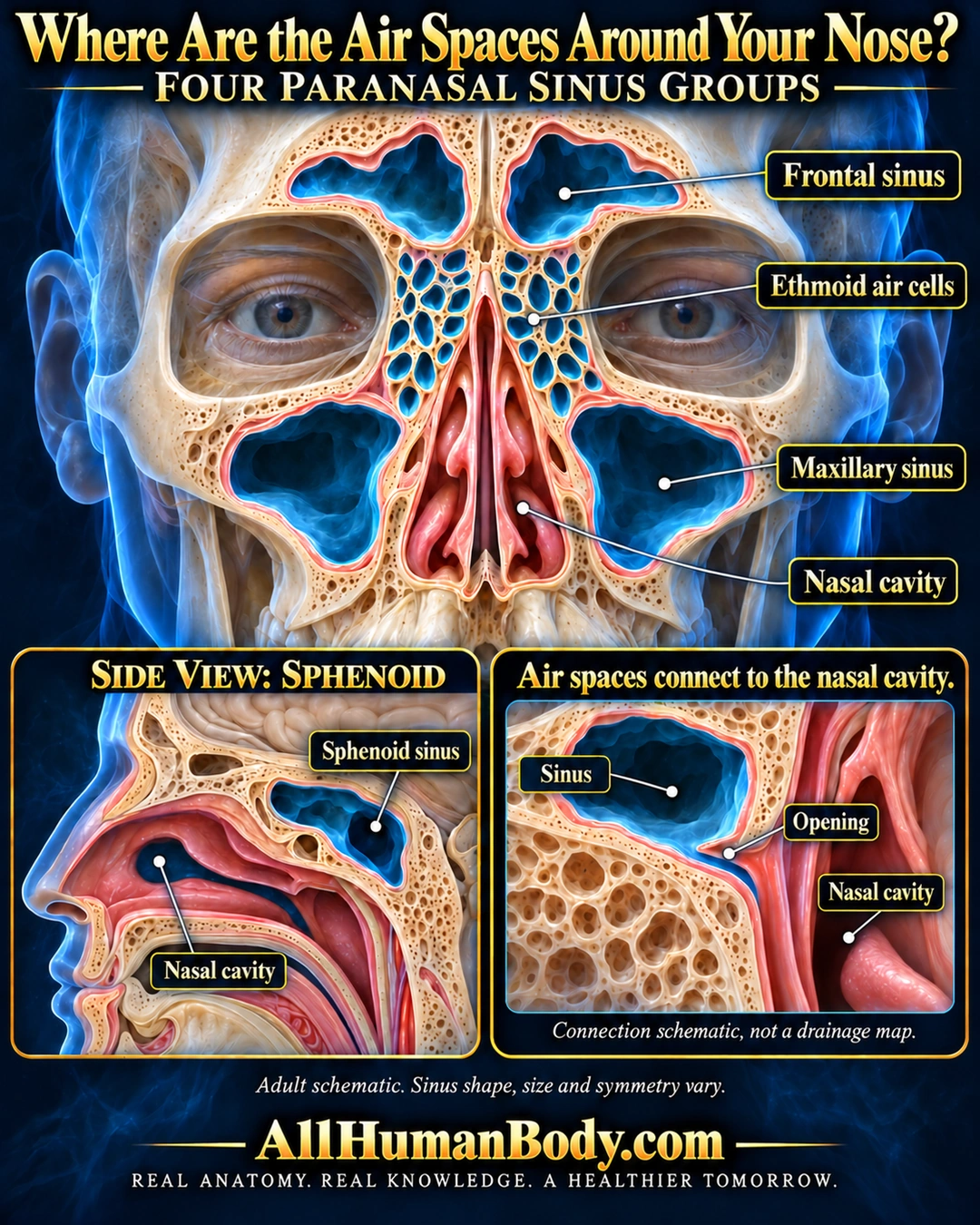
Paranasal sinuses are air-filled spaces in bones around the nasal cavity. Frontal, maxillary, ethmoid and sphenoid groups occupy different regions and connect with the nasal cavity rather than forming one common sac.
READ THE IMAGE
What the illustration shows
Portrait educational poster titled “Where Are the Air Spaces Around Your Nose?” A frontal adult skull and face cutaway shows blue hollow frontal sinus spaces above the eyes, many small ethmoid air cells between the eye sockets, and larger maxillary sinus cavities below the eyes beside the nasal cavity. Ivory bone and thin peach-pink lining surround the spaces against a navy and cyan background. A lower-left side-view inset places the sphenoid sinus behind the nasal cavity and shows a dark airway. A lower-right conceptual close-up shows a sinus opening into the nasal cavity, labeled as a connection schematic rather than a drainage map. Text states that adult sinus shape, size and symmetry vary. Gold AllHumanBody.com branding appears above the slogan “REAL ANATOMY. REAL KNOWLEDGE. A HEALTHIER TOMORROW.” This is a simplified dimensional illustration, not a scan or complete drainage map.
How to interpret this poster
- Adult dimensions, symmetry and openings vary; this is not a scan or drainage map. No claim that inhaled air must cross every sinus or any sinusitis treatment advice.
- AI-assisted educational illustration; not physician certification, microscopy, a diagnosis or individualized medical advice.
- Fine annotations need enlargement; the full description provides an accessible text alternative.
- Display the full uncropped illustration; do not trim titles, legends or boundary annotations.
AI-assisted educational illustration, adapted into web-sized images without changing its composition. This is general education, not an individual diagnosis or treatment recommendation.
EVIDENCE / CONTEXT
Sources and what they support
- National Cancer Institute normal anatomy introduction ↗
Four anatomical groups and their positions.
- NCI SEER teaching ↗
Air cavities in named bones open into nasal cavity.