Musculoskeletal / VISUAL EXPLAINER
Why Do Some Muscle Fibers Resist Fatigue Better?
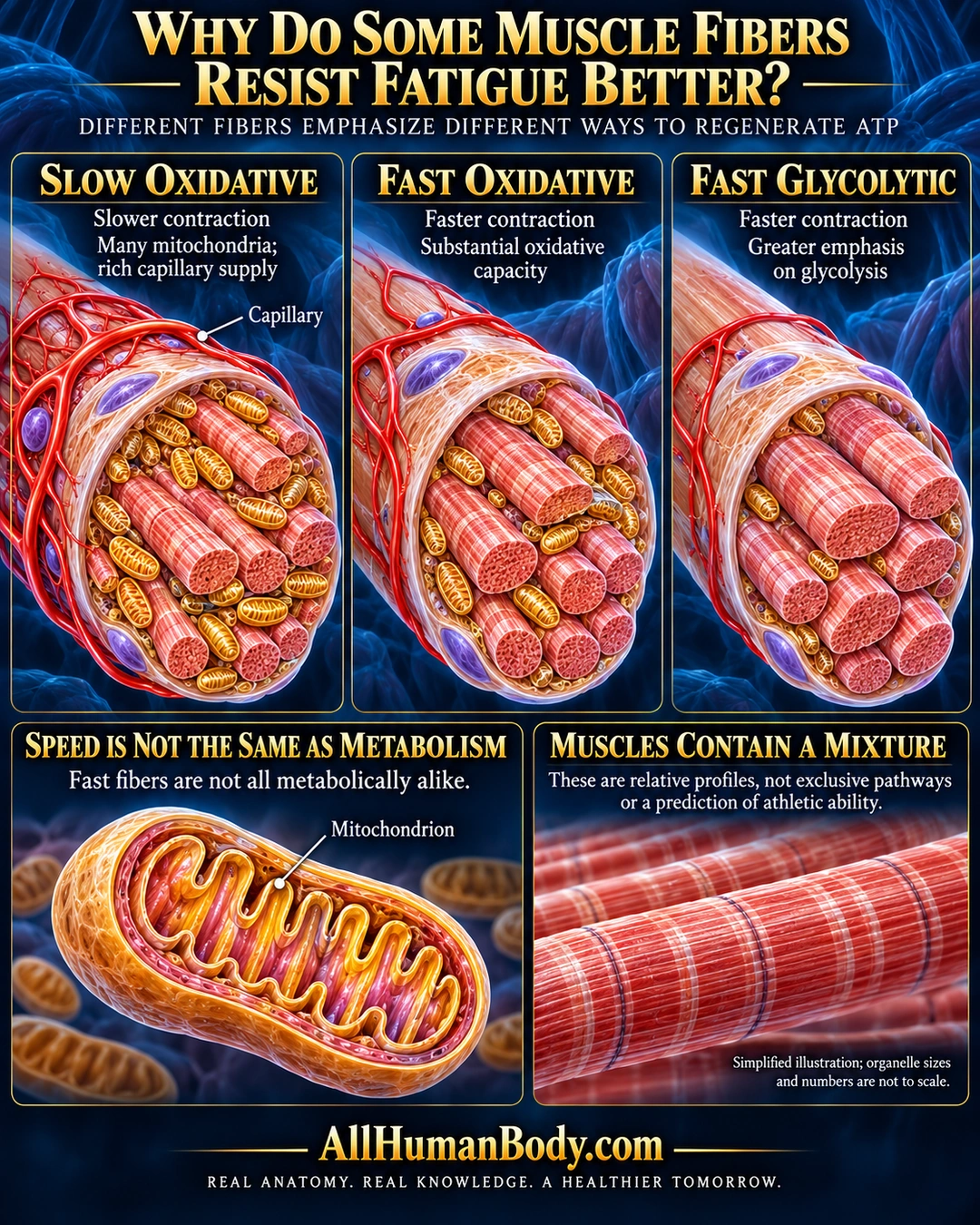
Oxidative muscle fibers generally have more mitochondria and a richer capillary supply than predominantly glycolytic fibers. Contraction speed and metabolic profile are not identical properties, and muscles contain mixtures rather than a single uniform fiber type.
READ THE IMAGE
What the illustration shows
Navy and gold poster comparing three cutaway skeletal muscle fibers: slow oxidative, fast oxidative and fast glycolytic. Gold mitochondria appear among pink striated myofibrils, with more in the oxidative examples and fewer, not zero, in the glycolytic example. Red capillaries run outside the fibers. Lower panels show an enlarged mitochondrion and striated muscle. Text distinguishes contraction speed from metabolic profile, describes muscles as mixtures, and notes that organelle sizes and numbers are not to scale. Gold AllHumanBody.com branding and the full slogan appear on a plain navy footer.
How to interpret this poster
- Mitochondrial counts, myofibril numbers, vessel sizes and fiber proportions are illustrative, not biopsy measurements.
- Glycolytic fibers still contain mitochondria, and multiple ATP pathways can contribute. Human IIx is not equated with rodent IIb.
- No athletic destiny, exercise prescription, fixed proportions or exact fatigue time.
- AI-assisted educational illustration; not physician certification, microscopy, a diagnosis or individualized medical advice.
- Fine annotations need enlargement; the full description provides an accessible text alternative.
- Display the full uncropped illustration; do not trim titles, legends or boundary annotations.
AI-assisted educational illustration, adapted into web-sized images without changing its composition. This is general education, not an individual diagnosis or treatment recommendation.
EVIDENCE / CONTEXT
Sources and what they support
- Anatomy and Physiology: 10.5 Types of Muscle Fibers ↗
Qualitative slow/fast oxidative and fast glycolytic profiles, mitochondrial/capillary differences and mixed muscles.