Digestive / VISUAL EXPLAINER
How Does Histamine Tell the Stomach to Make Acid?
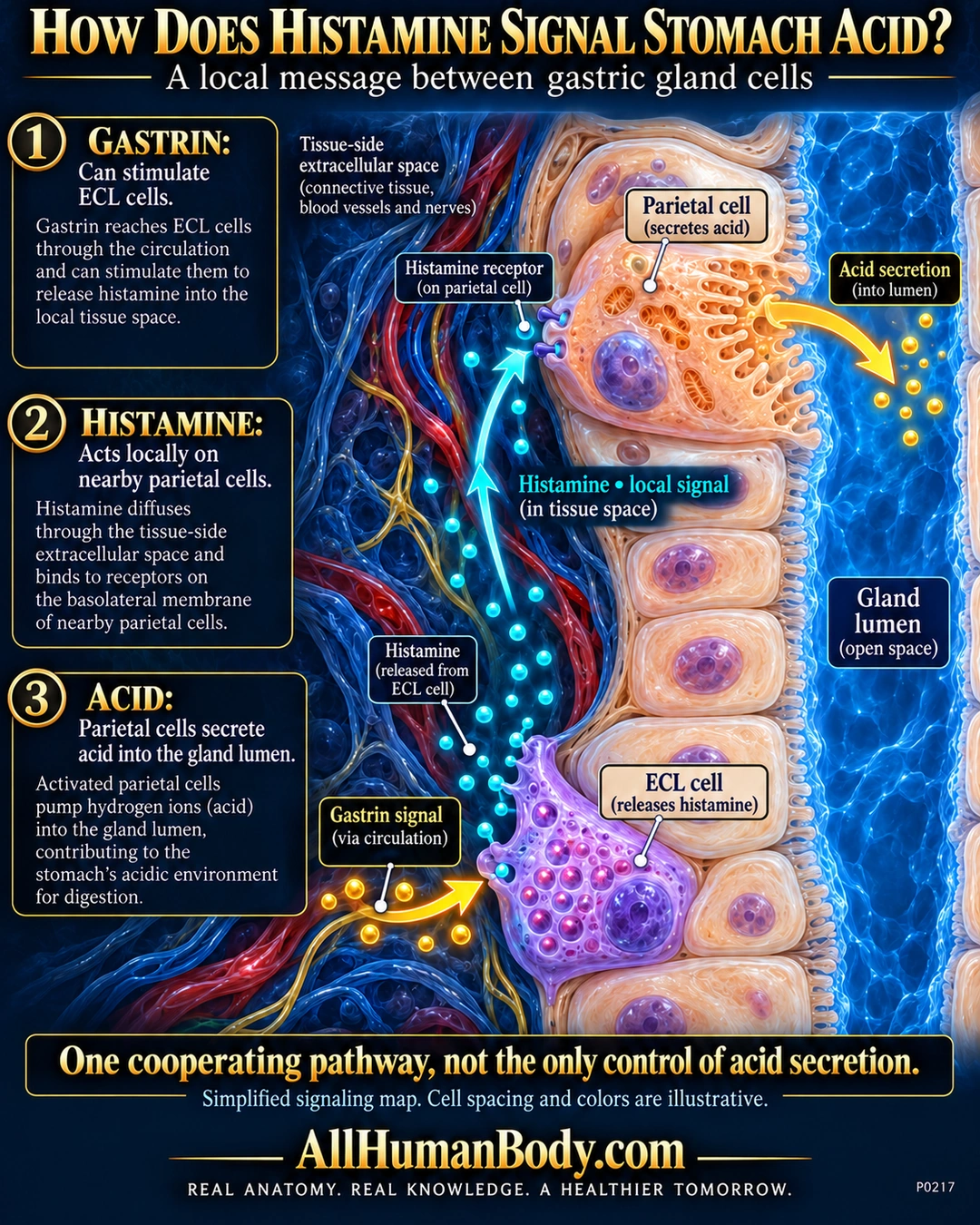
Circulating gastrin can stimulate gastric ECL cells to release histamine. Histamine acts locally on parietal cells to promote acid secretion into the gland lumen, one cooperating control pathway rather than the sole regulator.
READ THE IMAGE
What the illustration shows
Navy and gold gastric signaling poster. At left, tissue-side space contains vessels, nerves and cyan histamine dots. A purple ECL cell sits basally within the gland epithelium and receives a gold gastrin arrow labeled via circulation. A curved cyan arrow rises through extracellular tissue to the left face of a peach parietal cell. A separate gold acid-secretion arrow points from that cell into the blue gland lumen on the right. Three numbered panels explain gastrin, histamine and acid. A prominent qualifier says this is one cooperating pathway, not the only control. Plain navy footer carries AllHumanBody.com and its complete slogan.
How to interpret this poster
- Histamine is a signal, not the acid itself. ECL cells are distinct from serotonin-producing EC cells and mast cells.
- Cell spacing, receptor icons, canalicular folds and particle sizes are schematic; other gland cells and basement membrane are not individually mapped.
- No medication comparison, histamine-intolerance interpretation or acid-rebound advice.
- AI-assisted educational illustration; not physician certification, microscopy, a diagnosis or individualized medical advice.
- Fine annotations need enlargement; the full description provides an accessible text alternative.
- Display the full uncropped illustration; do not trim titles, legends or boundary annotations.
AI-assisted educational illustration, adapted into web-sized images without changing its composition. This is general education, not an individual diagnosis or treatment recommendation.
EVIDENCE / CONTEXT
Sources and what they support
- NLM MeSH: Enterochromaffin-like Cells ↗
Gastric ECL identity, gastrin response and local histamine stimulation of parietal acid release.
- The Physiology of the Gastric Parietal Cell ↗
Circulating gastrin, cooperating regulators and parietal apical acid output.