Special Senses / VISUAL EXPLAINER
How Does the Cornea Get Oxygen Without Blood Vessels?
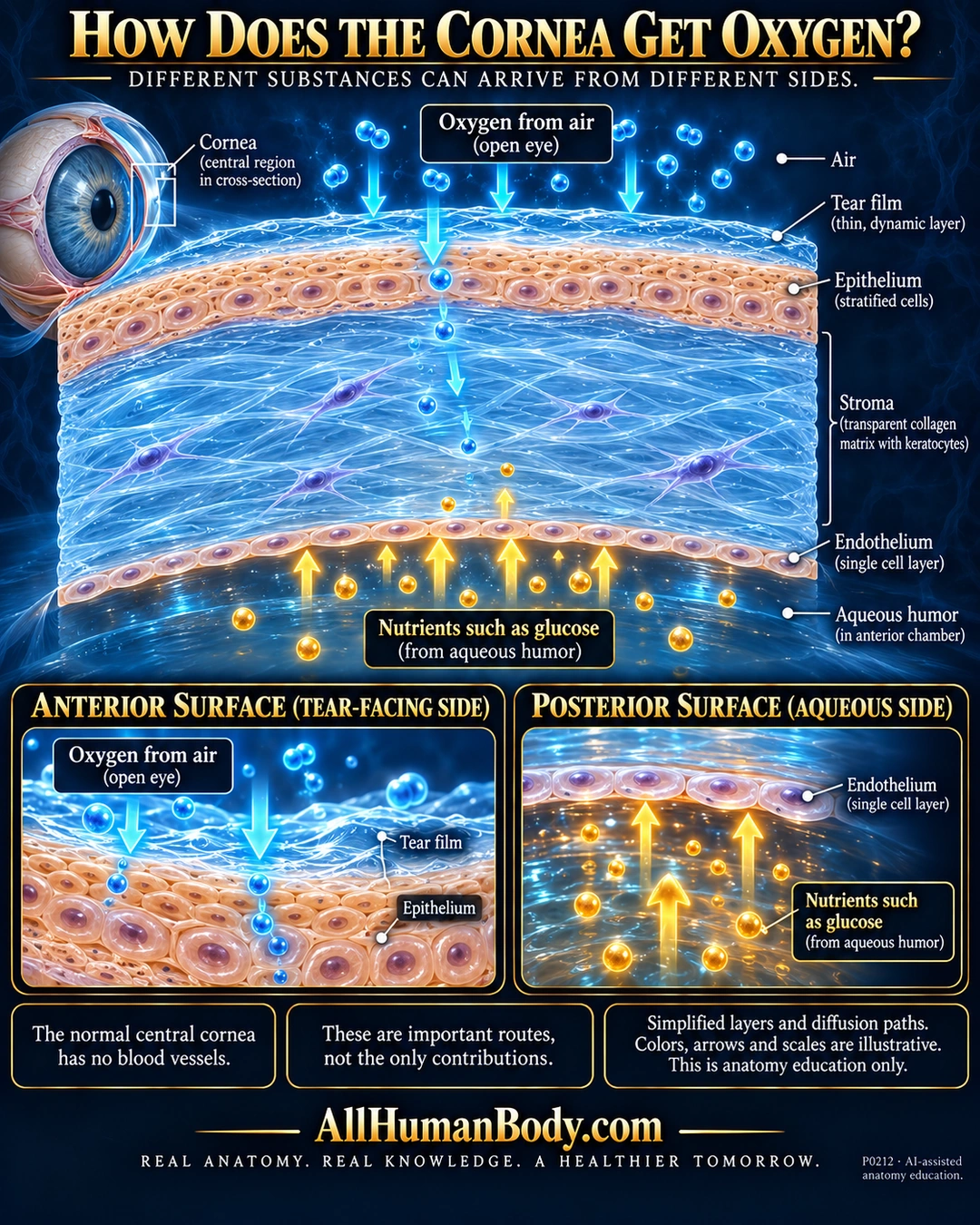
The normal central cornea lacks blood vessels. In an open eye, atmospheric oxygen enters through the tear-facing surface, while aqueous humor supplies nutrients such as glucose from the posterior side; these are important, not exclusive, supply routes.
READ THE IMAGE
What the illustration shows
English educational poster on a deep navy background. At upper left, an eye locator highlights the central cornea. A large curved cross-section places air and a thin tear film above peach stratified epithelium, a thick blue collagen stroma with sparse violet keratocytes, a thin single endothelial cell layer, and aqueous humor below. Cyan arrows point down from air through the anterior layers, labelled oxygen from air in an open eye. Gold arrows point up from aqueous toward the endothelium and stroma, labelled nutrients such as glucose. Two lower insets enlarge the anterior tear-facing and posterior aqueous-facing surfaces. Text states that the normal central cornea has no vessels and that these are important but not exclusive supply routes. Layers, particles, glow and scales are illustrative. Gold AllHumanBody.com and the full slogan appear on a plain navy footer.
How to interpret this poster
- Open-eye condition is essential; no claim that all oxygen comes from tears or all nutrients from aqueous.
- Layer thicknesses, collagen mesh, keratocytes and diffusion arrows are schematic. Bowman and Descemet layers are not separately mapped.
- No quantitative flux, concentration, timing, contact-lens or sleeping guidance; review evidence is not a new primary experiment.
- AI-assisted educational illustration; not physician certification, microscopy, a diagnosis or individualized medical advice.
- Fine annotations need enlargement; the full description provides an accessible text alternative.
- Display the full uncropped illustration; do not trim titles, legends or boundary annotations.
AI-assisted educational illustration, adapted into web-sized images without changing its composition. This is general education, not an individual diagnosis or treatment recommendation.
EVIDENCE / CONTEXT
Sources and what they support
- Maintaining Transparency: A Review of the Developmental Physiology and Pathophysiology of Two Avascular Tissues ↗
Corneal nutrient transport, atmospheric oxygen and aqueous glucose supply.