Musculoskeletal / VISUAL EXPLAINER
Why Does Muscle Have Myoglobin?
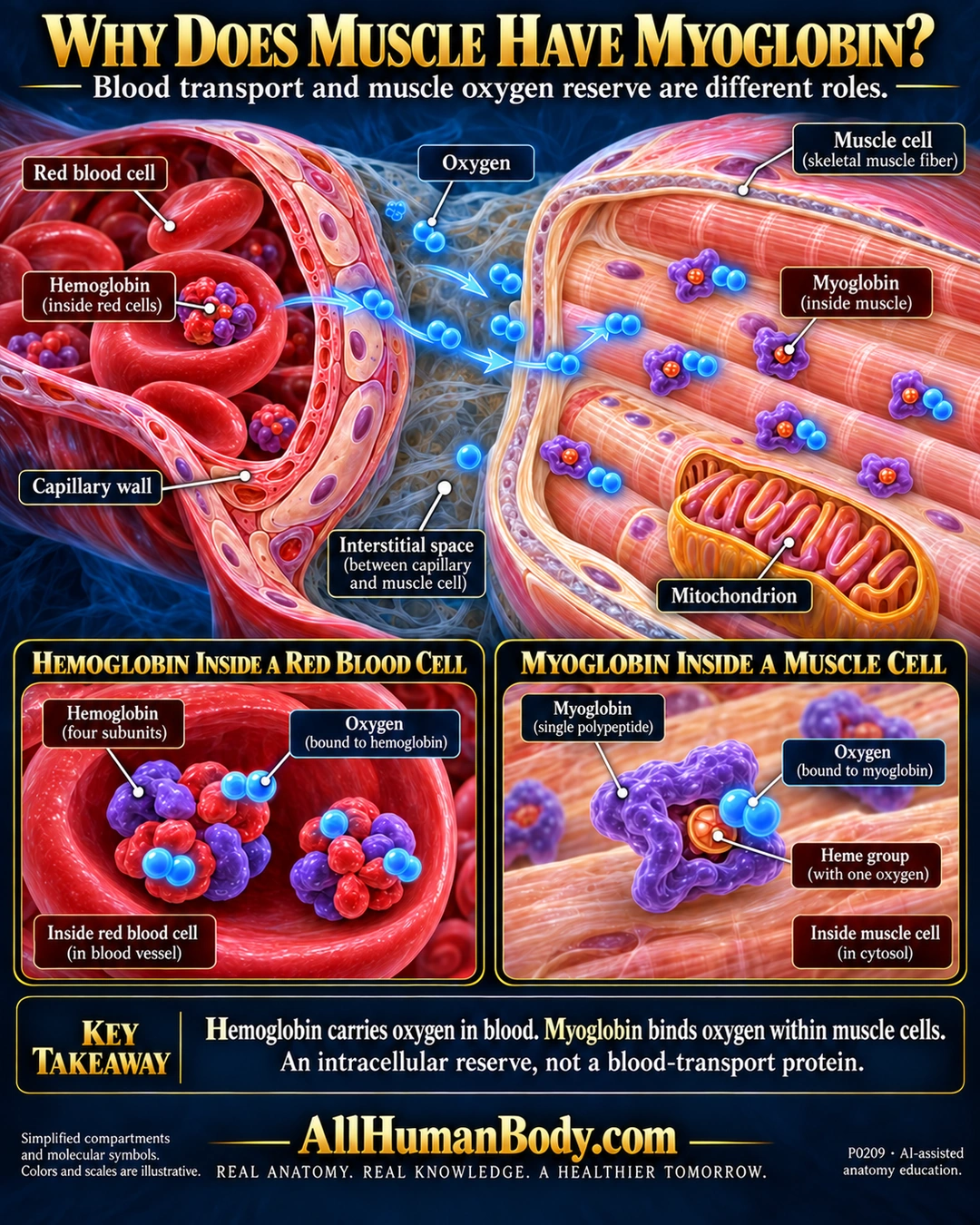
Hemoglobin carries oxygen in red blood cells, while myoglobin binds oxygen inside muscle cells and contributes an intracellular reserve. Oxygen crosses tissue boundaries; these two proteins do not shuttle together between blood and muscle.
READ THE IMAGE
What the illustration shows
Gold-titled medical illustration on navy: a red-cell-filled capillary at left lies beside a cutaway peach skeletal muscle fiber at right. Blue paired oxygen symbols cross the vessel wall, gray interstitial space and muscle boundary. Hemoglobin icons remain in red cells; purple myoglobin icons and a mitochondrion remain within muscle. Two lower insets compare a hemoglobin symbol inside a red cell with myoglobin, heme and bound oxygen inside muscle. Molecular forms, sizes, colors and glow are conceptual, not atomic or measured emissions. Gold AllHumanBody.com and full slogan appear on a plain navy footer.
How to interpret this poster
- Protein icons are not atomic structures, and myoglobin is cytosolic rather than a coating on myofibrils.
- Capillary-wall thickness, tissue distances, mitochondrion size and oxygen arrows are exaggerated; no measured flux or fixed release threshold.
- Myoglobin content varies among muscle fibers. No exercise, breath-holding, oxygen-therapy or performance advice.
- AI-assisted educational illustration; not physician certification, microscopy, a diagnosis or individualized medical advice.
- Fine annotations need enlargement; the full description provides an accessible text alternative.
- Display the full uncropped illustration; do not trim titles, legends or boundary annotations.
AI-assisted educational illustration, adapted into web-sized images without changing its composition. This is general education, not an individual diagnosis or treatment recommendation.
EVIDENCE / CONTEXT
Sources and what they support
- RCSB PDB-101: Myoglobin ↗
Muscle oxygen binding/storage by heme-containing myoglobin; structural teaching includes nonhuman examples.
- Anatomy and Physiology: 10.5 Types of Muscle Fibers ↗
Capillary oxygen delivery and intracellular myoglobin; preserved direct teaching text.
- RCSB PDB-101: Hemoglobin ↗
Hemoglobin protein chains, reversible heme oxygen binding and contrast with muscle myoglobin.