Lymphatic & Immune / VISUAL EXPLAINER
What Does a Mast Cell Release from Its Granules?
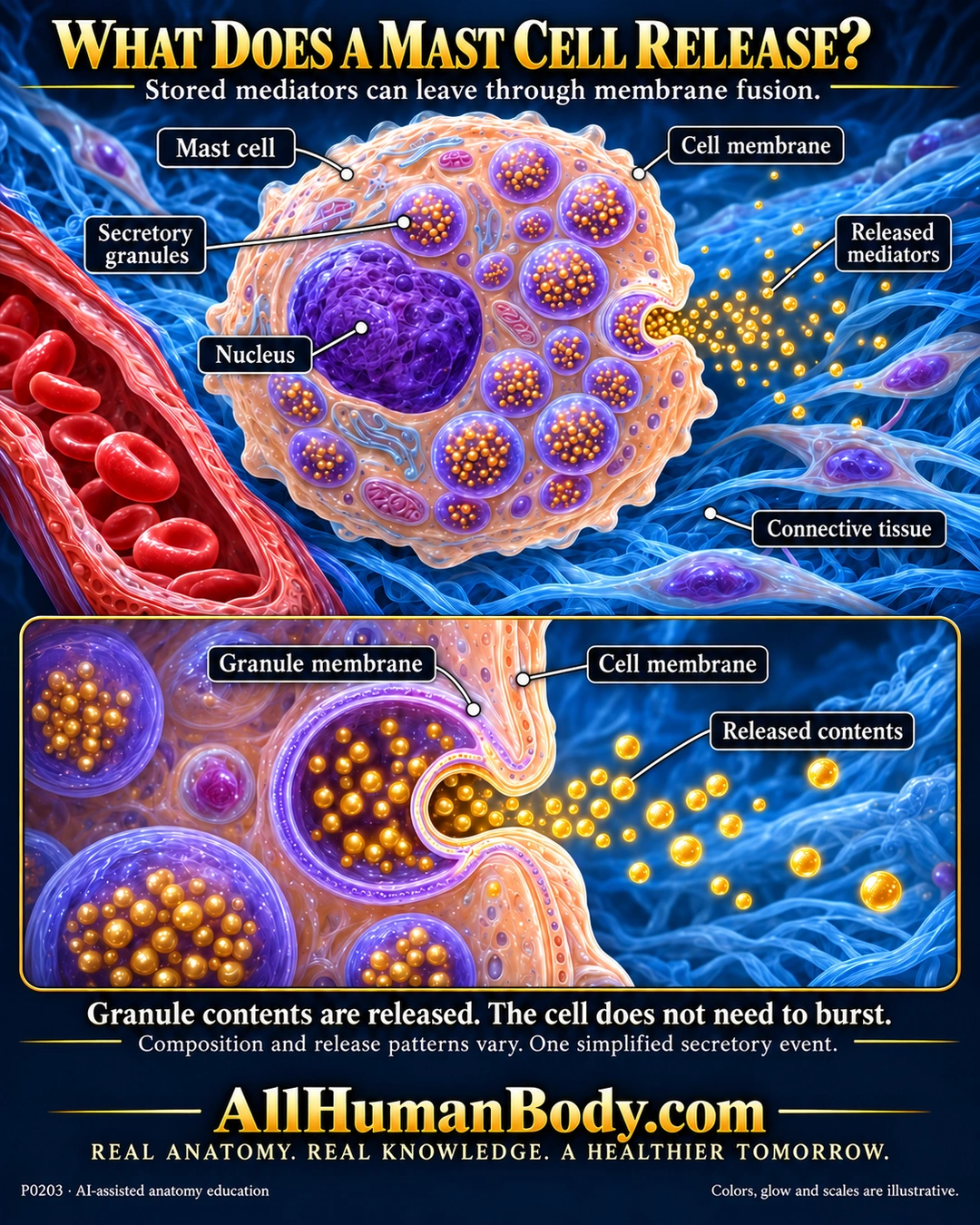
Mast cells store some mediators in secretory granules. During degranulation, granule membranes can fuse with the cell surface so their contents reach surrounding tissue; this is secretion, not the cell bursting apart.
READ THE IMAGE
What the illustration shows
Portrait medical illustration on a deep navy and cyan connective-tissue background. A peach cutaway mast cell lies beside, not inside, a red-cell-containing blood vessel. Its large purple nucleus is separately labeled. Smaller lavender secretory granules hold gold mediator symbols; one granule opens at the right cell surface and gold contents move into tissue. A lower inset enlarges an omega-shaped opening where granule and cell membranes join, showing released contents outside. Text explains that granule contents can be released without the cell bursting and that composition and release patterns vary. Colors, glow, membrane thickness and scales are illustrative, not measured morphology or light emission. Gold AllHumanBody.com and the complete slogan occupy a plain navy footer.
How to interpret this poster
- One simplified fusion event does not show every secretion mode or the complete signaling pathway. Not every activation releases all granules.
- Colored contents are generic stored mediators, not exclusively histamine; granule numbers, sizes and molecular shapes are not measured.
- No allergy, mast-cell disorder, symptom interpretation or treatment advice.
- AI-assisted educational illustration; not physician certification, microscopy, a diagnosis or individualized medical advice.
- Fine annotations need enlargement; the full description provides an accessible text alternative.
- Display the full uncropped illustration; do not trim titles, legends or boundary annotations.
AI-assisted educational illustration, adapted into web-sized images without changing its composition. This is general education, not an individual diagnosis or treatment recommendation.
EVIDENCE / CONTEXT
Sources and what they support
- University of Leeds Histology: Connective-tissue phagocytes ↗
Tissue mast cells and granule-associated mediators.
- Cytoskeletal Transport, Reorganization, and Fusion Regulation in Mast Cell-Stimulus Secretion Coupling ↗
Granule/plasma-membrane fusion and release of stored contents; review of multiple experimental models.