Lymphatic & Immune / VISUAL EXPLAINER
Can Immune Proteins Assemble a Pore in a Membrane?
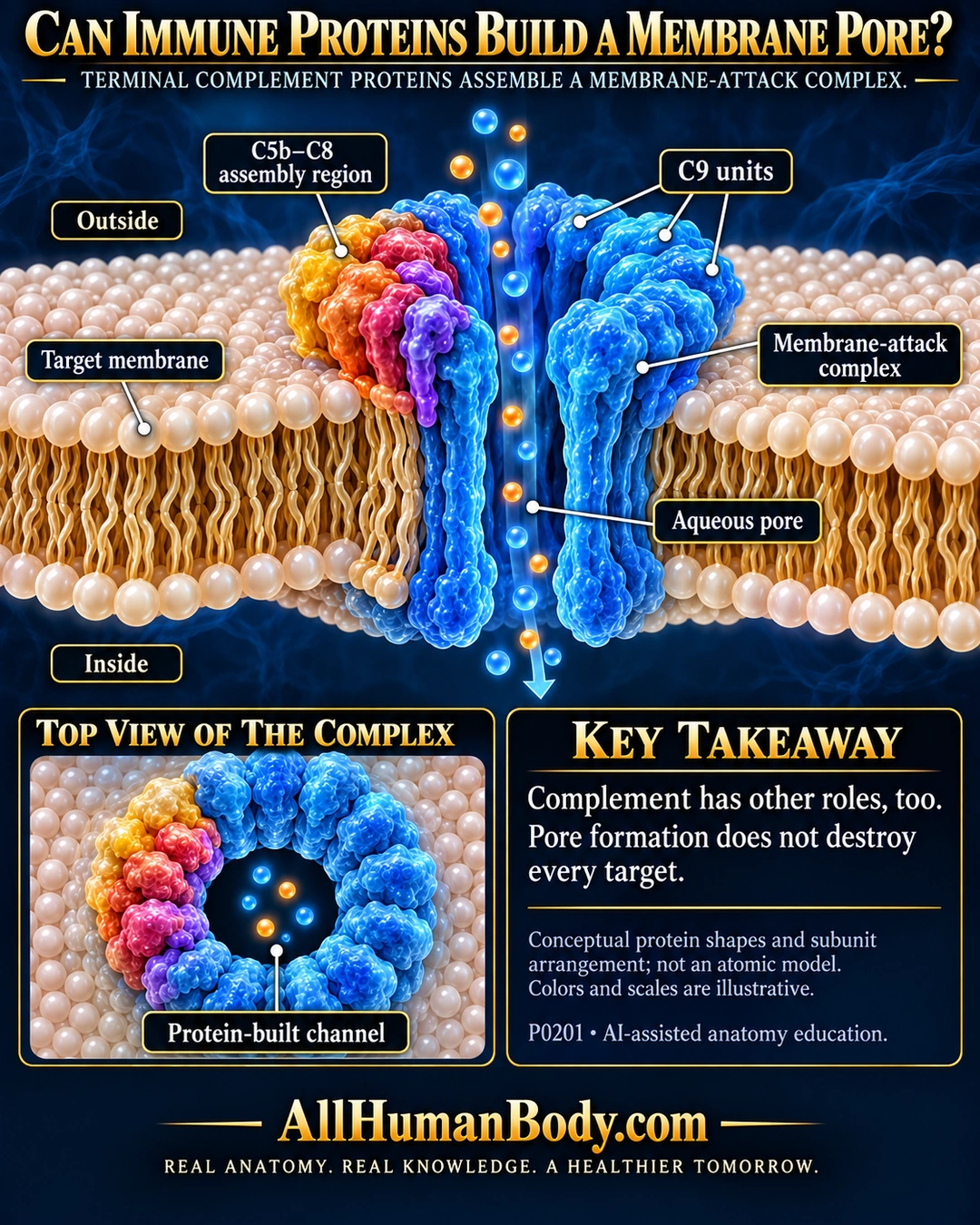
Terminal complement proteins can assemble a membrane-attack complex that forms a pore in susceptible membranes. Complement has other roles as well, and pore formation does not mean that every target is destroyed.
READ THE IMAGE
What the illustration shows
Navy and gold educational poster. An oblique lipid-bilayer cutaway shows a mostly blue complement-protein barrel crossing the membrane. A differently colored C5b–C8 assembly region sits at one side, with repeated C9 units around a central aqueous pore. Small blue and gold tokens and a downward arrow depict passage through the channel. Outside and inside are labeled. A lower top view shows the protein ring and open center. Text notes that complement has other roles and does not destroy every target. Protein shapes, subunit numbers, solutes, arrow direction and colors are conceptual, not an atomic model or measured flux. Gold AllHumanBody.com and the full slogan appear on a plain navy footer.
How to interpret this poster
- Protein folds, C9 count, membrane texture and channel diameter are conceptual, not an atomic structural model.
- One arrow illustrates passage, not compulsory one-way transport or measured flux; generic membrane is not a complete bacterial envelope.
- Antibodies do not drill the pore, and complement activation does not always require antibodies. No complete cascade, universal lysis or therapeutic claim.
- AI-assisted educational illustration; not physician certification, microscopy, a diagnosis or individualized medical advice.
- Fine annotations need enlargement; the full description provides an accessible text alternative.
- Display the full uncropped illustration; do not trim titles, legends or boundary annotations.
AI-assisted educational illustration, adapted into web-sized images without changing its composition. This is general education, not an individual diagnosis or treatment recommendation.
EVIDENCE / CONTEXT
Sources and what they support
- Immunobiology: The complement system and innate immunity ↗
Terminal-complex assembly, pore formation and regulated/qualified membrane damage.