Digestive / VISUAL EXPLAINER
How Do Your Cheeks Help Keep Food Between Your Teeth?
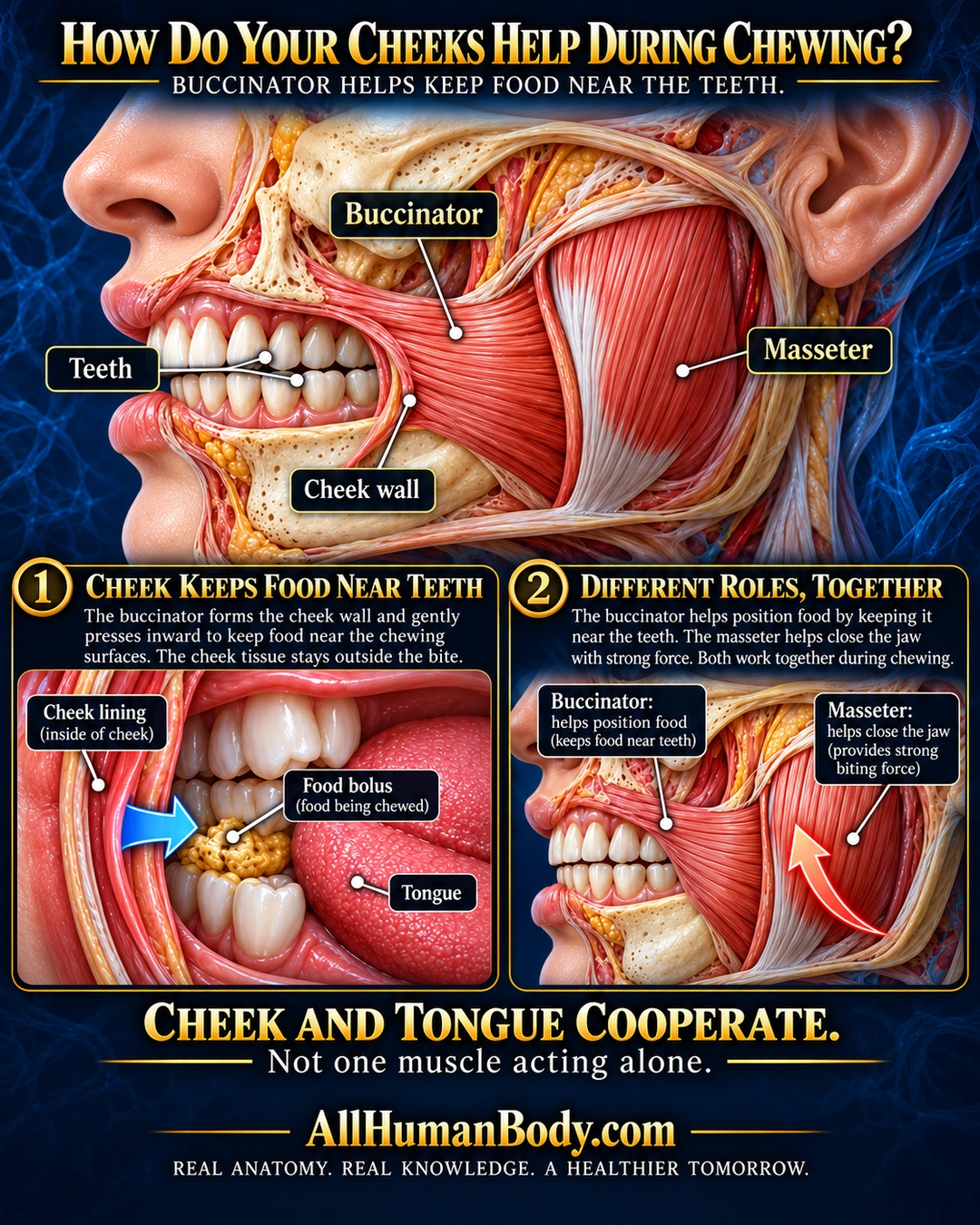
The buccinator helps press the cheek inward and cooperates with the tongue to keep food near chewing surfaces. Its food-positioning role differs from the masseter, which helps elevate the lower jaw.
READ THE IMAGE
What the illustration shows
Gold-titled poster on a navy and cyan background. A lateral face dissection labels the thin horizontal buccinator in front of a thick vertical masseter, with ivory teeth and bone. A lower inset shows cheek lining outside the teeth, a food bolus near the chewing surfaces and tongue on the inner side; a blue arrow points inward from the cheek. Another inset contrasts buccinator food positioning with masseter jaw closing. Gold AllHumanBody.com and the complete slogan sit on a plain navy footer.
How to interpret this poster
- Muscle fibers, bony exposure and inset section are simplified, not a surgical dissection, exact attachment map or force-vector measurement.
- Assistance does not guarantee prevention of cheek biting, and buccinator is not a primary jaw closer.
- No cosmetic reshaping, mewing, muscle-atrophy, exercise or swallowing advice; no nerve map is taught.
- AI-assisted educational illustration; not physician certification, microscopy, a diagnosis or individualized medical advice.
- Fine annotations need enlargement; the full description provides an accessible text alternative.
- Display the full uncropped illustration; do not trim titles, legends or boundary annotations.
AI-assisted educational illustration, adapted into web-sized images without changing its composition. This is general education, not an individual diagnosis or treatment recommendation.
EVIDENCE / CONTEXT
Sources and what they support
- Des Moines University: Anatomy word of the month — buccinator ↗
Buccinator and tongue cooperate to keep food near teeth rather than the vestibule.
- University of Iowa: Buccal Mucosa and Masticator Space Anatomy ↗
Cheek mucosa/buccinator relationships versus separate masticator-space masseter.
- Anatomy and Physiology 2e: 11.3 Axial Muscles of the Head, Neck, and Back ↗
Cheek compression and masseter mandibular elevation.