Digestive / VISUAL EXPLAINER
How Can an Intestinal Lining Cell Sense Food and Send a Signal?
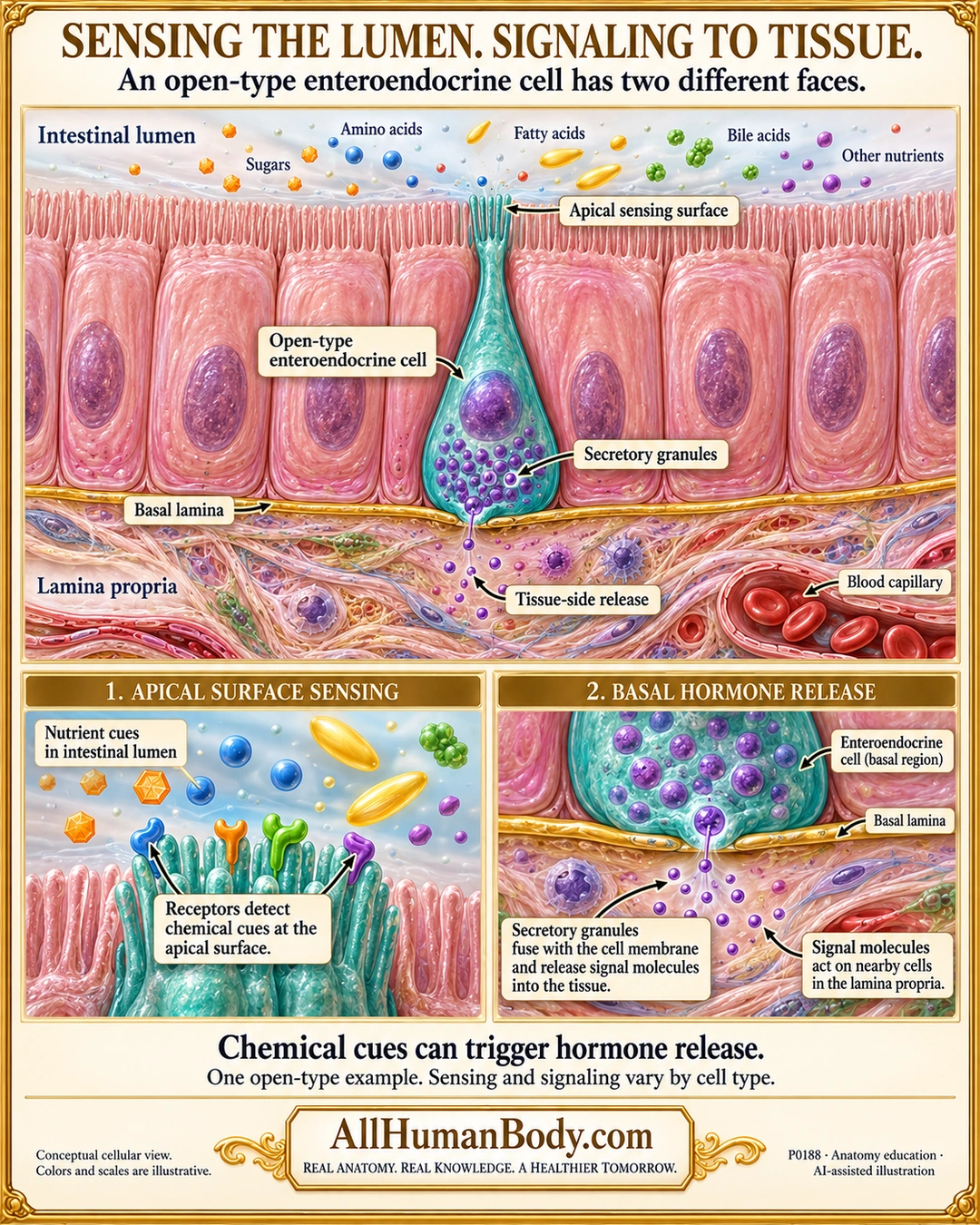
An open-type enteroendocrine cell can sample chemical cues at its luminal tip and release signals toward underlying tissue. Sensing and hormone output vary among cell populations; not every enteroendocrine cell has this shape or uses the same receptors.
READ THE IMAGE
What the illustration shows
Ivory-and-gold poster titled Sensing the Lumen. Signaling to Tissue. A teal open-type enteroendocrine cell lies between tall pink epithelial cells. Its narrow microvillar tip reaches the intestinal lumen with illustrative chemical cues. Purple secretory granules lie below its nucleus. Small signal dots emerge from the basal surface toward lamina propria; a separate blood capillary contains red cells. Two lower insets contrast apical sensing and basal granule fusion. Text qualifies this as one open-type example. Gold AllHumanBody.com and the full slogan are at the bottom.
How to interpret this poster
- Generic open-type example, not exact human small-intestinal histology. Basal-granule teaching evidence includes mouse colon.
- Cue icons denote categories across subtypes, not every receptor on one cell; some sensing is basolateral. Receptor shapes, cell size and granule counts are schematic.
- No intact food transport to blood, conscious taste, exclusive vagal synapse, weight-loss promise or drug advice.
- AI-assisted educational illustration; not physician certification, microscopy, a diagnosis or individualized medical advice.
- Fine annotations need enlargement; the full description provides an accessible text alternative.
- Display the full uncropped illustration; do not trim titles, legends or boundary annotations.
AI-assisted educational illustration, adapted into web-sized images without changing its composition. This is general education, not an individual diagnosis or treatment recommendation.
EVIDENCE / CONTEXT
Sources and what they support
- Molecular mechanisms of stimulus detection and secretion in enteroendocrine cells ↗
Variable nutrient stimulus detection and secretory responses; review abstract, not a universal receptor map.
Evidence correspondence is limited to the abstract. - Histology Guide: EM021 Enteroendocrine Cell ↗
Basal granules and tissue-side release; mouse large-intestine teaching description, not human geometry.
- Models and Tools for Studying Enteroendocrine Cells ↗
Open-type cell facing the lumen between enterocytes and local/distant hormone secretion; methodological review with animal, culture and human tissue limitations.