Endocrine / VISUAL EXPLAINER
Do Pancreatic Islet Cells Send Messages to Their Neighbors?
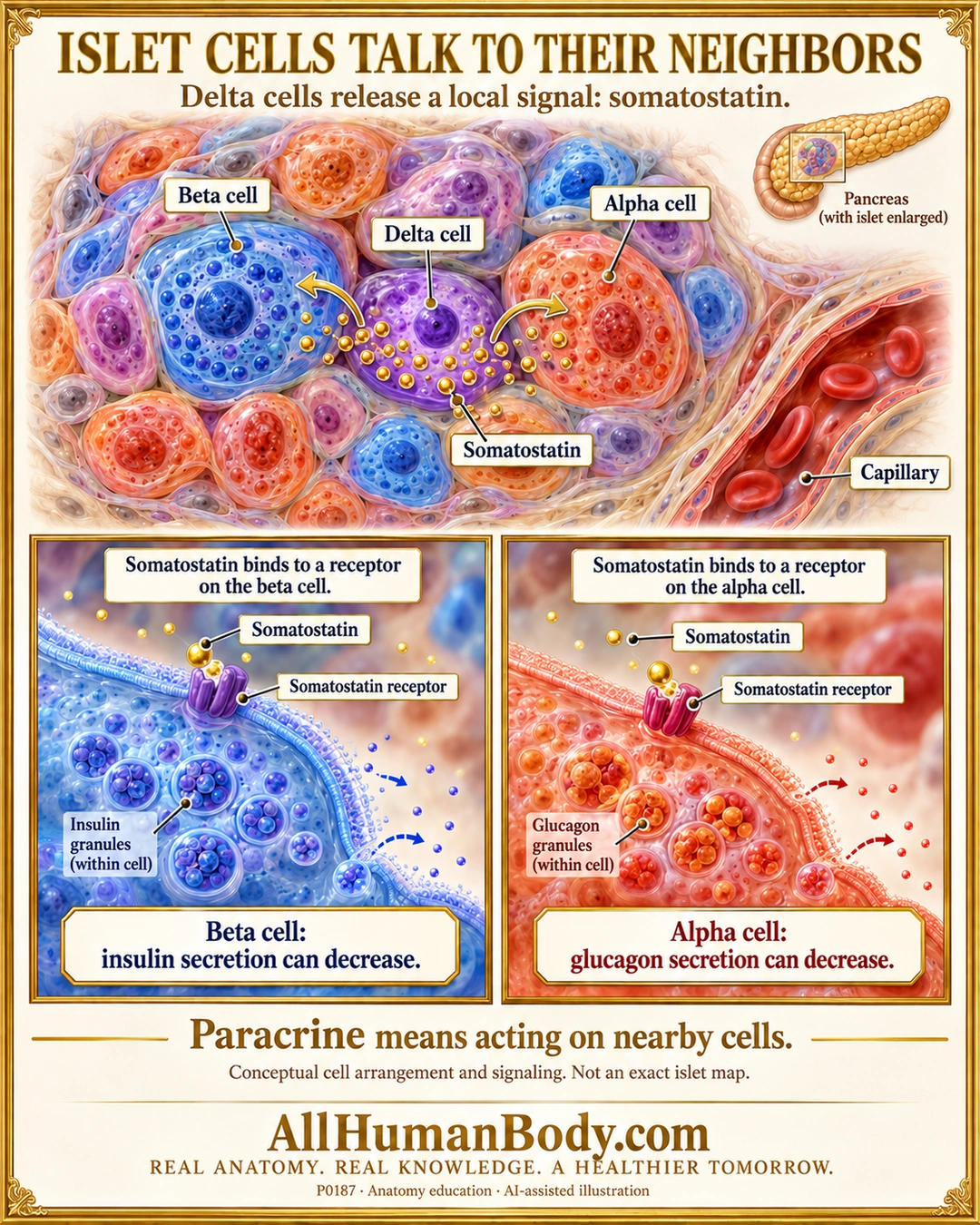
Pancreatic delta cells release somatostatin that can act on nearby islet cells. This paracrine signal can reduce insulin and glucagon secretion, modulating release rather than destroying hormones or permanently switching cells off.
READ THE IMAGE
What the illustration shows
Ivory-and-gold poster titled Islet Cells Talk to Their Neighbors. An enlarged mixed pancreatic islet contains a purple delta cell between a blue beta cell and coral alpha cell. Gold somatostatin dots and short arrows connect nearby cells; a separate capillary contains red cells. Two lower receptor closeups show intracellular granules and small extracellular signal dots, with text saying insulin and glucagon secretion can decrease. Footer defines paracrine action and states the cell arrangement is conceptual. Gold AllHumanBody.com and the complete slogan appear below.
How to interpret this poster
- Mixed cell arrangement, receptor shapes, granule counts and signal sizes are conceptual, not an exact human islet map or receptor-subtype distribution.
- The simplified delta cell does not show its complete branching morphology. No fixed cell percentage or signaling kinetics.
- Reducing both hormones does not imply an invariably lower blood glucose. No diabetes correction or treatment advice.
- AI-assisted educational illustration; not physician certification, microscopy, a diagnosis or individualized medical advice.
- Fine annotations need enlargement; the full description provides an accessible text alternative.
- Display the full uncropped illustration; do not trim titles, legends or boundary annotations.
AI-assisted educational illustration, adapted into web-sized images without changing its composition. This is general education, not an individual diagnosis or treatment recommendation.
EVIDENCE / CONTEXT
Sources and what they support
- The somatostatin-secreting pancreatic δ-cell in health and disease ↗
Delta-cell somatostatin, local inhibition of insulin/glucagon secretion and receptor-mediated modulation; review abstract.
Evidence correspondence is limited to the abstract.