Respiratory / VISUAL EXPLAINER
Does Every Part of an Inhaled Breath Reach the Gas-Exchange Surface?
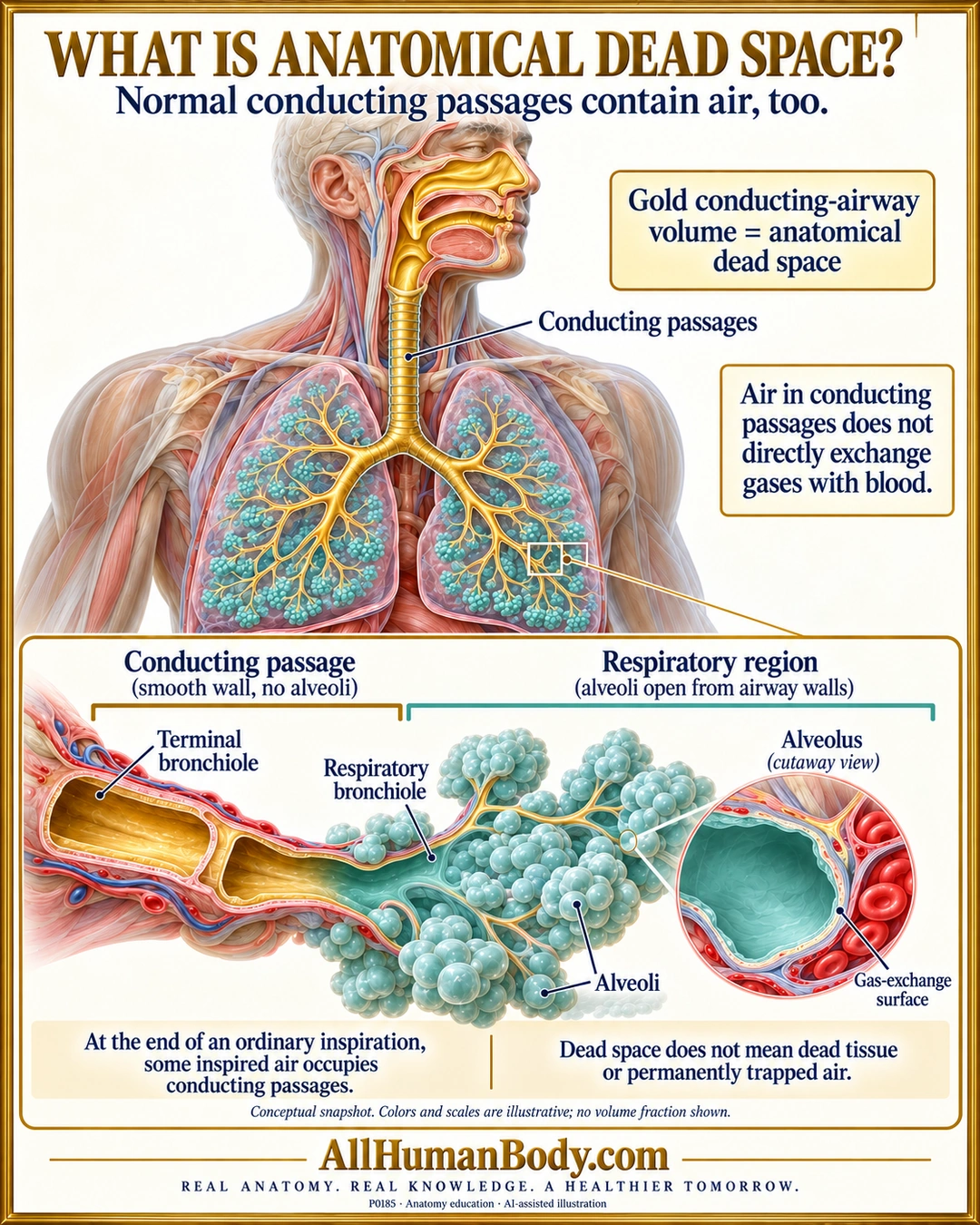
At the end of an ordinary inspiration, some inspired air occupies conducting passages rather than the gas-exchange region. This normal airway volume is anatomical dead space: not dead tissue, residual volume or air that remains permanently trapped.
READ THE IMAGE
What the illustration shows
Ivory and gold poster titled What is anatomical dead space? A head and thorax cutaway shows gold conducting-airway volume from nose and mouth to the branching airways, with teal distal regions. Text explains that conducting air does not directly exchange gases with blood. An enlarged lower transition shows a non-alveolated terminal bronchiole leading to a teal respiratory region with alveolar openings. A circular alveolar cutaway places a thin gas-exchange surface beside red blood cells in external capillaries. Bottom text describes an end-inspiration snapshot and explains that dead space is neither dead tissue nor permanently trapped air. Gold AllHumanBody.com and the complete slogan are present. Colors and scales are illustrative.
How to interpret this poster
- Regional locators and brackets are schematic, not exact airway generations, boundary coordinates or a measured volume fraction.
- Conducting walls still have a blood supply. Anatomical dead space is distinct from unperfused alveoli and does not mean a molecule can never reach alveoli later.
- No breath-holding, snorkel, treatment or numerical breathing instructions; capillary and alveolar geometry is enlarged.
- AI-assisted educational illustration; not physician certification, microscopy, a diagnosis or individualized medical advice.
- Fine annotations need enlargement; the full description provides an accessible text alternative.
- Display the full uncropped illustration; do not trim titles, legends or boundary annotations.
AI-assisted educational illustration, adapted into web-sized images without changing its composition. This is general education, not an individual diagnosis or treatment recommendation.
EVIDENCE / CONTEXT
Sources and what they support
- Anatomy and Physiology 2e: 22.3 The Process of Breathing ↗
Anatomical versus alveolar dead space and conducting volume; preserved relevant direct text and production reread.
- Anatomy and Physiology 2e: 22.1 Organs and Structures of the Respiratory System ↗
Conducting-zone versus respiratory-region structure; preserved directly read section, same publisher not independent study.