Digestive / VISUAL EXPLAINER
Where Does Your Liver Store Vitamin A?
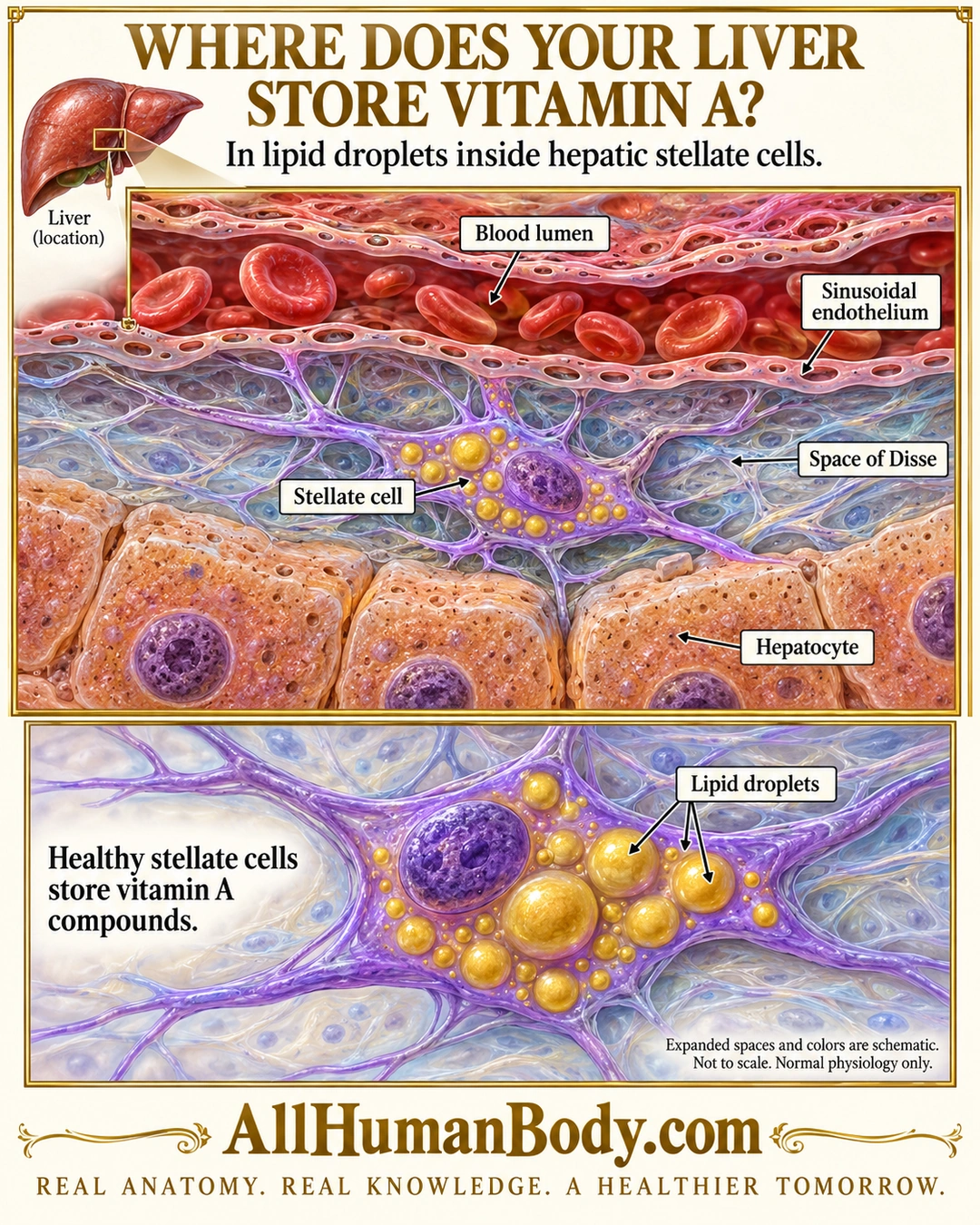
In normal liver, hepatic stellate cells occupy the space between sinusoidal endothelium and hepatocytes. These cells store vitamin A compounds within lipid droplets, in a compartment outside the blood-containing lumen.
READ THE IMAGE
What the illustration shows
Cream-and-gold anatomy poster titled Where does your liver store vitamin A? A liver locator leads to a sinusoid cutaway. Red blood cells lie in the lumen above a thin fenestrated endothelial wall. Below the wall, a purple branching stellate cell with gold intracellular droplets lies in an enlarged space of Disse, above orange hepatocytes. A lower enlargement identifies the lipid droplets. Gold AllHumanBody.com and the full project slogan appear below. Colors, gap width, pore size and droplet counts are schematic, not microscopy.
How to interpret this poster
- Normal quiescent-cell teaching only. Droplets are not pure vitamin A, and their number or size does not measure vitamin stores.
- Space of Disse is deliberately expanded; pores, background mesh, proportions and colors are not ultrastructure or fibrosis grading.
- No storage percentage or duration, deficiency/toxicity diagnosis, supplement dosage or treatment recommendation.
- AI-assisted educational illustration; not physician certification, microscopy, a diagnosis or individualized medical advice.
- Fine annotations need enlargement; the full description provides an accessible text alternative.
- Display the full uncropped illustration; do not trim titles, legends or boundary annotations.
AI-assisted educational illustration, adapted into web-sized images without changing its composition. This is general education, not an individual diagnosis or treatment recommendation.
EVIDENCE / CONTEXT
Sources and what they support
- Hepatic stellate cell (vitamin A-storing cell) and its relative--past, present and future ↗
Normal perisinusoidal location and cytoplasmic vitamin-A-containing lipid droplets; review abstract only, no quantitative or pathological inference.
Evidence correspondence is limited to the abstract.