Cardiovascular / VISUAL EXPLAINER
Where Do New Platelets Come From?
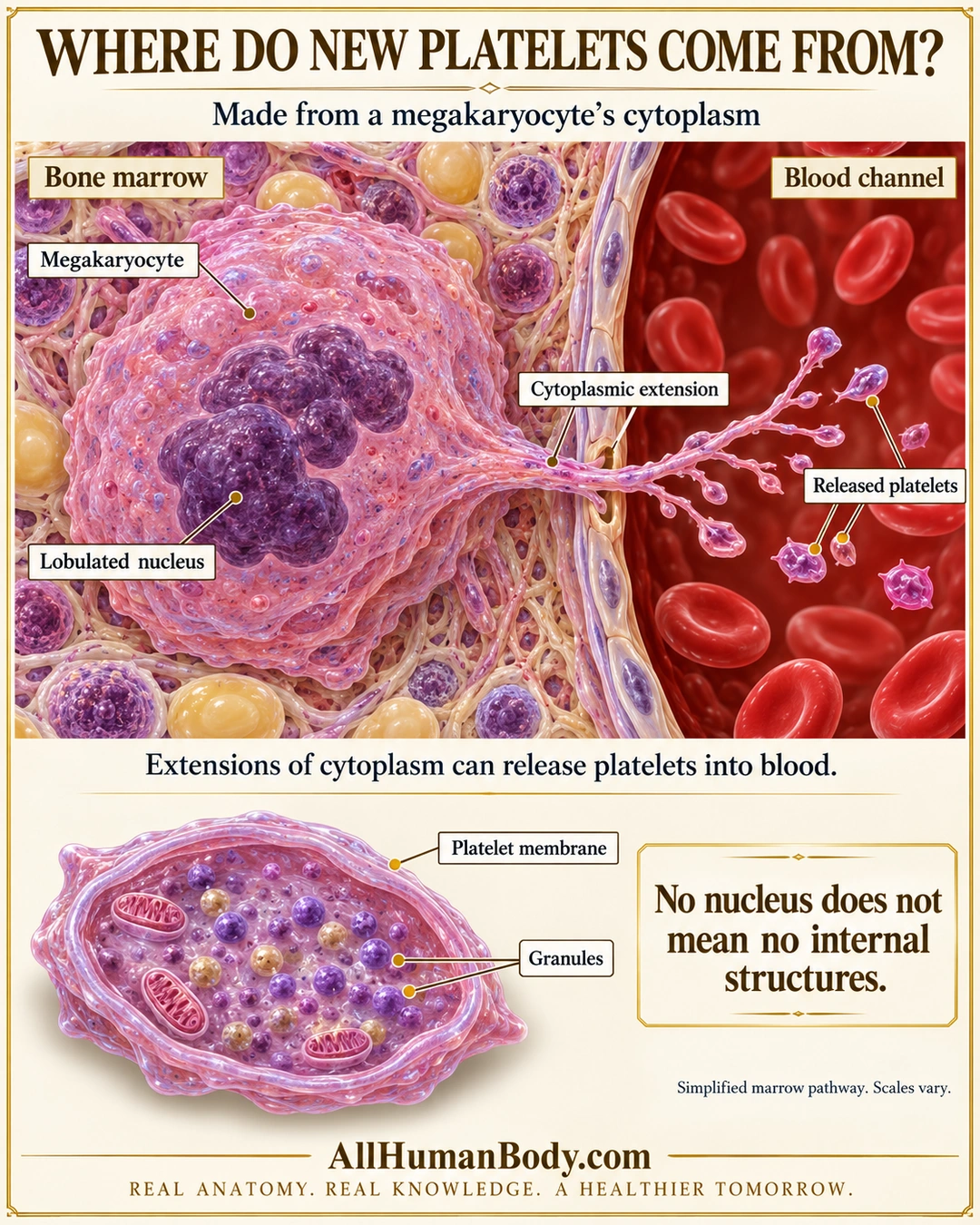
Megakaryocyte cytoplasm gives rise to membrane-bounded platelets. In this simplified marrow pathway, cytoplasmic extensions reach the blood channel while the large lobulated nucleus stays in the parent cell. Platelets lack nuclei but retain internal structures.
READ THE IMAGE
What the illustration shows
Gold-and-ivory poster asks where new platelets come from. A large pink megakaryocyte with a dark lobulated nucleus sits in bone marrow on the left of a blood-channel wall. Its branching pink cytoplasmic extension crosses into the channel, with small released platelets nearby among red disc-shaped blood cells. Labels identify the cell, nucleus, extension and released platelets. A separate enlarged platelet cutaway shows a membrane, granules and mitochondria but no nucleus. Text notes a simplified marrow pathway and varying scales. AllHumanBody.com and the full slogan are below.
How to interpret this poster
- Only one production pathway is shown, not an assertion that release occurs exclusively in marrow.
- Cell scales, endothelial crossing and release stages are simplified; irregular platelet outlines are not a resting-shape or activation sequence.
- No nuclear fragmentation into platelets, mitotic platelet division, exact production/lifespan/count, clot sequence or treatment.
- AI-assisted educational illustration; not physician certification, microscopy, a diagnosis or individualized medical advice.
- Fine annotations need enlargement; the full description provides an accessible text alternative.
- Display the full uncropped illustration; do not trim titles, legends or boundary annotations.
AI-assisted educational illustration, adapted into web-sized images without changing its composition. This is general education, not an individual diagnosis or treatment recommendation.
EVIDENCE / CONTEXT
Sources and what they support
- Anatomy and Physiology 2e: 18.4 Leukocytes and Platelets ↗
Membrane-bounded cytoplasmic origin and extensions across marrow channel walls.
- University of Leeds: Platelets ↗
Megakaryocyte origin, absent nucleus and internal platelet structures.