Musculoskeletal / VISUAL EXPLAINER
Does All Foot Movement Happen at the Ankle Joint?
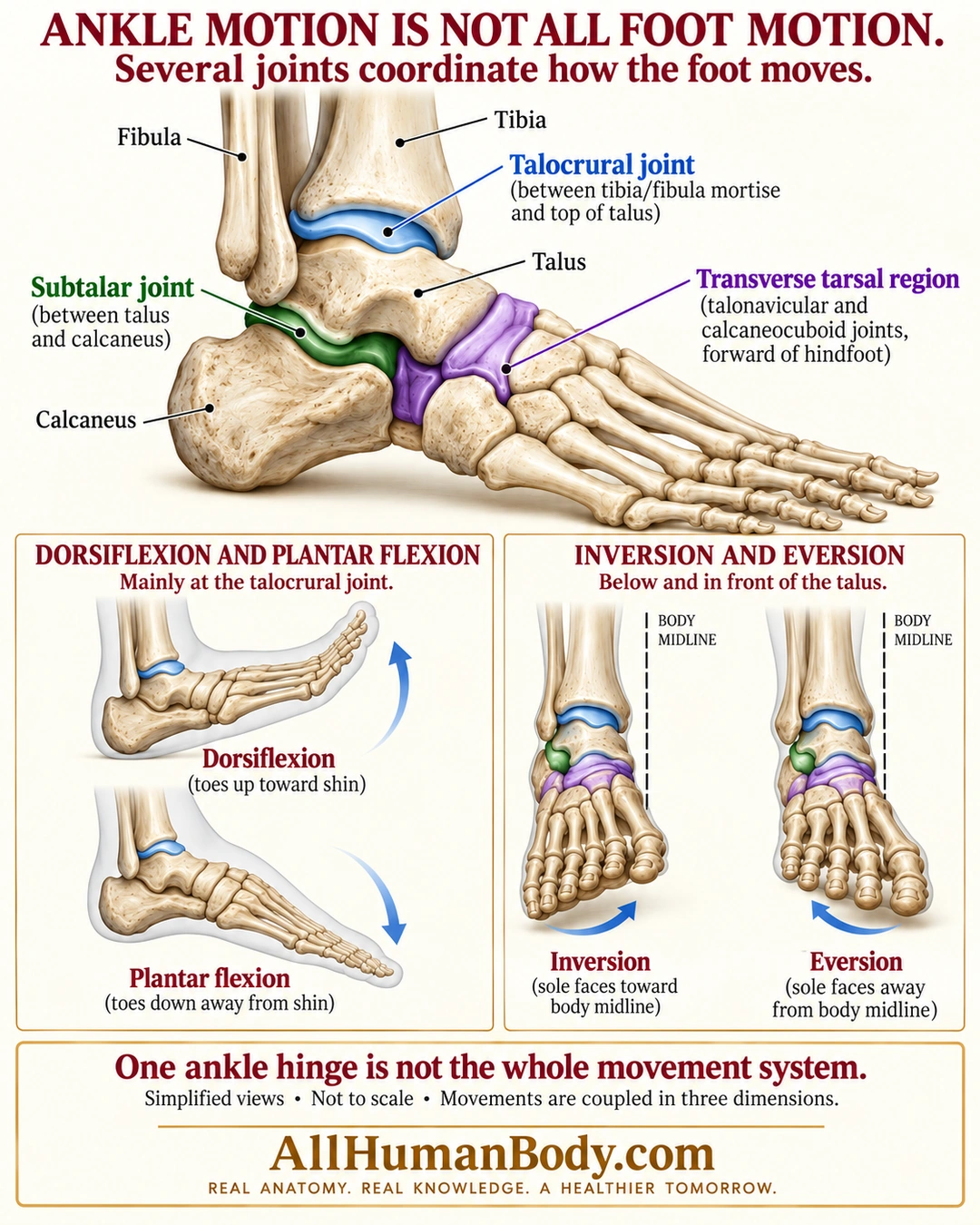
Upward and downward foot bending occurs mainly at the talocrural joint. Turning the sole inward or outward involves subtalar and other tarsal articulations as part of coupled three-dimensional movement. One ankle hinge does not explain every foot motion.
READ THE IMAGE
What the illustration shows
Cream-background anatomy poster titled Ankle Motion Is Not All Foot Motion. An oblique foot skeleton shows tibia, fibula, talus and calcaneus. Blue highlights the talocrural joint above the talus, green the subtalar joint between talus and calcaneus, and purple the transverse tarsal region in front of the hindfoot. Lower left side-view drawings and blue arrows show dorsiflexion with toes raised toward the shin and plantar flexion with toes pointed down. Lower right front-view drawings show inversion with the sole toward a dashed body midline and eversion with the sole away. The text says these motions are coupled in three dimensions, with simplified views not to scale. The takeaway says One ankle hinge is not the whole movement system. Gold AllHumanBody.com branding and its complete slogan run along the bottom.
How to interpret this poster
- Joint colors indicate approximate regions, not exact articular reconstructions or universal motion axes.
- Mainly does not mean exclusively; not every participating joint is shown.
- No angle measurements, exercise, stretching, injury-risk prediction or clinical assessment.
- AI-assisted educational illustration; not physician certification, microscopy, a diagnosis or individualized medical advice.
- Fine annotations need enlargement; the full description provides an accessible text alternative.
- Display the full uncropped illustration; do not trim titles, legends or boundary annotations.
AI-assisted educational illustration, adapted into web-sized images without changing its composition. This is general education, not an individual diagnosis or treatment recommendation.
EVIDENCE / CONTEXT
Sources and what they support
- University of Utah: Foot and Ankle anatomy lecture ↗
Talocrural main hinge motion and subtalar/transverse-tarsal contributions.
- Anatomy and Physiology 2e: 9.5 Types of Body Movements ↗
Dorsiflexion, plantar flexion, inversion and eversion definitions; preserved direct section and production reread.