Special Senses / VISUAL EXPLAINER
Why Is Your Earlobe Softer Than the Rest of Your Ear?
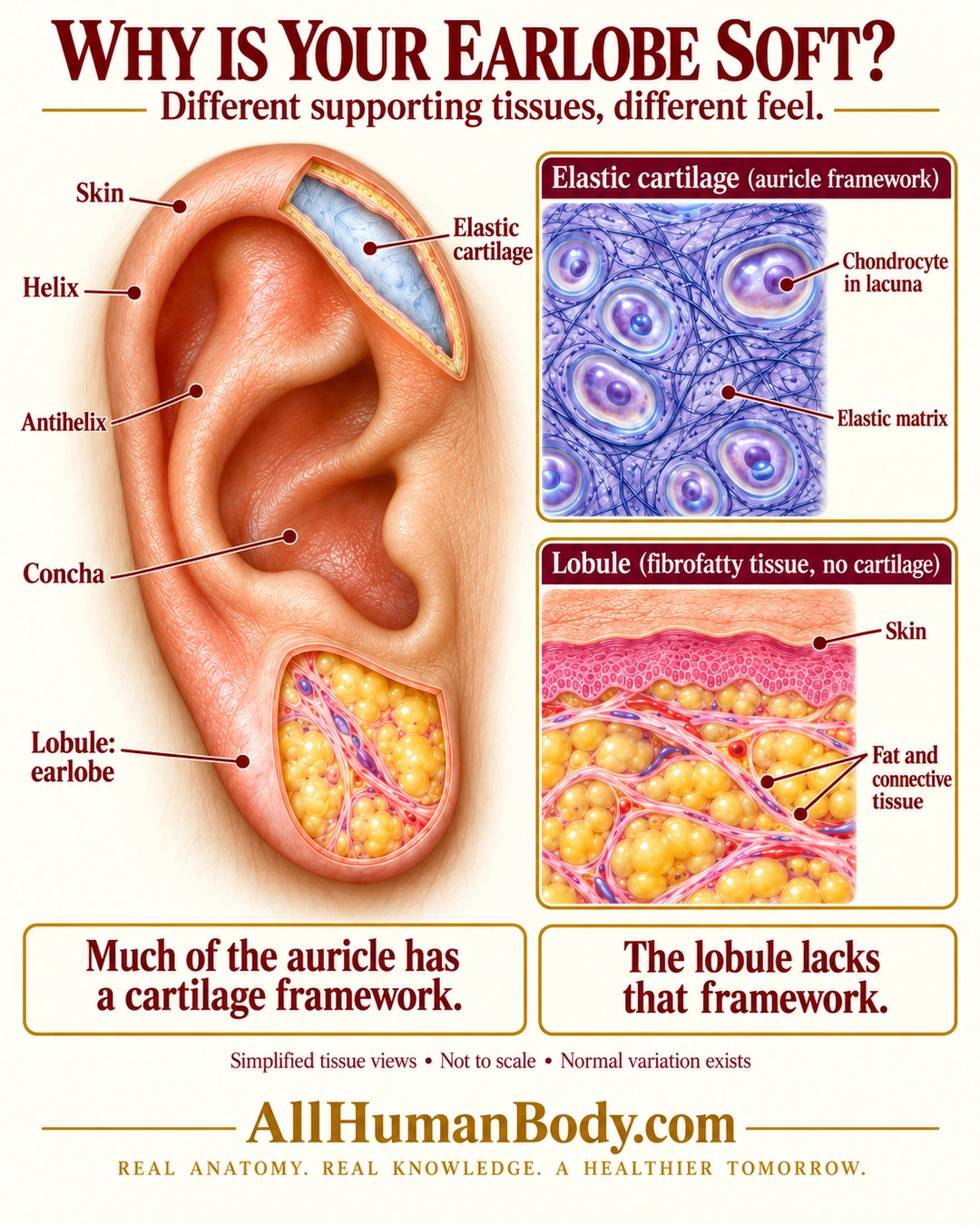
Much of the auricle is shaped by flexible cartilage beneath the skin. The lobule lacks that framework and instead contains soft fatty and connective tissue. These are different support tissues, not identical material arranged into different outlines.
READ THE IMAGE
What the illustration shows
Portrait anatomy poster titled Why Is Your Earlobe Soft? A large external ear on the left has an upper skin window exposing pale blue elastic cartilage and a lower lobule window exposing yellow fat and pink connective tissue. Labels identify skin, helix, antihelix, concha, cartilage and earlobe. Two right panels compare chondrocytes in lacunae within an elastic matrix with skin over fibrofatty lobule tissue. Text explains that much of the auricle has a cartilage framework and the lobule lacks it. Views are simplified, not to scale, with normal variation. Gold AllHumanBody.com branding and full slogan appear below.
How to interpret this poster
- Selected cutaways are not wounds; shape, cell proportions, fat fraction and tissue colors vary and are not measured.
- No assertion that every point of the upper ear contains cartilage or that cartilage is bone.
- No piercing, infection, pain, surgery, rejuvenation or treatment guidance.
- AI-assisted educational illustration; not physician certification, microscopy, a diagnosis or individualized medical advice.
- Fine annotations need enlargement; the full description provides an accessible text alternative.
- Display the full uncropped illustration; do not trim titles, legends or boundary annotations.
AI-assisted educational illustration, adapted into web-sized images without changing its composition. This is general education, not an individual diagnosis or treatment recommendation.
EVIDENCE / CONTEXT
Sources and what they support
- Elsevier: Auricular cartilage ↗
Auricular framework excludes lobule and has normal small gaps.
- Southern Illinois University: Skeletal Tissue (Bone and Cartilage) ↗
Cartilage cells in lacunae, elastic matrix and elastic cartilage in ear.
- Esthetic and reconstructive options for earlobe deformities ↗
Normal earlobe contains areolar connective and adipose tissue and lacks cartilage.