Nervous / VISUAL EXPLAINER
Can Several Small Inputs Help a Neuron Fire?
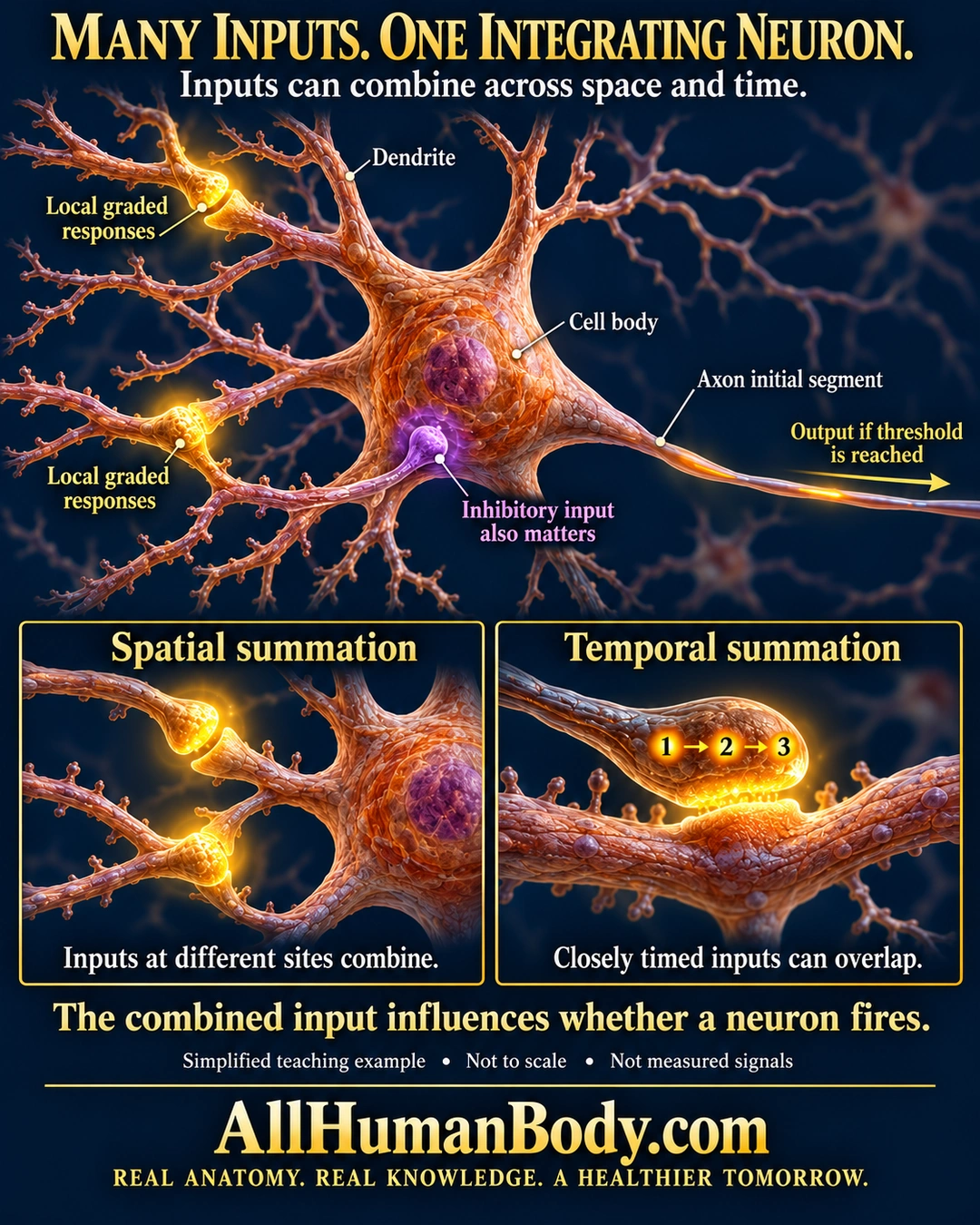
Synaptic inputs can produce local graded responses that combine across different sites or close timing. Excitatory and inhibitory effects together influence whether the axon’s initial segment reaches firing threshold; an input does not automatically cause a spike.
READ THE IMAGE
What the illustration shows
Gold-on-navy anatomical poster titled Many inputs. One integrating neuron. A copper multipolar neuron receives two gold-highlighted contacts on different dendrites and a purple inhibitory contact near its cell body. Labels identify local graded responses, the dendrite, cell body and axon initial segment. A gold arrow on the outgoing axon is qualified as output if threshold is reached. The lower left spatial-summation inset shows two separate contacts; the right temporal-summation inset shows one contact with successive-input indicators 1, 2 and 3. The text explains that combined input influences firing. Glows and numbered indicators are conceptual, not measured signals or particles.
How to interpret this poster
- Glows and 1–3 markers are concepts, not particles, signal measurements or a sufficient input count.
- No fixed threshold voltage, timing, linear arithmetic rule or identical integration for every neuron.
- Inhibition is not asserted always to hyperpolarize; cell geometry and synapses are representative.
- AI-assisted educational illustration; not physician certification, microscopy, a diagnosis or individualized medical advice.
- Fine annotations need enlargement; the full description provides an accessible text alternative.
- Display the full uncropped illustration; do not trim titles, legends or boundary annotations.
AI-assisted educational illustration, adapted into web-sized images without changing its composition. This is general education, not an individual diagnosis or treatment recommendation.
EVIDENCE / CONTEXT
Sources and what they support
- Anatomy and Physiology 2e: 12.5 Communication Between Neurons ↗
Graded potentials, spatial/temporal summation, inhibitory influence and trigger region; preserved direct relevant sections.