Nervous / VISUAL EXPLAINER
Why Do Nerve Fibers Mix in a Limb Plexus?
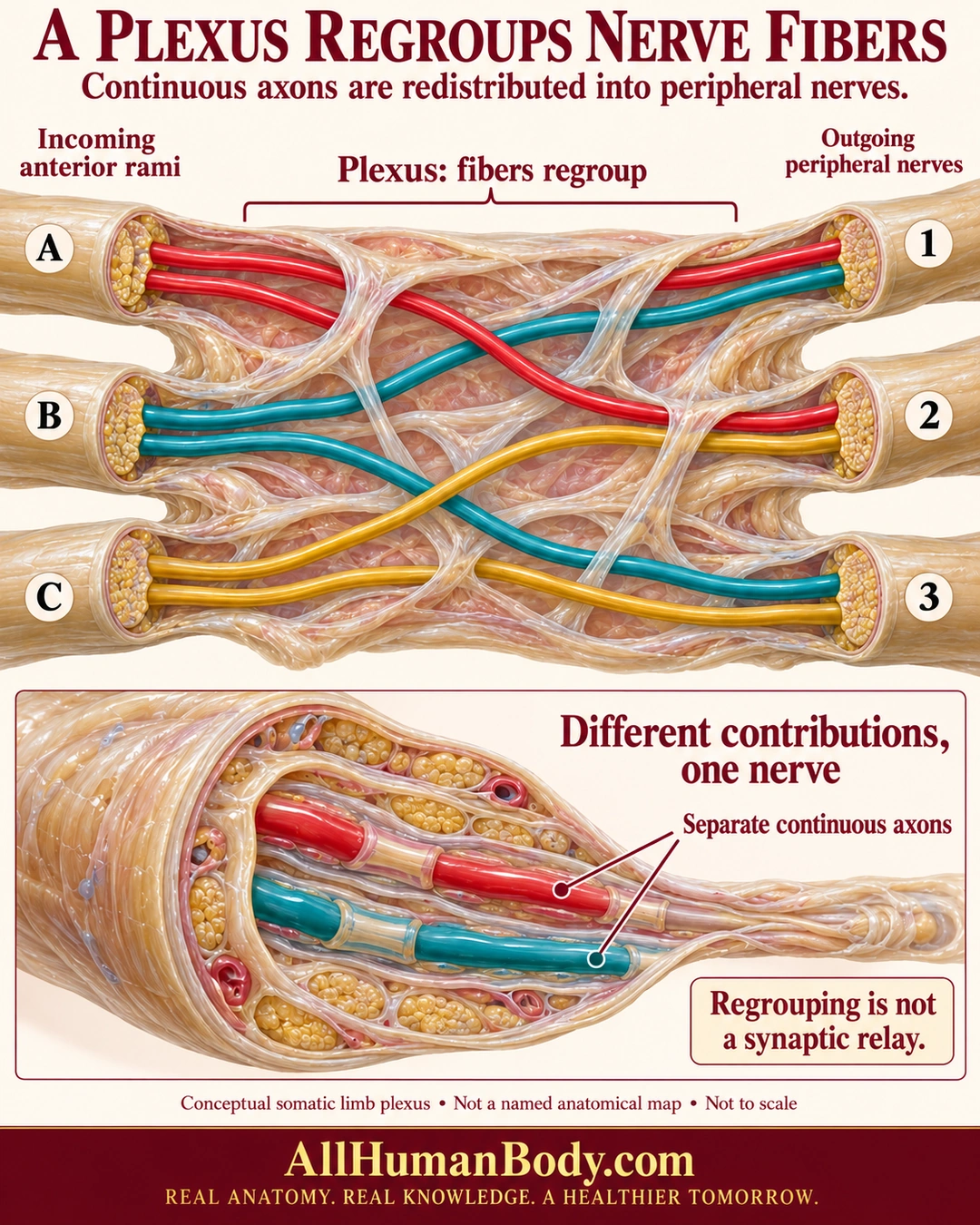
Somatic limb plexuses redistribute intact axons from spinal nerve anterior rami into peripheral nerves. A resulting nerve can carry contributions from several spinal levels; regrouping does not mean that each crossing forms a synapse with a new neuron.
READ THE IMAGE
What the illustration shows
English medical teaching poster showing a conceptual somatic limb plexus. Three beige incoming bundles A, B and C contain red, teal and gold example axons. Unbroken colored paths cross at different depths and regroup into three outgoing bundles: red with teal, red with gold, teal with gold. A lower peeled bundle shows separate axons beside each other in connective tissue. Text says regrouping is not a synaptic relay. Colors indicate contributions, not signal direction. Simplified, not a named anatomical map. Gold AllHumanBody.com and full slogan below.
How to interpret this poster
- Conceptual routing, not a named plexus, exact spinal-level contribution or surgical map.
- Colors identify contributions, not sensory/motor classes or signal direction.
- No autonomic/enteric plexus generalization, clinical territory or precise sheath/node reconstruction.
- AI-assisted educational illustration; not physician certification, microscopy, a diagnosis or individualized medical advice.
- Fine annotations need enlargement; the full description provides an accessible text alternative.
- Display the full uncropped illustration; do not trim titles, legends or boundary annotations.
AI-assisted educational illustration, adapted into web-sized images without changing its composition. This is general education, not an individual diagnosis or treatment recommendation.
EVIDENCE / CONTEXT
Sources and what they support
- Anatomy and Physiology 2e: 13.4 The Peripheral Nervous System ↗
Selected somatic-plexus reorganization without cell-body relay; preserved direct lines 99–107. Erroneous specific root/radial-to-axillary examples excluded.
- Elsevier Anatomy: Brachial plexus, left ↗
Anterior-ramus contribution and division/recombination into peripheral routes.