Cardiovascular / VISUAL EXPLAINER
Why Are Red Blood Cells Dimpled Rather Than Hollow?
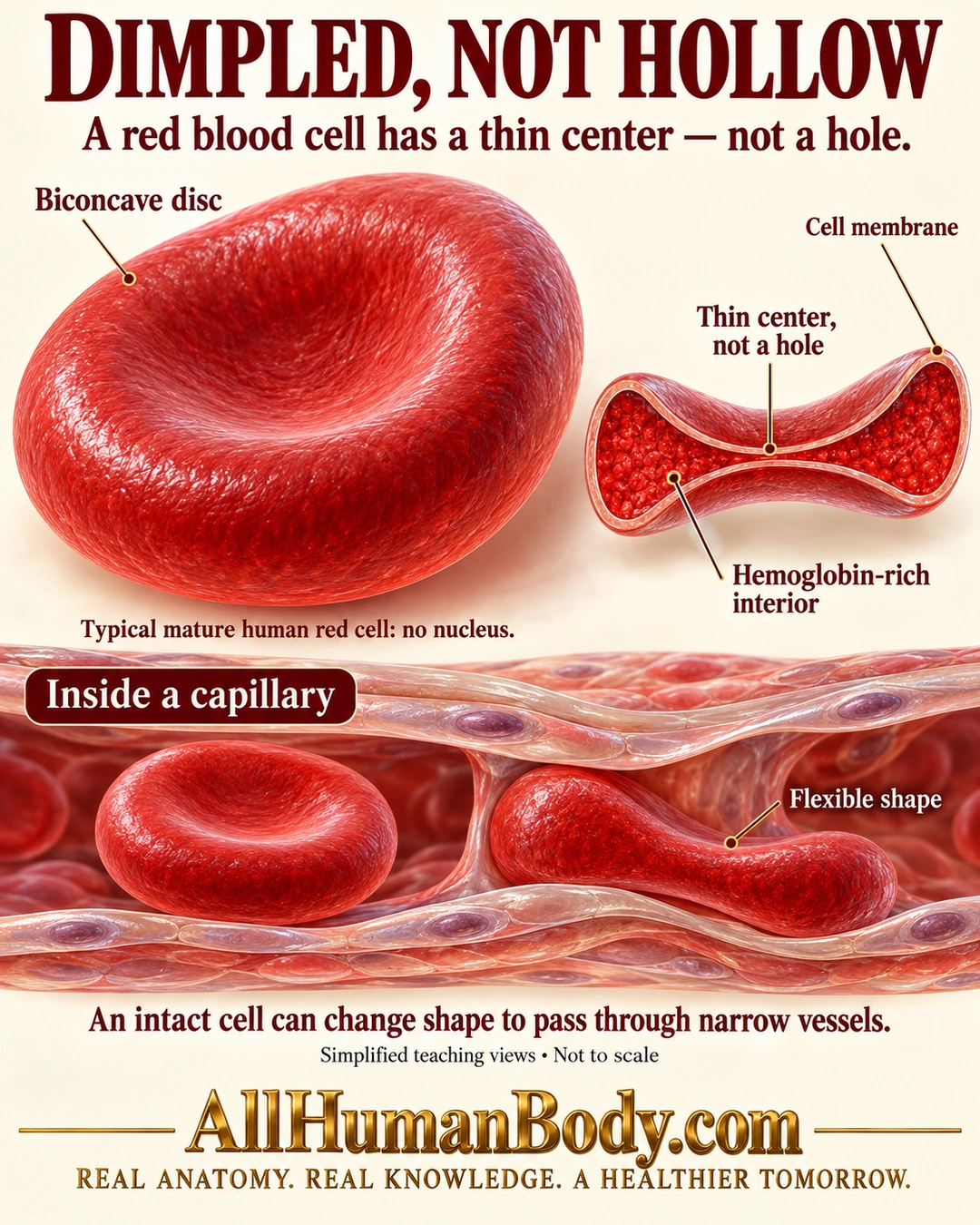
Typical mature human red blood cells are biconcave discs with a thin center, not hollow rings. They lack a nucleus but retain hemoglobin-rich cytoplasm; flexible membrane support allows shape changes through narrow vessels.
READ THE IMAGE
What the illustration shows
English medical poster titled Dimpled, Not Hollow. A large red biconcave disc has an intact central depression. A neighboring cut-through profile shows a continuous thin center between thicker rims, labeled cell membrane and hemoglobin-rich interior. Text states that a typical mature human red cell has no nucleus. A lower capillary cutaway shows an intact rounded red cell and an elongated, deformed cell inside the vessel, labeled flexible shape. Text explains that an intact cell can change shape through narrow vessels. Simplified teaching views, not to scale. Gold AllHumanBody.com branding and the full slogan appear below.
How to interpret this poster
- Normal mature human example, not every species or pathological red-cell shape.
- Granular texture, dimensions and vessel geometry are illustrative; inset is not a timed flow simulation.
- No empty/dead-cell claim, exact diameter, anemia diagnosis or complete membrane-skeleton reconstruction.
- AI-assisted educational illustration; not physician certification, microscopy, a diagnosis or individualized medical advice.
- Fine annotations need enlargement; the full description provides an accessible text alternative.
- Display the full uncropped illustration; do not trim titles, legends or boundary annotations.
AI-assisted educational illustration, adapted into web-sized images without changing its composition. This is general education, not an individual diagnosis or treatment recommendation.
EVIDENCE / CONTEXT
Sources and what they support
- Anatomy and Physiology 2e: 18.3 Erythrocytes ↗
Biconcave shape, absent nucleus, structural support and reversible deformation; preserved direct shape lines 34–40 and production reread.
- University of Leeds Histology Guide: Red blood cells ↗
Typical red-cell shape, hemoglobin-containing cytoplasm and deformability.