Lymphatic & Immune / VISUAL EXPLAINER
How Can White Blood Cells Leave a Blood Vessel?
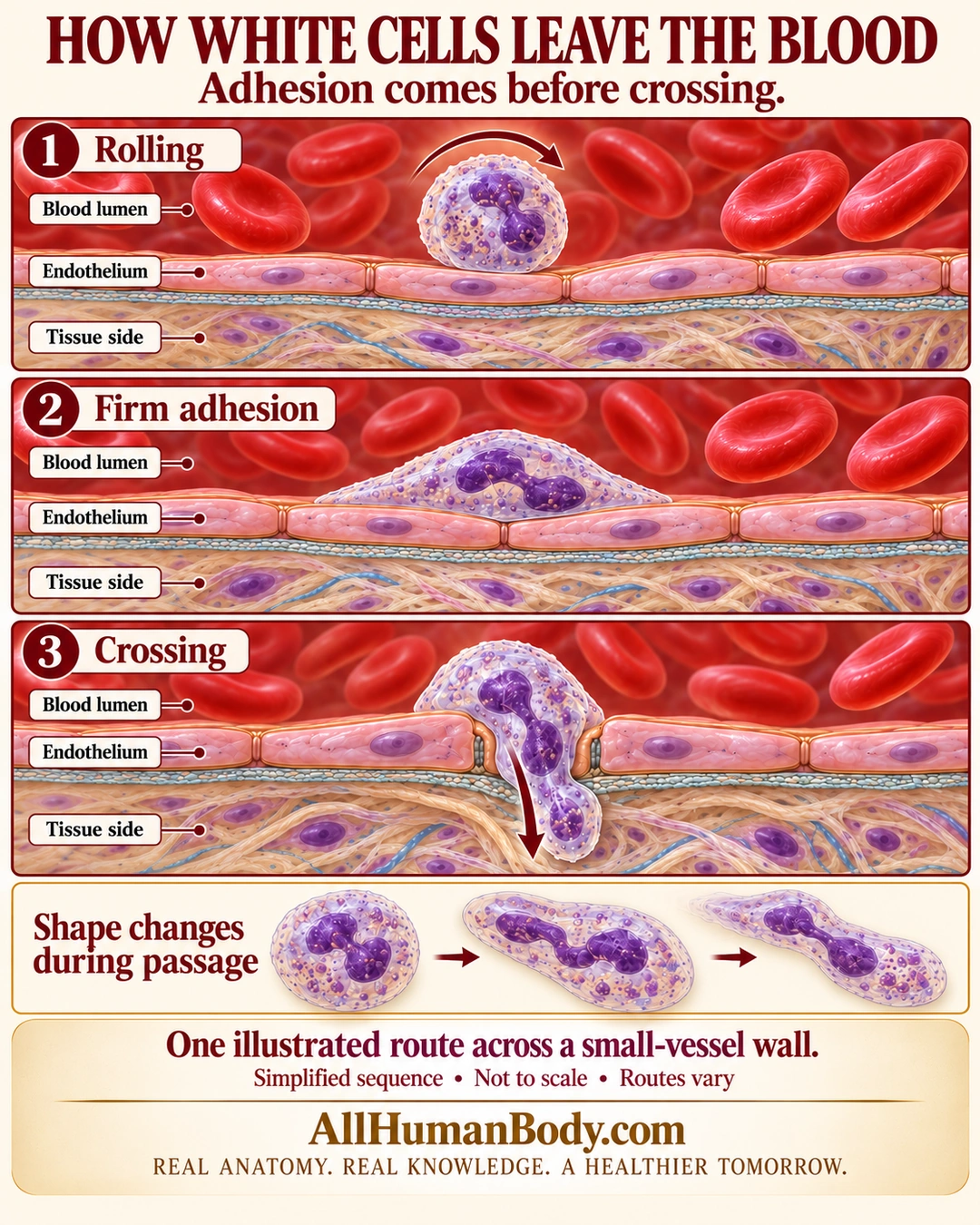
A common leukocyte recruitment sequence includes rolling, firm adhesion and passage across the vessel wall. This example shows a neutrophil-like cell crossing between endothelial cells, not blood simply leaking out; routes and recruitment steps vary with tissue and cell type.
READ THE IMAGE
What the illustration shows
English poster titled How White Cells Leave the Blood. Three stacked tissue panels show a pale granular white cell with a connected lobulated purple nucleus: rolling along the luminal surface, flattening during firm adhesion, then elongating between two neighboring endothelial cells toward the tissue below. Red cells remain in the blood lumen above the wall. Labels distinguish Blood lumen, Endothelium and Tissue side. A downward arrow indicates crossing. A lower inset compares rounded and elongated cell shapes. The caveat says One illustrated route across a small-vessel wall; Simplified sequence; Not to scale; Routes vary. Gold AllHumanBody.com and full slogan finish the poster.
How to interpret this poster
- Separate temporal snapshots, not measured duration or one universal sequence in every vessel.
- Nuclear lobes, contacts and basement-layer details are simplified; transcellular passage and full molecular cascades are not drawn.
- No persistent wall tear, immune-strength promise, disease grading or treatment advice.
- AI-assisted educational illustration; not physician certification, microscopy, a diagnosis or individualized medical advice.
- Fine annotations need enlargement; the full description provides an accessible text alternative.
- Display the full uncropped illustration; do not trim titles, legends or boundary annotations.
AI-assisted educational illustration, adapted into web-sized images without changing its composition. This is general education, not an individual diagnosis or treatment recommendation.
EVIDENCE / CONTEXT
Sources and what they support
- Anatomy and Physiology 2e: 18.4 Leukocytes and Platelets ↗
Small-vessel exit between adjacent endothelial cells and tissue chemical guidance; preserved direct lines 35–39 and fresh reread.
- Organ-Specific Mechanisms of Transendothelial Neutrophil Migration in the Lung, Liver, Kidney, and Aorta ↗
Rolling, stable adhesion and subsequent transmigration as a model-dependent cascade with organ-specific variation.