Musculoskeletal / VISUAL EXPLAINER
What Helps Joint Surfaces Glide Instead of Grinding?
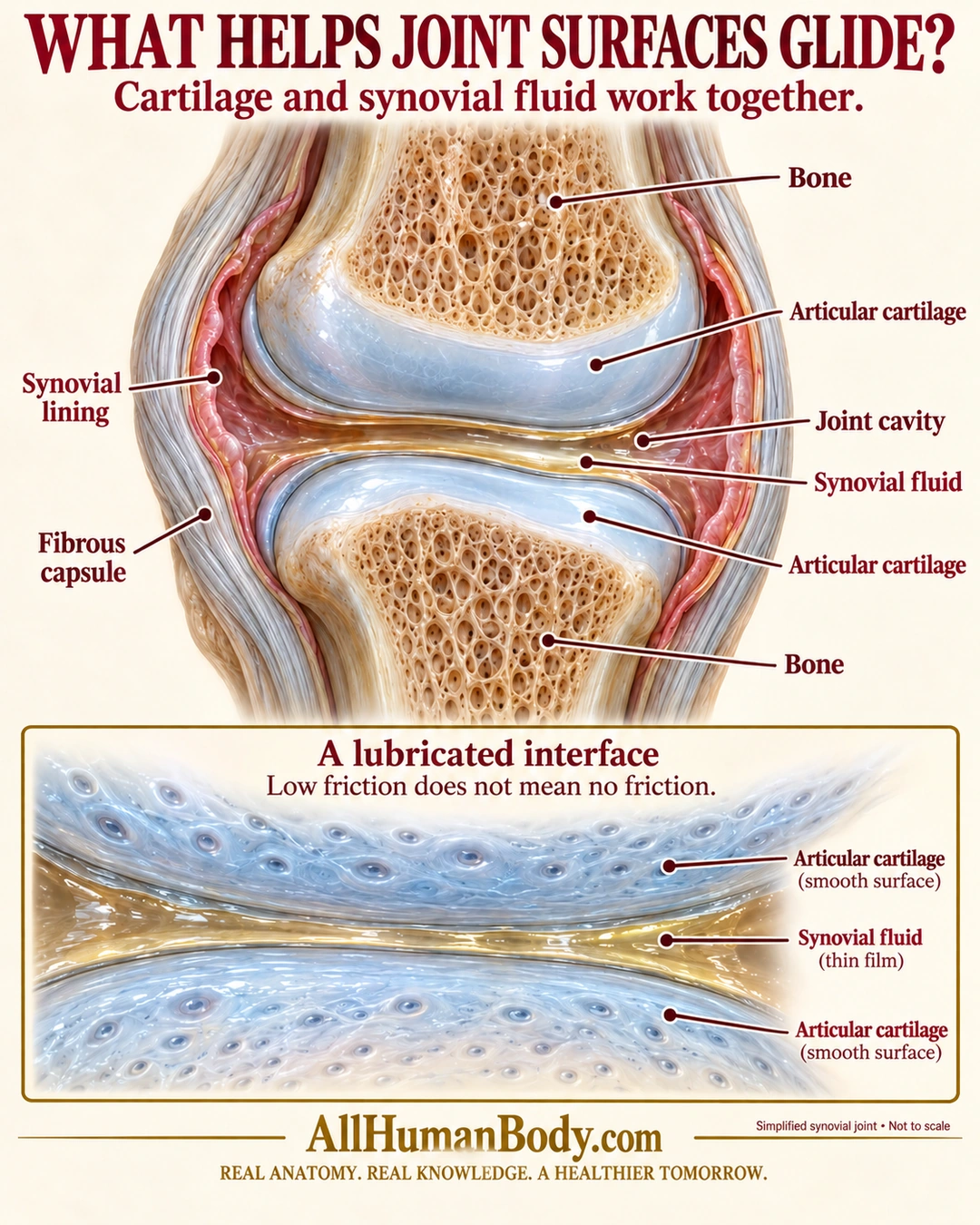
In a typical synovial joint, opposing bone surfaces are covered by articular cartilage and separated by a small fluid-containing cavity. The synovial lining lies inside the capsule rather than covering the articular surface; cartilage and fluid help reduce friction.
READ THE IMAGE
What the illustration shows
English anatomy poster titled What Helps Joint Surfaces Glide? A generic synovial joint cutaway shows two trabecular bone ends capped with pale-blue articular cartilage. A narrow golden fluid-filled cavity separates the surfaces. A white fibrous capsule surrounds the joint, with a pink synovial lining on its inner side stopping at the cartilage margins. Labels identify bone, cartilage, capsule, lining, cavity and fluid. A lower enlarged inset shows smooth cartilage surfaces separated by a thin fluid film. Text states Low friction does not mean no friction. Simplified, not to scale. Gold AllHumanBody.com and full slogan appear at the bottom.
How to interpret this poster
- Generic joint, not a named-joint reconstruction; fluid color, film thickness and cell arrangement are illustrative.
- Low friction is not zero friction, indestructibility or a lifetime-wear prediction.
- No treatment, pain/crepitus diagnosis or oil-producing duct.
- AI-assisted educational illustration; not physician certification, microscopy, a diagnosis or individualized medical advice.
- Fine annotations need enlargement; the full description provides an accessible text alternative.
- Display the full uncropped illustration; do not trim titles, legends or boundary annotations.
AI-assisted educational illustration, adapted into web-sized images without changing its composition. This is general education, not an individual diagnosis or treatment recommendation.
EVIDENCE / CONTEXT
Sources and what they support
- Anatomy and Physiology 2e: 9.4 Synovial Joints ↗
Cartilage-covered surfaces, capsule, synovial lining and lubricating fluid. Preserved direct structural-feature lines 34–39 and production reread.