Digestive / VISUAL EXPLAINER
How Does Saliva Start Breaking Down Starch?
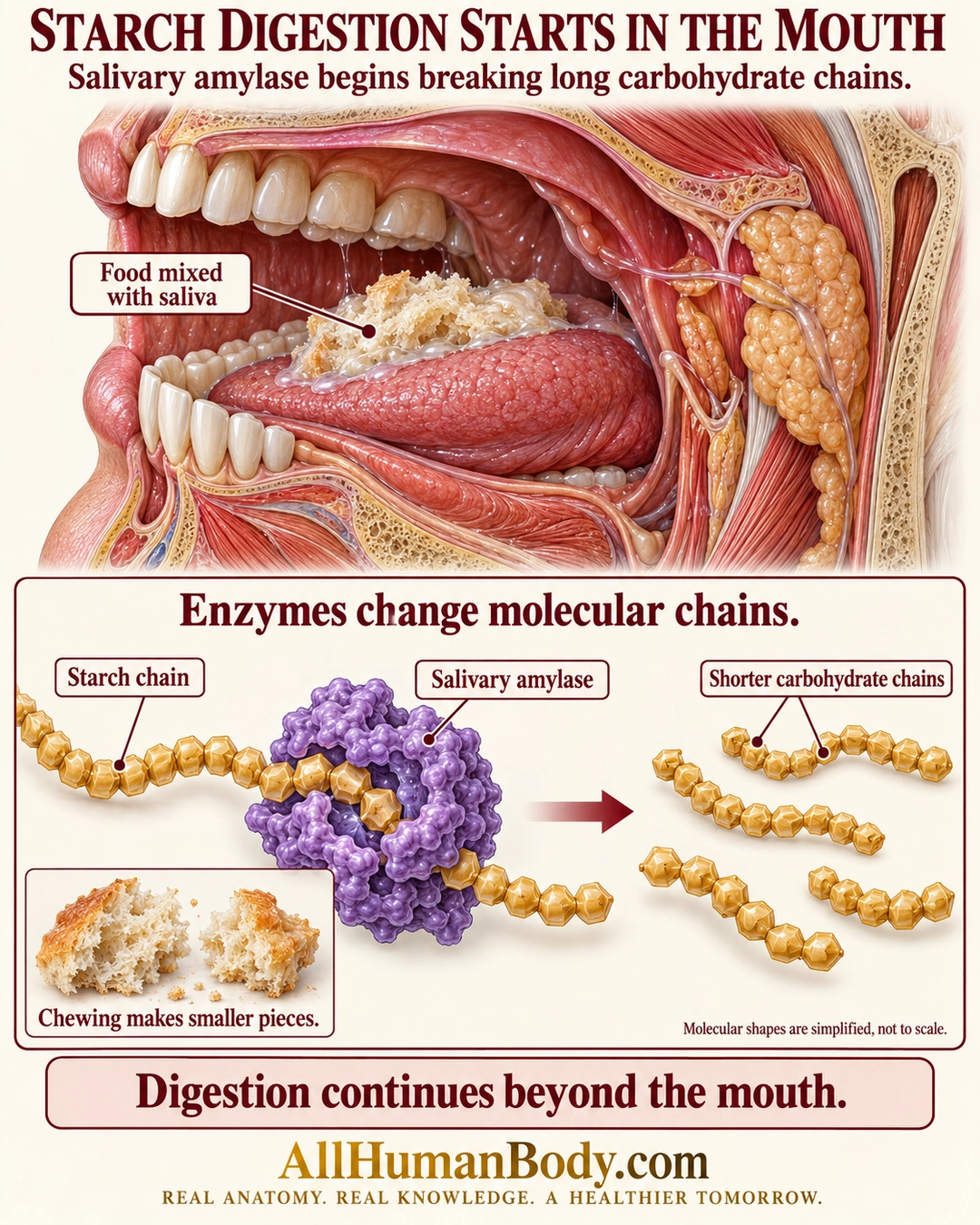
Salivary amylase begins breaking susceptible starch bonds into smaller carbohydrate fragments. Chewing physically breaks food and mixes it with saliva, but this differs from molecular cleavage and does not complete carbohydrate digestion in the mouth.
READ THE IMAGE
What the illustration shows
A cream medical poster shows a regional mouth cutaway with bread coated in saliva resting on the tongue. Below, a qualitative molecular diagram shows a long gold starch chain entering a purple salivary-amylase shape and emerging as several shorter connected chains, not isolated glucose units. An inset contrasts this with two physical bread fragments. Text states that digestion continues beyond the mouth and molecular shapes are simplified. Gold AllHumanBody.com branding and the full slogan appear at the bottom.
How to interpret this poster
- Molecular shapes, bead numbers and enzyme geometry are symbols, not validated structures or reaction stoichiometry.
- Regional mouth view is not an exact salivary-duct reconstruction.
- No all-carbohydrate or cellulose digestion claim, holding-food experiment, chewing duration or dietary advice.
- AI-assisted educational illustration; not physician certification, microscopy, a diagnosis or individualized medical advice.
- Fine annotations need enlargement; the full description provides an accessible text alternative.
- Display the full uncropped illustration; do not trim titles, legends or boundary annotations.
AI-assisted educational illustration, adapted into web-sized images without changing its composition. This is general education, not an individual diagnosis or treatment recommendation.
EVIDENCE / CONTEXT
Sources and what they support
- Anatomy and Physiology 2e: 23.3 The Mouth, Pharynx, and Esophagus ↗
Salivary amylase initiates starch breakdown; chewing and limited oral processing. Preserved direct saliva/table lines 58–69 and 112; production reread.