Special Senses / VISUAL EXPLAINER
Why Do Both Eyes Turn Inward to Look at Something Near?
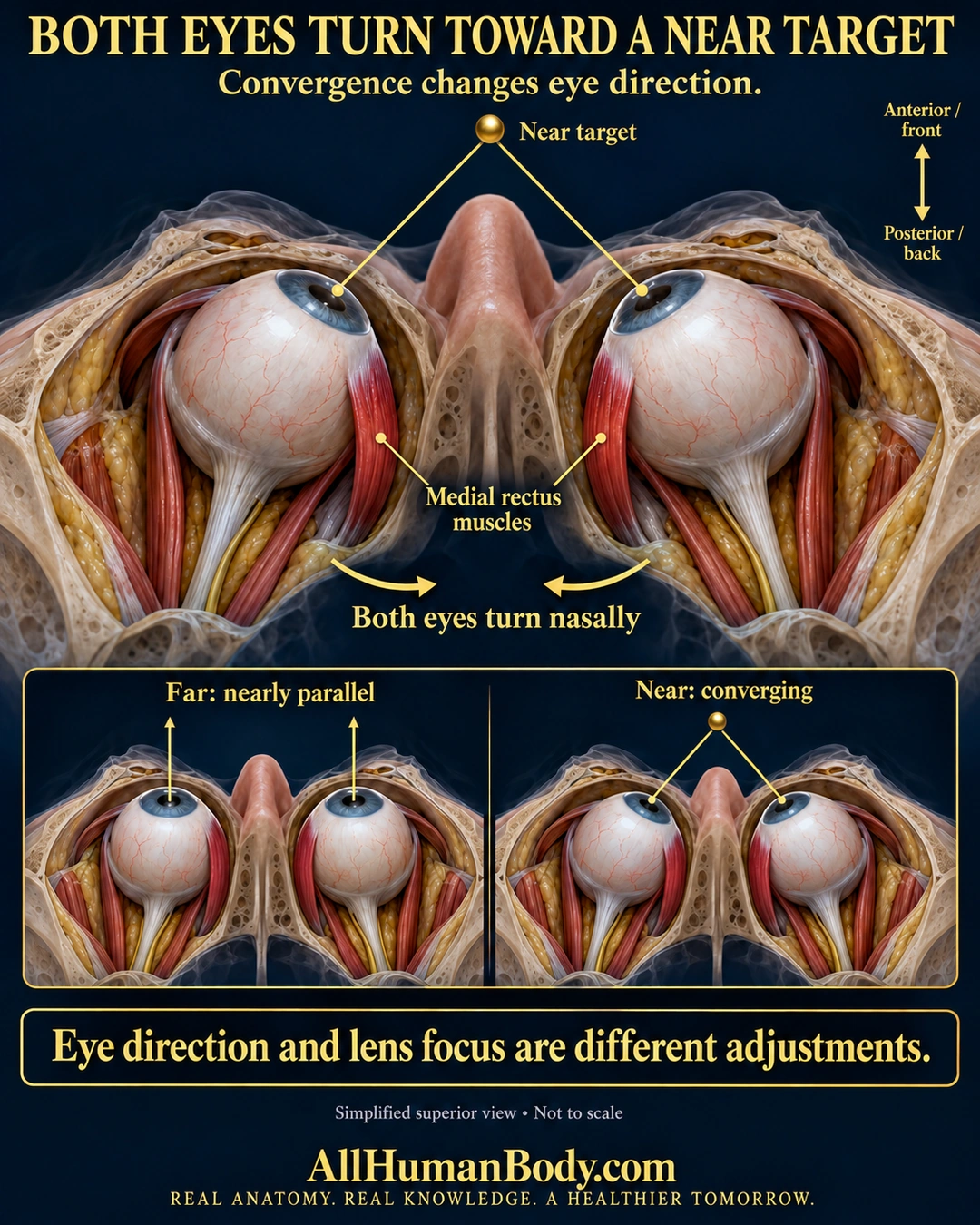
When looking toward a near midline target, both eyes rotate nasally so their viewing directions converge. The medial rectus muscles contribute to this movement; changing eye direction is distinct from changing lens focusing power.
READ THE IMAGE
What the illustration shows
Gold-on-navy poster viewed from above the paired eyes. Anterior/front is at the top. Both corneas turn toward a single gold target on the midline; sight-lines meet there. The medial rectus muscles are highlighted on the nasal sides of the globes. Lower comparisons show nearly parallel far gaze and converging near gaze. The takeaway distinguishes eye direction from lens focus. The anatomical context and angles are schematic, not to scale. Gold AllHumanBody.com branding and the full slogan appear below.
How to interpret this poster
- Superior-view orbit contours, eye size and target distance are schematic, not measured angles or a surgical map.
- No diagnosis, eye-training advice or complete brainstem wiring reconstruction.
- Convergence, lens accommodation and pupil constriction act on different structures even when coordinated.
- AI-assisted educational illustration; not physician certification, microscopy, a diagnosis or individualized medical advice.
- Fine annotations need enlargement; the full description provides an accessible text alternative.
- Display the full uncropped illustration; do not trim titles, legends or boundary annotations.
AI-assisted educational illustration, adapted into web-sized images without changing its composition. This is general education, not an individual diagnosis or treatment recommendation.
EVIDENCE / CONTEXT
Sources and what they support
- Neuroscience Online: Chapter 7 — Ocular Motor System ↗
Nasal rotation, medial rectus action and distinction between convergence and accommodation.