Musculoskeletal / VISUAL EXPLAINER
Why Do Some Muscle Fibers Meet Their Tendon at an Angle?
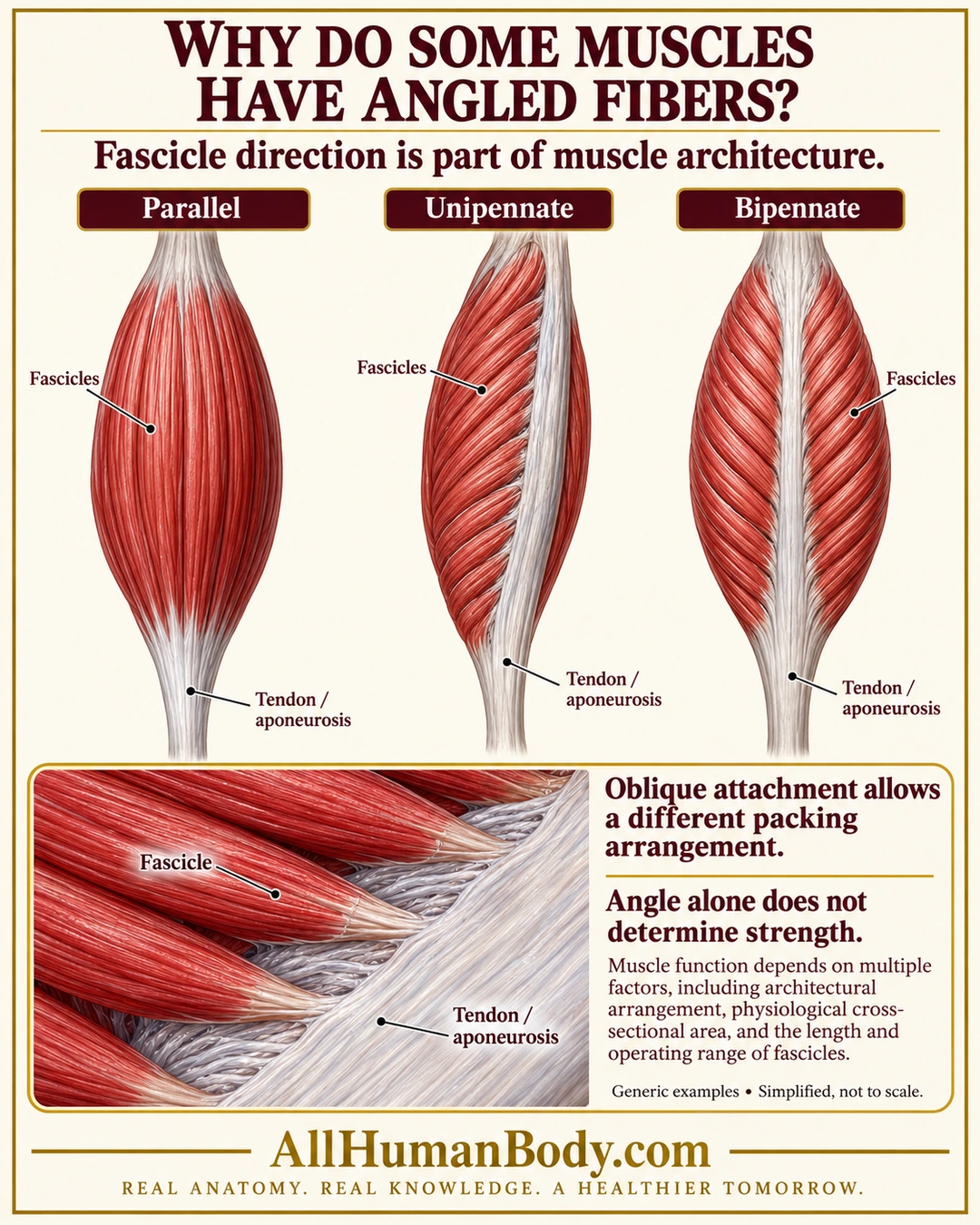
Parallel fascicles run broadly along a muscle’s length, while pennate fascicles meet a tendon or aponeurosis obliquely. Such arrangements change how fibers fit within a muscle; angle alone does not determine strength. Fiber length, physiological cross-sectional area and operating conditions also matter.
READ THE IMAGE
What the illustration shows
Three dimensional generic muscle cutaways compare parallel, unipennate and bipennate fascicle arrangements. Red fascicles run lengthwise in the first, obliquely toward one side of white aponeurosis in the second, and obliquely toward a central white aponeurosis from both sides in the third. Labels identify fascicles and tendon/aponeurosis. An enlarged attachment shows red fascicles meeting white collagen. Text states that angle alone does not determine strength. Gold AllHumanBody.com branding and exact slogan appear below. Generic examples, not to scale.
How to interpret this poster
- The biomechanics source synthesizes human and animal findings; the drawings are not measurements of individual fibers, equal-volume tests or performance predictions.
- Generic arrangements, not named muscles, measured angles or equal-volume force comparisons.
- No strongest/weakest ranking, exercise advice or universal force multiplier.
- AI-assisted educational illustration; not physician certification, microscopy, a diagnosis or individualized medical advice.
- Fine annotations need enlargement; the full description provides an accessible text alternative.
- Display the full uncropped illustration; do not trim titles, legends or boundary annotations.
AI-assisted educational illustration, adapted into web-sized images without changing its composition. This is general education, not an individual diagnosis or treatment recommendation.
EVIDENCE / CONTEXT
Sources and what they support
- Anatomy and Physiology: 11.1 Interactions of Skeletal Muscles, Their Fascicle Arrangement, and Their Lever Systems ↗
Parallel/pennate geometry and different packing arrangements; not an unconditional force ranking.
- Muscle structural assembly and functional consequences ↗
Muscle architecture, physiological cross-sectional area, fiber length and operating range all contribute to mechanical behavior.