Musculoskeletal / VISUAL EXPLAINER
Why Is a Normal Spine Curved Rather Than Straight?
Viewed from the side, an adult spine has cervical and lumbar curves convex toward the front and thoracic and sacral curves convex toward the back. Curves and discs help accommodate everyday loads, with normal variation rather than one compulsory posture.
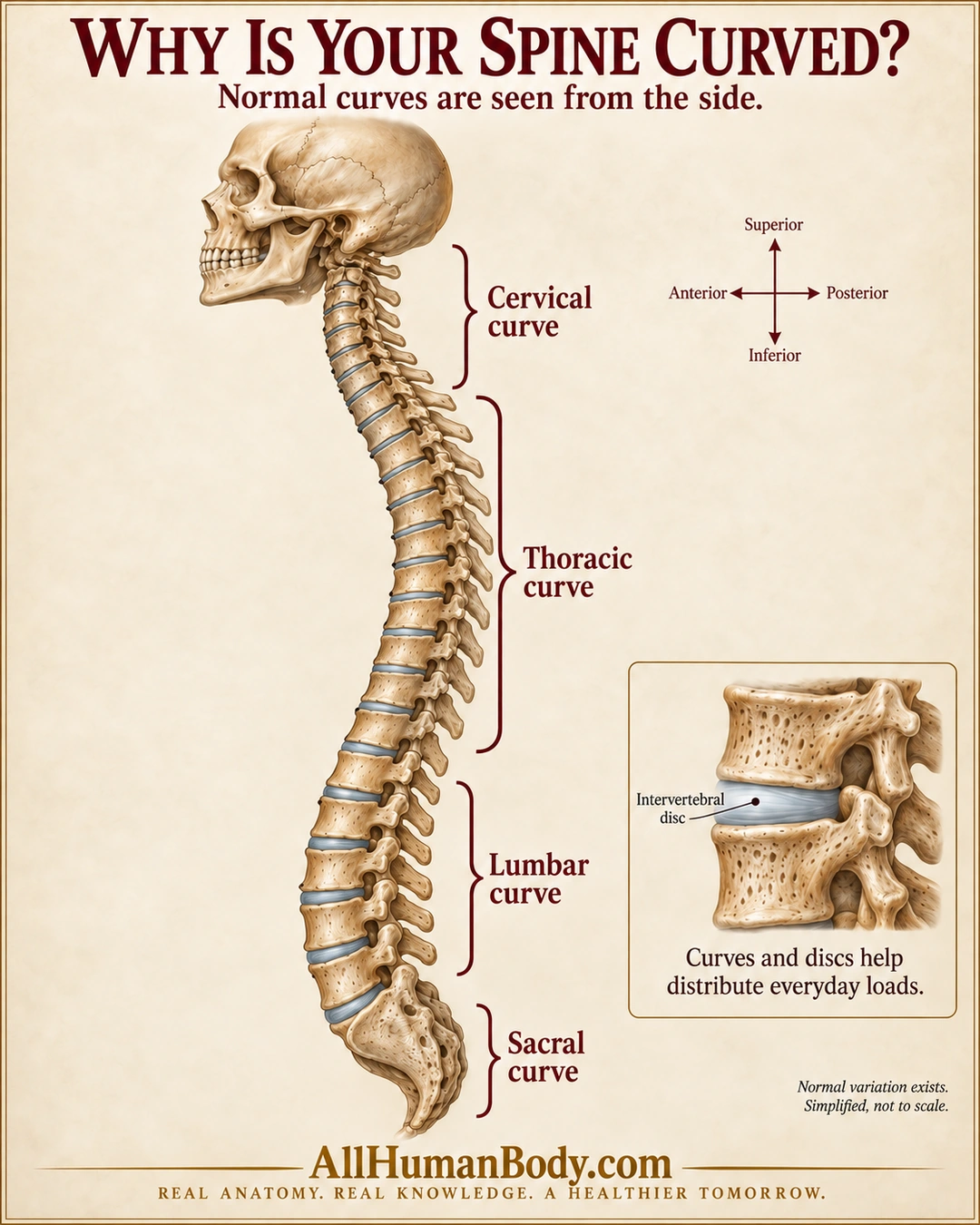
READ THE IMAGE
What the illustration shows
Portrait atlas with a lateral skull and adult spinal column facing left. An orientation compass marks anterior left and posterior right. Brackets identify cervical, thoracic, lumbar and sacral curves. Vertebral bodies and blue-grey discs alternate above the fused sacrum. An inset enlarges two bodies and an intervertebral disc. Text says curves and discs help distribute everyday loads and that normal variation exists. Gold AllHumanBody.com and the full brand slogan appear at the bottom. Proportions are simplified, not to scale.
How to interpret this poster
- Regional brackets and illustrated levels are approximate, not a vertebral-count atlas or measured curve angles.
- Bone geometry, proportions and disc thickness are schematic.
- No ideal posture, pain diagnosis, scoliosis screening or corrective exercise advice.
- AI-assisted educational illustration; not physician certification, microscopy, a diagnosis or individualized medical advice.
- Fine annotations need enlargement; the full description provides an accessible text alternative.
- Display the full uncropped illustration; do not trim titles, legends or boundary annotations.
AI-assisted educational illustration, adapted into web-sized images without changing its composition. This is general education, not an individual diagnosis or treatment recommendation.
EVIDENCE / CONTEXT
Sources and what they support
- Anatomy and Physiology 2e: 7.3 The Vertebral Column ↗
Regional curves and alternating sagittal directions; direct curve section preserved and reopened during production.
- MedlinePlus Medical Encyclopedia: Spinal curves ↗
Curves, discs and stress distribution.