Special Senses / VISUAL EXPLAINER
Does Every Smell Have Its Own Receptor?
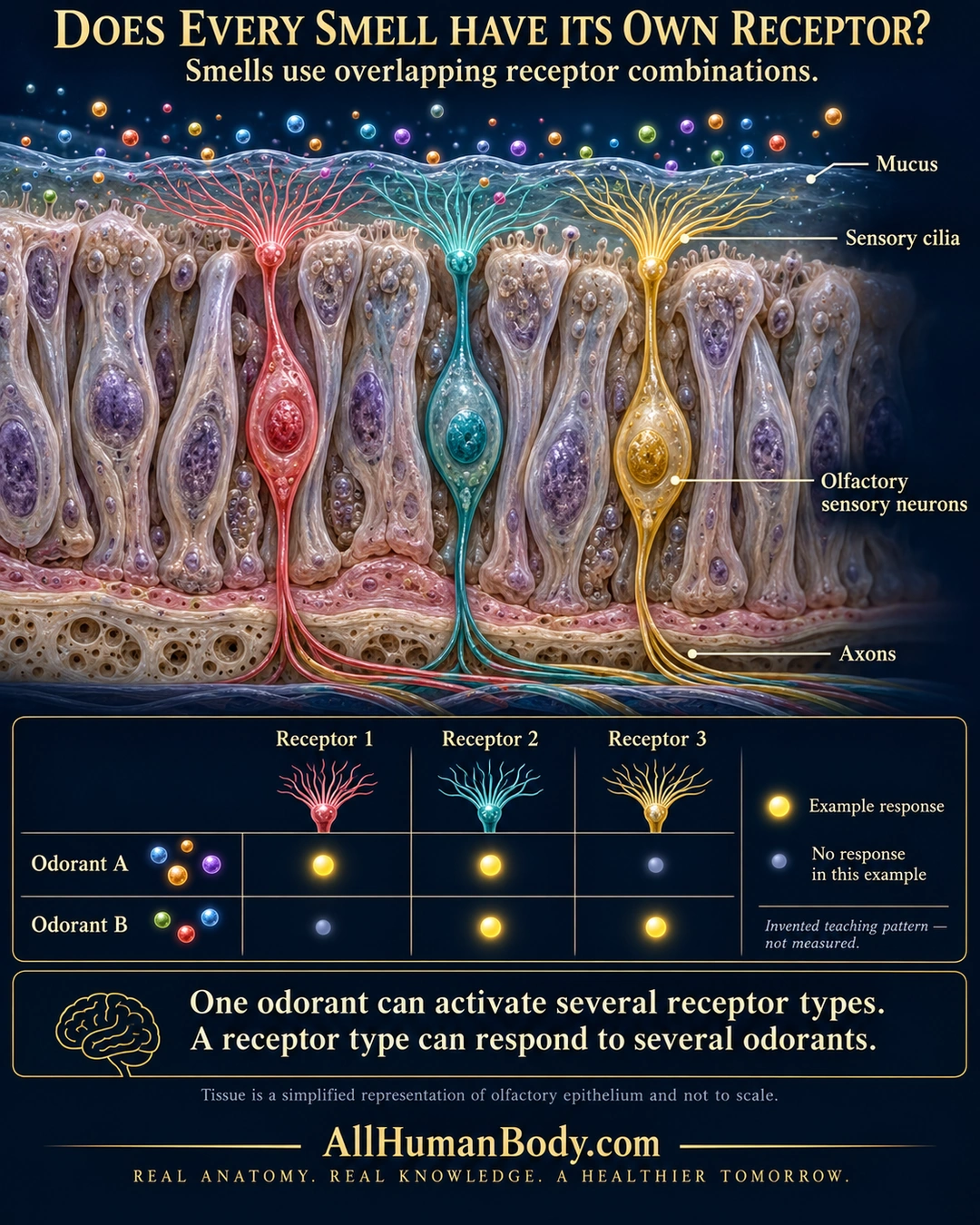
Smell input uses overlapping receptor combinations. One odorant can activate several receptor types, and a receptor type can respond to several odorants; these population patterns contribute to recognition rather than forming one dedicated cable per smell.
READ THE IMAGE
What the illustration shows
Gold-titled poster on navy: Does every smell have its own receptor? A dimensional strip of olfactory epithelium contains red, teal and gold sensory neurons among neutral supporting cells. Fine sensory cilia extend into mucus; basal axons descend below the tissue. Labels identify mucus, sensory cilia, neurons and axons. A three-column teaching chart shows odorant A activating receptor groups 1 and 2, and odorant B groups 2 and 3. Bright and dim dots indicate example response and no response. The chart is explicitly invented, not measured. The takeaway states that one odorant can activate several receptor types and one receptor type can respond to several odorants. Gold AllHumanBody.com and the full slogan appear below.
How to interpret this poster
- Invented binary response chart, not a real receptor assay, named smell or measured intensity.
- Colors distinguish example types, not multiple receptor identities proven within one cell.
- No exact receptor/smell count, linear mixture arithmetic or smell-disorder treatment.
- AI-assisted educational illustration; not physician certification, microscopy, a diagnosis or individualized medical advice.
- Fine annotations need enlargement; the full description provides an accessible text alternative.
- Display the full uncropped illustration; do not trim titles, legends or boundary annotations.
AI-assisted educational illustration, adapted into web-sized images without changing its composition. This is general education, not an individual diagnosis or treatment recommendation.
EVIDENCE / CONTEXT
Sources and what they support
- NIDCD: Smell Disorders ↗
Normal receptor combinations contributing to smell recognition.
- Neuroscience Online: Chemical Senses: Olfaction and Gustation ↗
Receptors interact with multiple odorant molecules.