Respiratory / VISUAL EXPLAINER
Who Collects Particles in Your Lung Air Sacs?
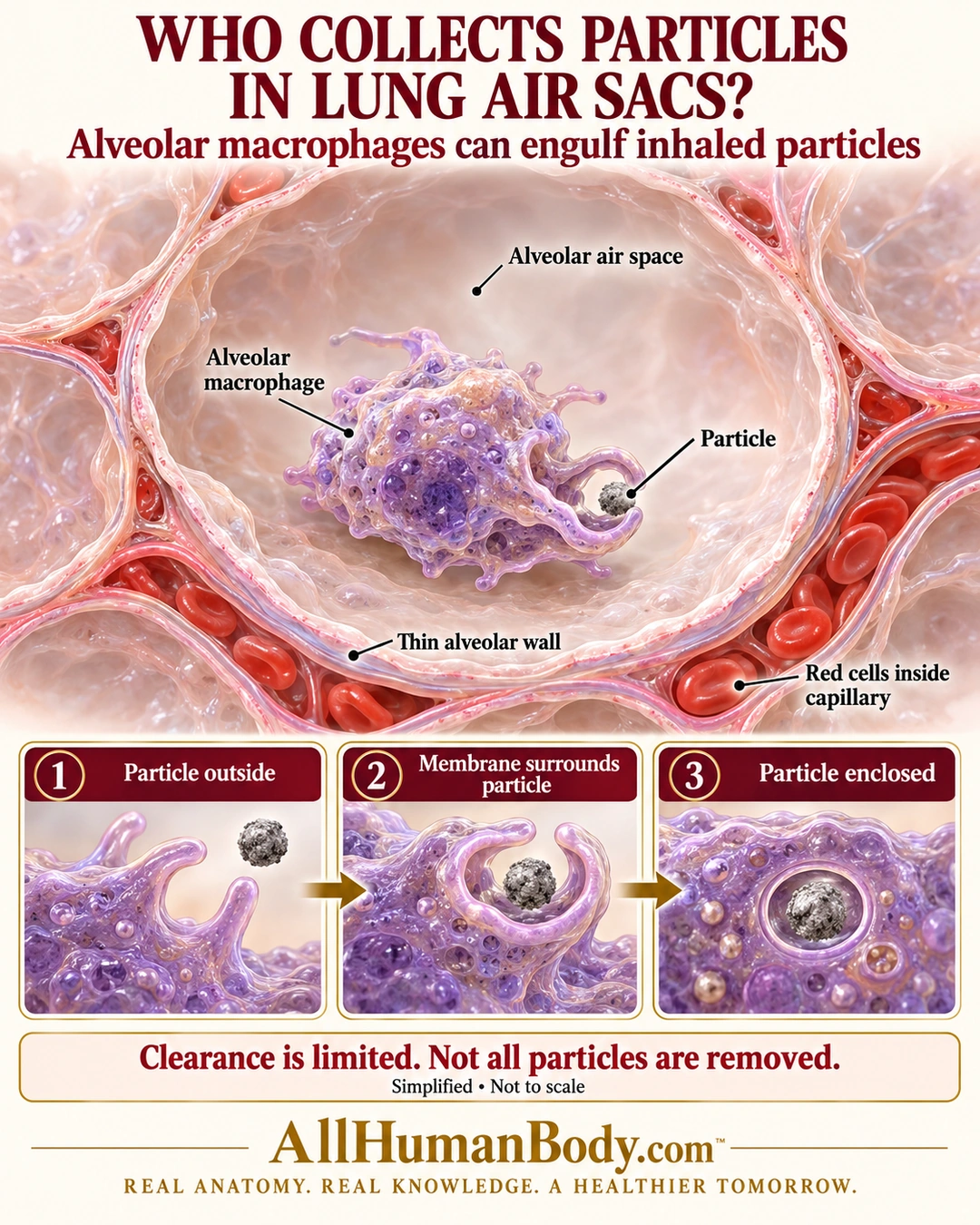
Alveolar macrophages can engulf particles that reach lung air spaces. They are separate cells rather than the thin alveolar lining, and their activity does not mean that every inhaled particle is removed or an exposure is harmless.
READ THE IMAGE
What the illustration shows
Cream medical poster titled Who Collects Particles in Lung Air Sacs? An opened air sac contains a separate purple irregular macrophage cupping a gray particle at its air-facing surface. Red blood cells remain inside capillaries beyond the thin alveolar wall, not loose in the air space. Three close-ups show a particle outside the cell, an open membrane cup surrounding it, and the particle enclosed in an internal membrane-bound compartment. Text warns that clearance is limited and not all particles are removed. The illustration is simplified and not to scale, with gold AllHumanBody.com and the project slogan below.
How to interpret this poster
- Particle and cell sizes are exaggerated; tissue geometry and uptake stages are schematic.
- No fixed clearance time, complete removal or lung-restoration guarantee.
- No occupational-exposure assessment, smoking timeline or treatment advice.
- AI-assisted educational illustration; not physician certification, microscopy, a diagnosis or individualized medical advice.
- Fine annotations need enlargement; the full description provides an accessible text alternative.
- Display the full uncropped illustration; do not trim titles, legends or boundary annotations.
AI-assisted educational illustration, adapted into web-sized images without changing its composition. This is general education, not an individual diagnosis or treatment recommendation.
EVIDENCE / CONTEXT
Sources and what they support
- Canadian Centre for Occupational Health and Safety: What are the Effects of Dust on the Lungs? ↗
Macrophage uptake and limits of particle clearance.
- Southern Illinois University Histology: Alveolar macrophages ↗
Separate macrophages at alveolar surfaces beside septal capillaries.