Respiratory / VISUAL EXPLAINER
Do All Your Airways Have Cartilage?
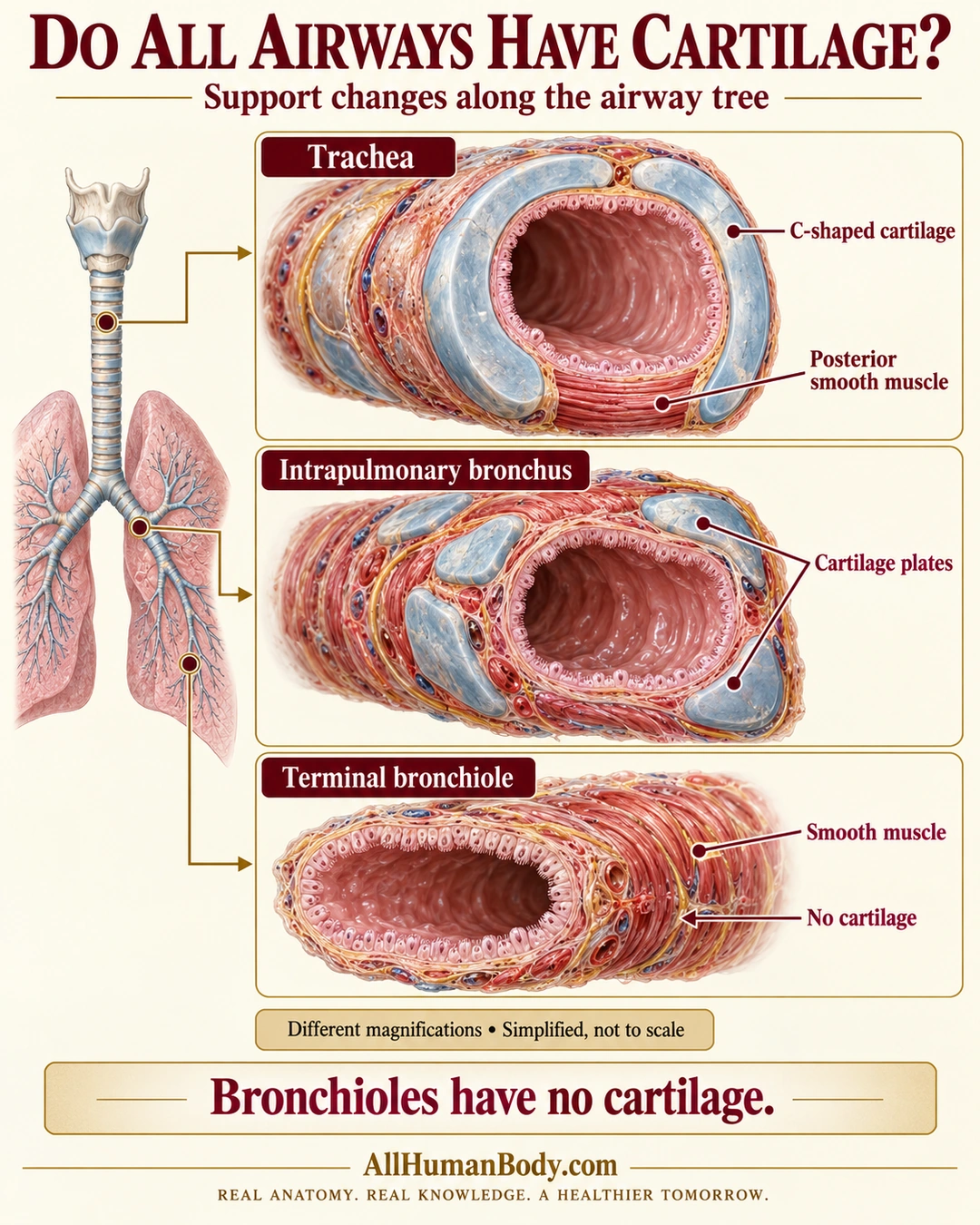
Supporting walls change along the airway tree. The trachea has C-shaped cartilage supports, intrapulmonary bronchi have cartilage plates, and bronchioles lack cartilage while retaining smooth muscle in their walls.
READ THE IMAGE
What the illustration shows
Cream medical poster titled Do All Airways Have Cartilage? A small airway tree locates three enlarged oblique cutaways. The trachea has blue C-shaped cartilage with a pink posterior smooth-muscle bridge. The intrapulmonary bronchus has separate blue cartilage plates around its wall. The terminal bronchiole has an epithelial lumen and pink smooth muscle, with no cartilage or alveoli in its wall. A note states different magnifications, simplified and not to scale. The key sentence says bronchioles have no cartilage. Gold AllHumanBody.com branding and the full project slogan appear below.
How to interpret this poster
- Different magnifications; wall thicknesses and epithelial detail are not measured or diagnostic.
- Tracheal superior segmentation is stylized; the posterior muscular gap supplies the key contrast.
- Terminal bronchiole shown without wall alveoli; no asthma advice or fixed caliber rule.
- AI-assisted educational illustration; not physician certification, microscopy, a diagnosis or individualized medical advice.
- Fine annotations need enlargement; the full description provides an accessible text alternative.
- Display the full uncropped illustration; do not trim titles, legends or boundary annotations.
AI-assisted educational illustration, adapted into web-sized images without changing its composition. This is general education, not an individual diagnosis or treatment recommendation.
EVIDENCE / CONTEXT
Sources and what they support
- University of Leeds Histology Guide: Conducting airways ↗
Changing cartilage support and cartilage-free bronchioles.
- Duke University Histology: Respiratory System ↗
Comparative tracheal, bronchial and bronchiolar structure.