Cardiovascular / VISUAL EXPLAINER
How Can One Hemoglobin Carry Up to Four Oxygen Molecules?
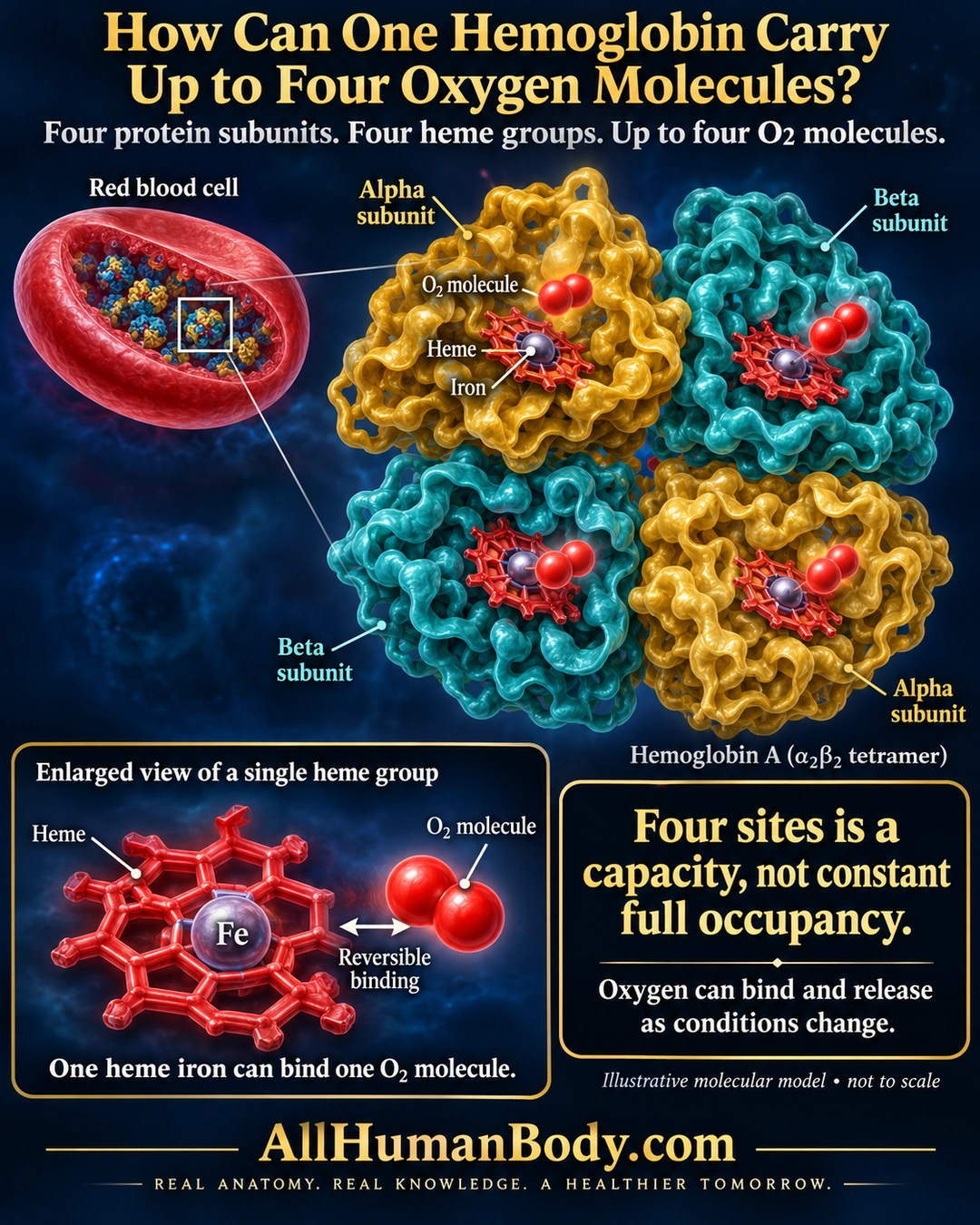
Hemoglobin A has two alpha and two beta protein subunits, each carrying an iron-containing heme. One oxygen molecule can bind at each heme, giving up to four per hemoglobin molecule; capacity is not constant full occupancy.
READ THE IMAGE
What the illustration shows
English medical poster about hemoglobin oxygen-binding capacity. A cutaway red blood cell containing many small proteins leads to an enlarged illustrative hemoglobin A tetramer. Two gold alpha subunits and two teal beta subunits each have one red heme group, a central iron bead and a paired-sphere oxygen molecule. Labels identify the four subunits, heme, iron and O2. A lower inset enlarges one heme with iron marked Fe and a reversible-binding arrow to one O2 pair. Text says four sites is a capacity, not constant full occupancy. Molecular shapes are illustrative and not to scale. Gold AllHumanBody.com branding and the full slogan appear below.
How to interpret this poster
- A teaching model, not validated atomic connectivity, crystallographic coordinates or a saturation curve.
- The red cell has no nucleus; magnification and protein packing are not quantitative.
- No complete tissue-unloading guarantee, iron-supplement advice or disease claim.
- AI-assisted educational illustration; not physician certification, microscopy, a diagnosis or individualized medical advice.
- Fine annotations need enlargement; the full description provides an accessible text alternative.
- Display the full uncropped illustration; do not trim titles, legends or boundary annotations.
AI-assisted educational illustration, adapted into web-sized images without changing its composition. This is general education, not an individual diagnosis or treatment recommendation.
EVIDENCE / CONTEXT
Sources and what they support
- PDB-101: Molecule of the Month — Hemoglobin ↗
Four subunits, iron-containing hemes and reversible oxygen binding.