Nervous / VISUAL EXPLAINER
Why Can’t an Axon Fire Again Immediately?
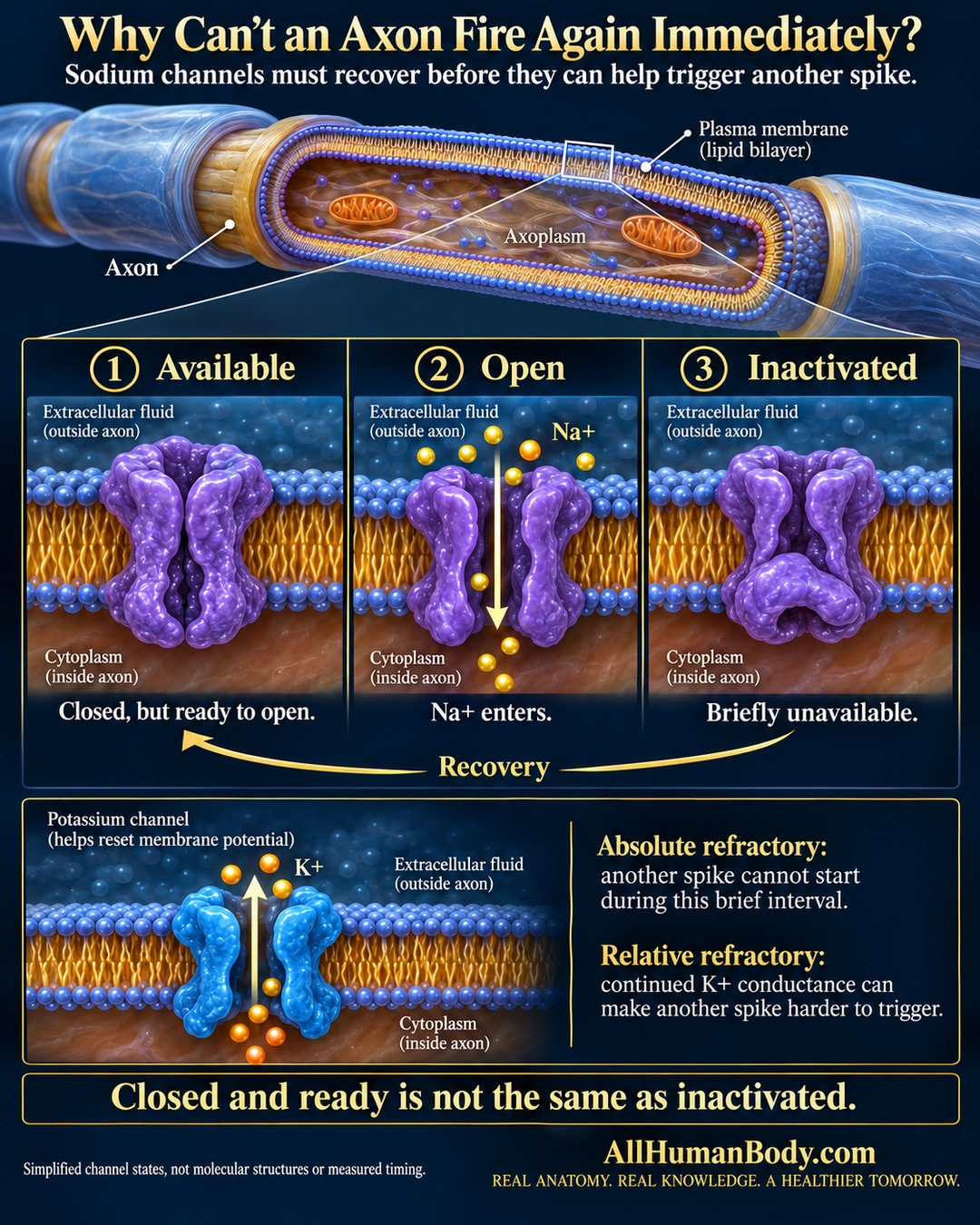
After an axonal spike, sodium channels must recover from inactivation before supporting another spike. Absolute refractoriness is followed by a relative interval in which continued potassium conductance can make triggering harder.
READ THE IMAGE
What the illustration shows
English anatomy poster titled Why Can’t an Axon Fire Again Immediately? A cutaway axon magnifies its membrane into three purple sodium-channel states: available and closed, open with a downward Na+ entry arrow, and inactivated with no ion flow. A recovery arrow returns to the available state. Below, a blue potassium channel shows K+ leaving upward. Text distinguishes absolute and relative refractory intervals and says closed and ready is not the same as inactivated. Channel shapes and timing are explicitly simplified. Gold AllHumanBody.com branding and the complete project slogan appear at the bottom.
How to interpret this poster
- A conventional axonal excitability model, not universal timing or behavior of every excitable cell.
- Channels and gates are invented teaching shapes, not molecular structures.
- Potassium flow changes voltage but does not alone restore all concentration gradients; no fatigue or health advice.
- AI-assisted educational illustration; not physician certification, microscopy, a diagnosis or individualized medical advice.
- Fine annotations need enlargement; the full description provides an accessible text alternative.
- Display the full uncropped illustration; do not trim titles, legends or boundary annotations.
AI-assisted educational illustration, adapted into web-sized images without changing its composition. This is general education, not an individual diagnosis or treatment recommendation.
EVIDENCE / CONTEXT
Sources and what they support
- Anatomy and Physiology 2e: 12.4 The Action Potential ↗
Sodium inactivation/recovery and potassium contribution to refractory intervals; preserved direct lines 97–106 and channel context.