Lymphatic & Immune / VISUAL EXPLAINER
Where Does Lymph Rejoin Your Blood?
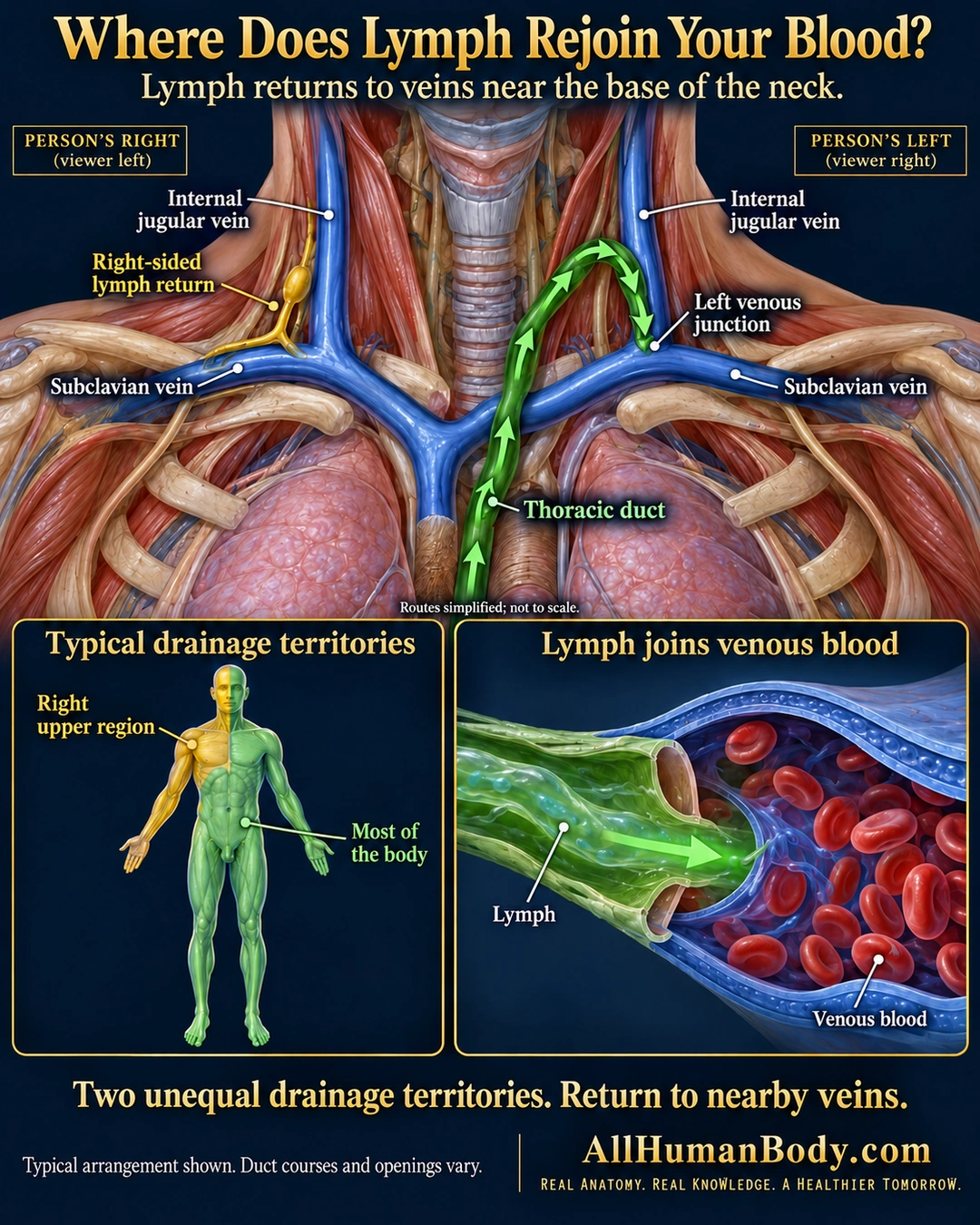
Lymph returns to venous blood near the base of the neck. The thoracic duct commonly serves the lower body and left upper regions, while the right upper territory returns through right-sided pathways; actual duct courses and openings vary.
READ THE IMAGE
What the illustration shows
English anatomy poster titled Where Does Lymph Rejoin Your Blood? An anterior neck and upper-chest illustration labels the person’s right on the viewer’s left. Blue internal jugular and subclavian veins meet near the neck base. A green thoracic duct rises from below and curves into the left venous junction; a gold right-sided lymph route joins the right junction. A small body map colors the right upper region gold and the remaining body, including both legs, green. An enlarged cutaway shows green lymph entering blue venous blood. Text notes unequal drainage territories, simplified routes and anatomical variation. Gold AllHumanBody.com branding and the complete project slogan appear below.
How to interpret this poster
- Routes are brought forward for visibility, not a precise surgical plane or mediastinal dissection.
- Calibers, wall thickness and green/gold colors are schematic; no universal terminal valve or collecting sac.
- No massage, detoxification, edema or treatment advice.
- AI-assisted educational illustration; not physician certification, microscopy, a diagnosis or individualized medical advice.
- Fine annotations need enlargement; the full description provides an accessible text alternative.
- Display the full uncropped illustration; do not trim titles, legends or boundary annotations.
AI-assisted educational illustration, adapted into web-sized images without changing its composition. This is general education, not an individual diagnosis or treatment recommendation.
EVIDENCE / CONTEXT
Sources and what they support
- Anatomy and Physiology 2e: 21.1 Anatomy of the Lymphatic and Immune Systems ↗
Asymmetric drainage territories and neck-vein return; preserved direct lines 54–60, fixed volume figures excluded.
- Anatomical Variations of the Thoracic Duct: A Preliminary Report in Adult and Fetal Specimens ↗
Variation in thoracic-duct anatomy, not a single universal course.
Evidence correspondence is limited to the abstract.