Musculoskeletal / VISUAL EXPLAINER
How Can Your Tongue Change Shape Without a Bone Inside It?
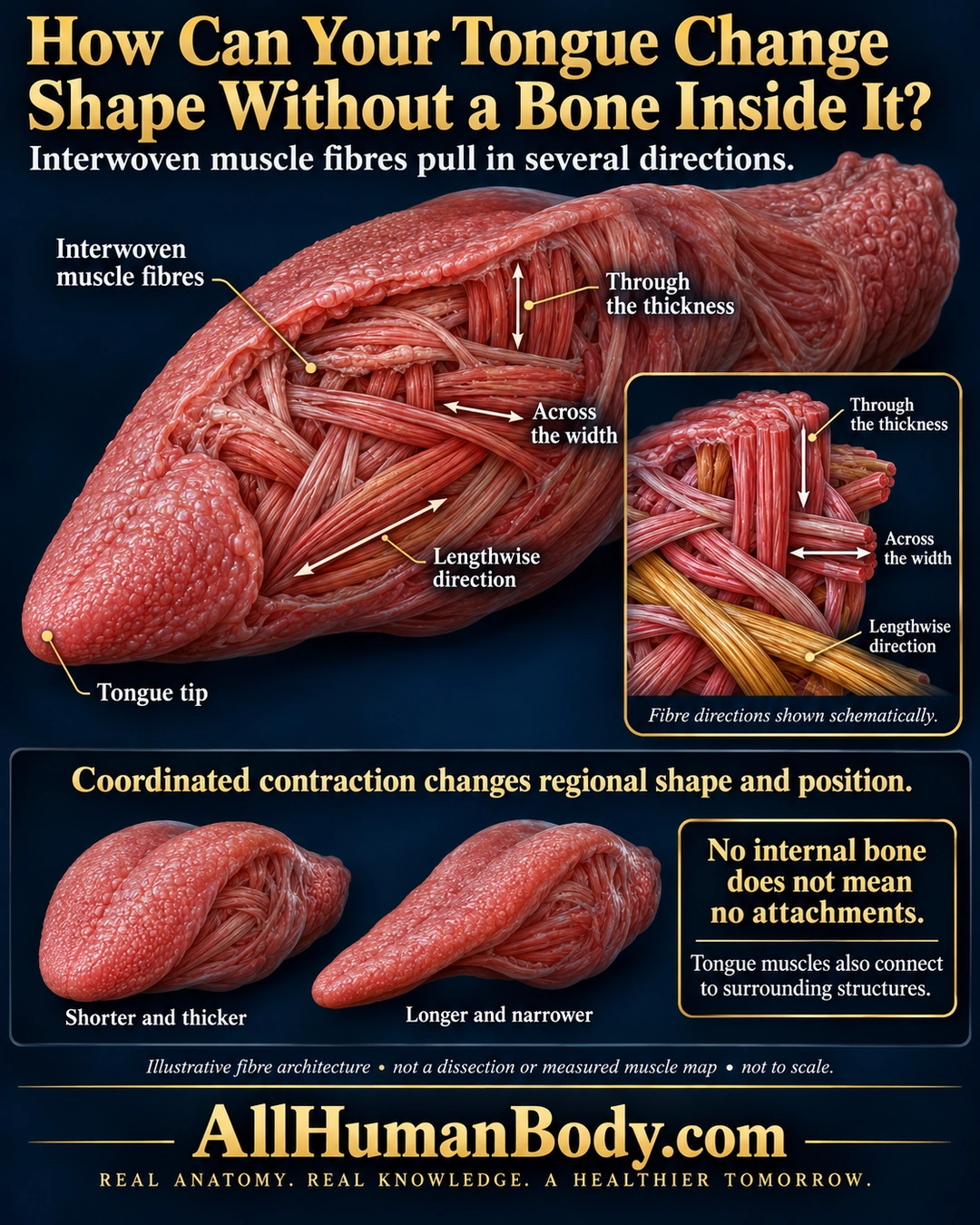
Interwoven tongue muscles coordinate changes in regional shape and position without a bone inside the tongue. Some muscles connect to surrounding structures, so a flexible muscular organ is not an unattached one.
READ THE IMAGE
What the illustration shows
Dimensional tongue-muscle poster with gold title asks how the tongue changes shape without an internal bone. An oblique cutaway shows the tip at lower left and textured muscle fascicles crossing in lengthwise, across-width and through-thickness directions beneath the surface. A magnified inset repeats these schematic fibre directions. Two lower tongue forms compare shorter and thicker with longer and narrower shapes. Text explains that coordinated contraction changes regional shape and position, and that tongue muscles connect to surrounding structures despite lacking an internal bone. The image is labeled illustrative fibre architecture, not a dissection or measured muscle map. Gold AllHumanBody.com branding and the complete slogan appear at the bottom.
How to interpret this poster
- Illustrative fiber architecture, not a dissection, measured atlas or exact origin/insertion map.
- Two shapes are coordinated examples, not the effect of one isolated muscle or a rigid shape-versus-position division.
- No tongue exercise, swallowing treatment, strength or genetics claim.
- AI-assisted educational illustration; not physician certification, microscopy, a diagnosis or individualized medical advice.
- Fine annotations need enlargement; the full description provides an accessible text alternative.
- Display the full uncropped illustration; do not trim titles, legends or boundary annotations.
AI-assisted educational illustration, adapted into web-sized images without changing its composition. This is general education, not an individual diagnosis or treatment recommendation.
EVIDENCE / CONTEXT
Sources and what they support
- How mandibular and hyoid morphology alters tongue muscle architecture in healthy adults: An anatomical atlas and statistical shape model of the tongue ↗
Complex human tongue architecture and relationships with surrounding bony structures.
Evidence correspondence is limited to the abstract. - Anatomy and Physiology 2e: 11.3 Axial Muscles of the Head, Neck, and Back ↗
Tongue muscle attachments and shape/position changes.