Special Senses / VISUAL EXPLAINER
Do the Same Taste Cells Last Your Whole Life?
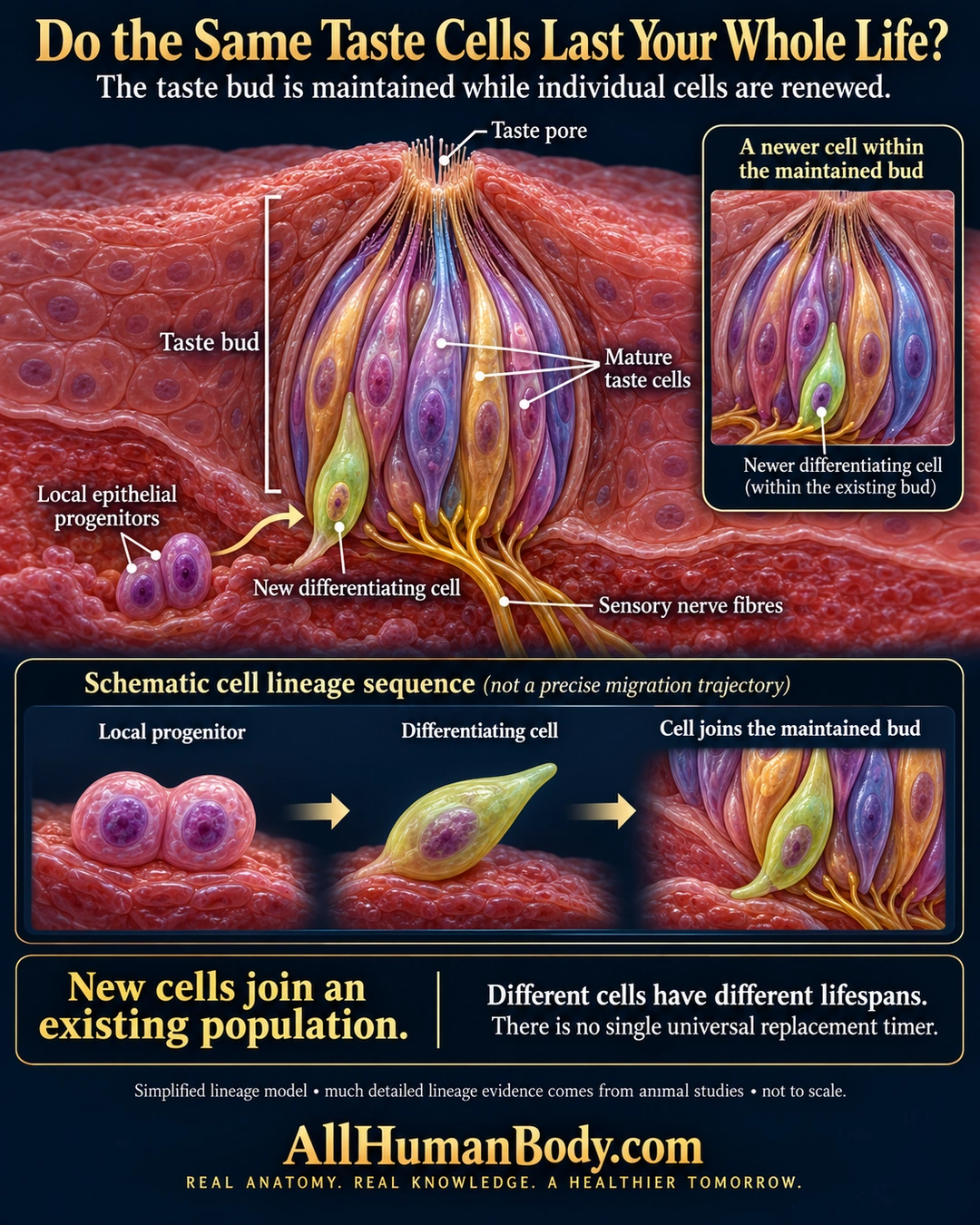
Taste-cell populations are maintained through cellular renewal. Mouse lineage studies identify local epithelial progenitors contributing new cells, and mouse labeling studies found different turnover among cell types. The diagram does not establish a human replacement timetable.
READ THE IMAGE
What the illustration shows
Gold-titled medical illustration asks whether the same taste cells last a lifetime. A taste bud sits within tongue epithelium, with elongated mature cells reaching an apical taste pore and yellow sensory nerve fibres at its base. Purple local epithelial progenitors lie beside the basal perimeter; a gold schematic arrow leads to one green differentiating cell joining the existing bud. An inset highlights that newer cell among mature cells. A lower three-stage sequence shows a local progenitor, a differentiating cell and a cell joining the maintained bud. Text states that cells have different lifespans and no universal replacement timer. Lineage placement is schematic and much detailed evidence comes from animal studies. Gold AllHumanBody.com branding and its full slogan appear below.
How to interpret this poster
- Adult mouse circumvallate taste-bud evidence supports differing cell-population turnover, not a guaranteed individual lifespan or universal human timer.
- Lineage arrows are schematic, not precise migration paths or molecular identification.
- No universal timer, whole-bud replacement, injury-recovery guarantee or treatment claim.
- AI-assisted educational illustration; not physician certification, microscopy, a diagnosis or individualized medical advice.
- Fine annotations need enlargement; the full description provides an accessible text alternative.
- Display the full uncropped illustration; do not trim titles, legends or boundary annotations.
AI-assisted educational illustration, adapted into web-sized images without changing its composition. This is general education, not an individual diagnosis or treatment recommendation.
EVIDENCE / CONTEXT
Sources and what they support
- Cell lineage mapping of taste bud cells and keratinocytes in the mouse tongue and soft palate ↗
Mouse epithelial progenitor contribution and ongoing taste-cell renewal.
Evidence correspondence is limited to the abstract. - Functional Cell Types in Taste Buds Have Distinct Longevities ↗
Mouse taste-cell populations differed in turnover in EdU/immunostaining experiments; not a human replacement timetable.