Endocrine / VISUAL EXPLAINER
How Does Glucose Trigger an Electrical Signal in a Beta Cell?
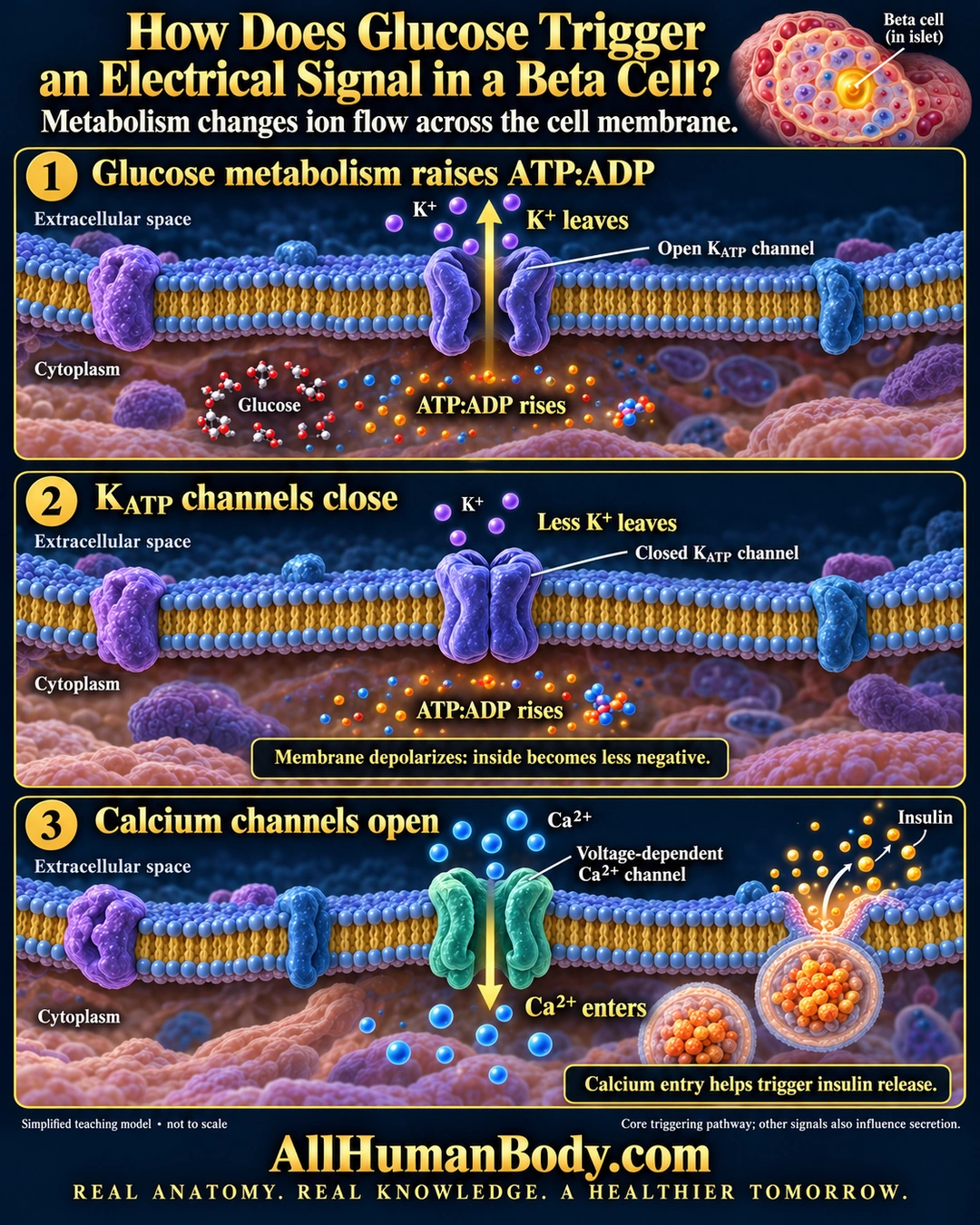
In a core glucose-stimulated pathway, metabolism changes ATP relative to ADP and reduces potassium flow through ATP-sensitive channels. The membrane becomes less negative, voltage-gated calcium channels open, and calcium helps trigger stored insulin release.
READ THE IMAGE
What the illustration shows
Three-panel dimensional teaching illustration of a pancreatic beta-cell membrane. Extracellular space is above each membrane and cytoplasm below. Panel1 shows glucose metabolism and rising ATP:ADP beside an open potassium channel, with an upward K+ arrow leaving the cell. Panel2 shows the KATP channel closed and says less potassium leaves; the inside becomes less negative. Panel3 shows a separate voltage-dependent calcium channel and a downward Ca2+ arrow entering the cell. A small insulin granule fuses with membrane and releases molecules outside. Channel and molecular shapes are schematic, not to scale. A small islet locator highlights a beta cell. Gold AllHumanBody.com branding and the full project slogan appear below.
How to interpret this poster
- A core triggering pathway, not the whole regulation of insulin secretion or an exclusively mitochondrial ATP mechanism.
- Ion arrows show direction, not measured currents, concentrations or channel structures.
- Depolarization means less negative, not that the whole cytoplasm becomes positively charged; no diabetes-treatment advice.
- AI-assisted educational illustration; not physician certification, microscopy, a diagnosis or individualized medical advice.
- Fine annotations need enlargement; the full description provides an accessible text alternative.
- Display the full uncropped illustration; do not trim titles, legends or boundary annotations.
AI-assisted educational illustration, adapted into web-sized images without changing its composition. This is general education, not an individual diagnosis or treatment recommendation.
EVIDENCE / CONTEXT
Sources and what they support
- Isocitrate-to-SENP1 signaling amplifies insulin secretion and rescues dysfunctional β cells ↗
Core ATP/KATP/depolarization/calcium trigger distinguished from amplification.
- A radical explanation for glucose-induced β cell dysfunction ↗
Normal ATP/ADP, potassium-channel closure and calcium-trigger sequence.