Special Senses / VISUAL EXPLAINER
Does Your Tongue Use the Same Signals for Taste and Touch?
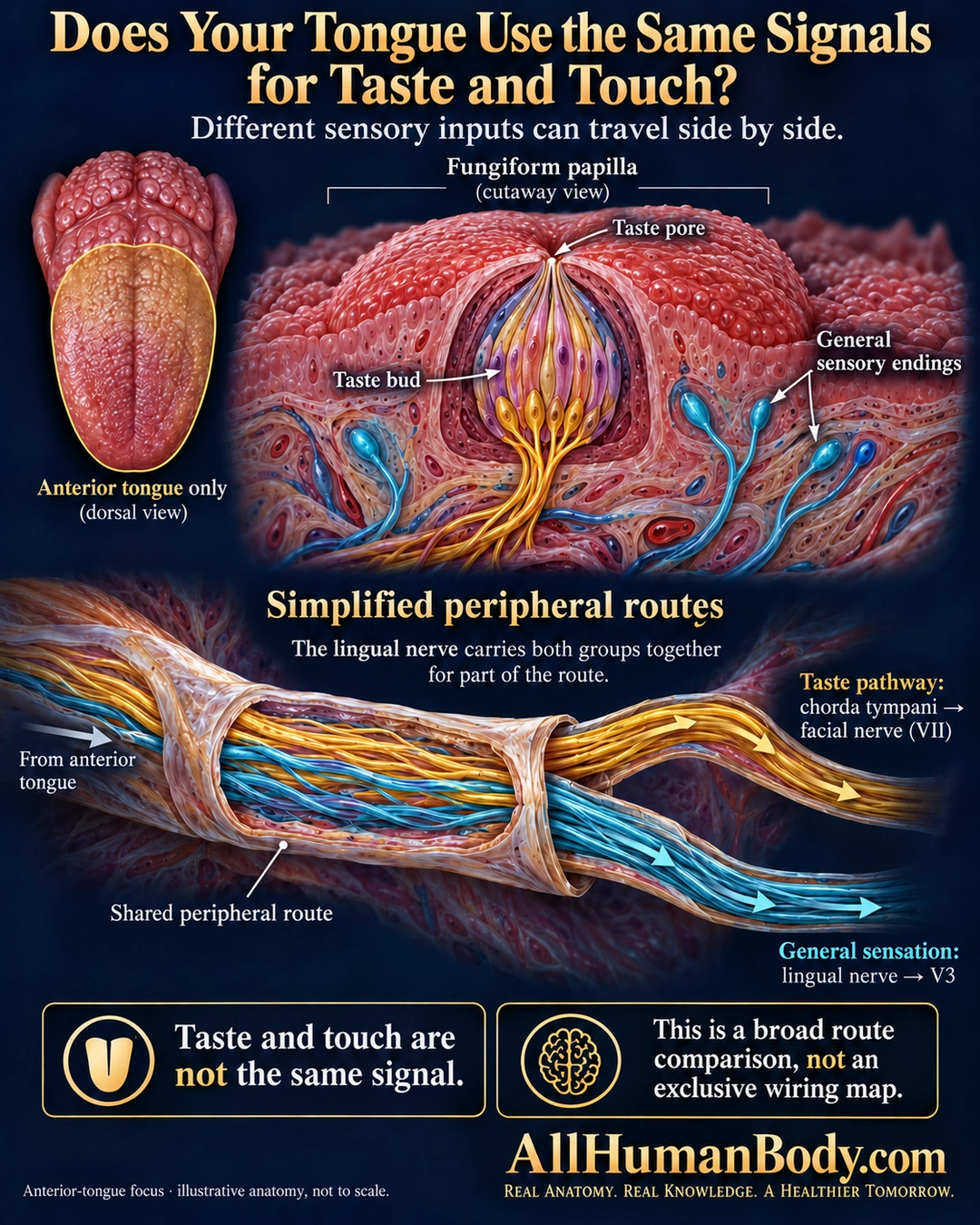
Taste and general sensation from the anterior tongue use different neural components. Taste fibers travel with the lingual nerve for part of their course before joining the chorda tympani route toward the facial nerve; general sensation continues toward the mandibular trigeminal division.
READ THE IMAGE
What the illustration shows
Original educational poster focused on the anterior tongue. A dorsal tongue locator highlights the front region. An enlarged fungiform papilla shows an epithelial taste bud with amber fibers at its base and separate blue general sensory endings nearby. Below, a dimensional cutaway of a shared peripheral nerve sheath contains amber and blue fibers that continue into separate branches. Amber arrows follow the chorda tympani toward facial nerve VII; blue arrows follow the lingual nerve toward V3. Text states that different inputs can travel together and this is not an exclusive wiring map. Anatomy and pathway geometry are simplified, not to scale. Gold AllHumanBody.com and the full slogan sit at the bottom.
How to interpret this poster
- A broad route comparison, not an exclusive modality map of every fiber.
- Colors distinguish teaching routes, not biological nerve colors or a synapse at the branch.
- No sensory test, nerve-injury prognosis or whole-tongue supply claim.
- AI-assisted educational illustration; not physician certification, microscopy, a diagnosis or individualized medical advice.
- Fine annotations need enlargement; the full description provides an accessible text alternative.
- Display the full uncropped illustration; do not trim titles, legends or boundary annotations.
AI-assisted educational illustration, adapted into web-sized images without changing its composition. This is general education, not an individual diagnosis or treatment recommendation.
EVIDENCE / CONTEXT
Sources and what they support
- Oral sensory nerve damage: Causes and consequences ↗
Normal anterior-tongue lingual/chorda-tympani route relationships only.