Digestive / VISUAL EXPLAINER
How Does a Pancreatic Cell Release Its Digestive Cargo?
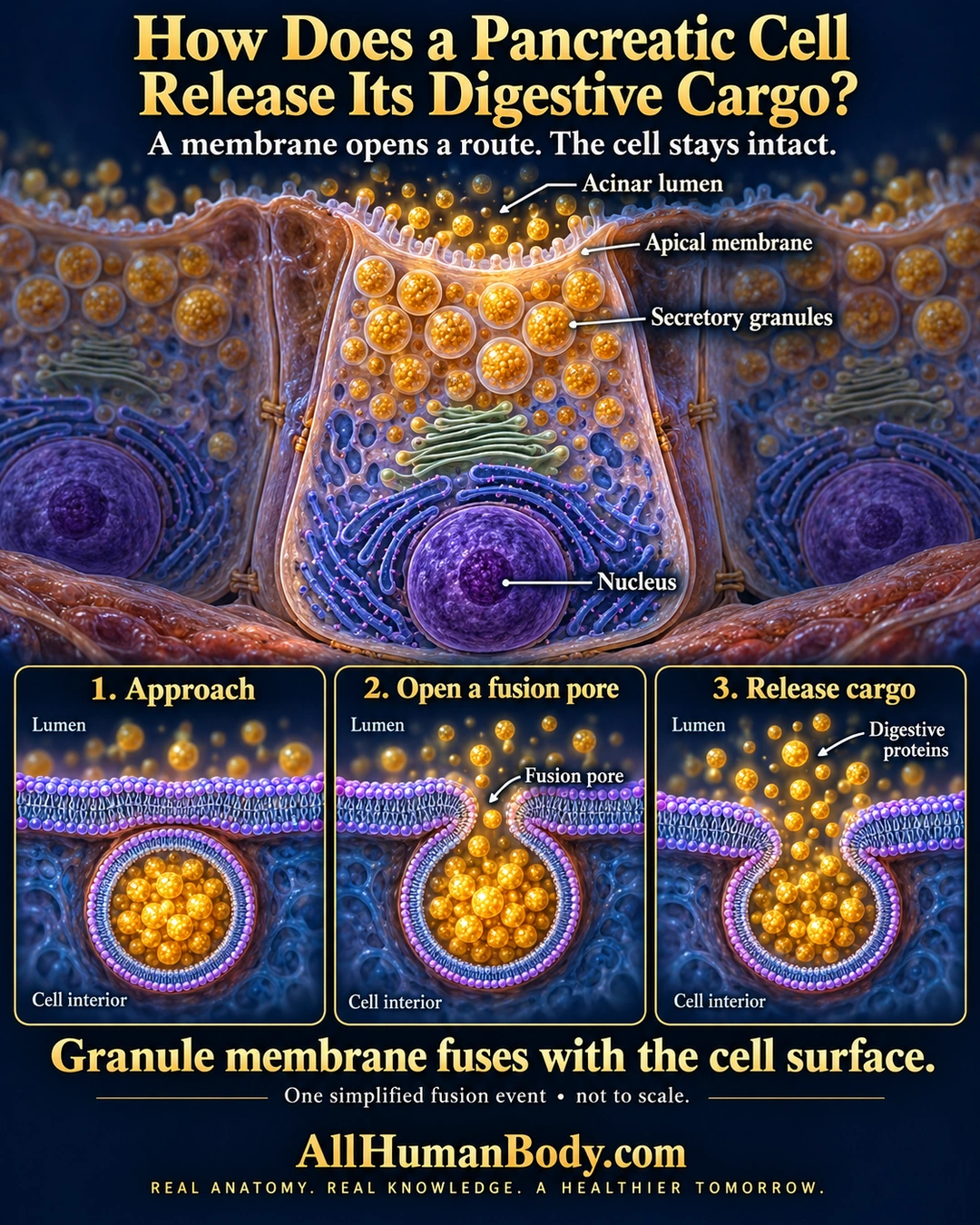
Pancreatic acinar cells package digestive proteins in secretory granules near their luminal surface. Granule membrane fusion opens a route for cargo into the acinar lumen, which connects with the duct system.
READ THE IMAGE
What the illustration shows
Original English poster titled How Does a Pancreatic Cell Release Its Digestive Cargo? A dimensional cutaway shows an acinar cell with a lower nucleus and rough endoplasmic reticulum, Golgi above, and many secretory granules near its upper apical surface facing the acinar lumen. Three enlarged panels show a closed granule approaching the surface, its membrane joining the apical membrane to form an open fusion pore, and gold digestive-protein symbols leaving into the lumen. The cell interior remains below the membrane and the lumen above. The illustrated membrane stays continuous around the open pocket. Text identifies this as one simplified event, not to scale. Gold AllHumanBody.com and the complete slogan appear at the bottom.
How to interpret this poster
- A simplified secretion sequence, not proof every granule fully collapses or follows identical timing.
- Not all stored digestive proteins are inactive precursors; no enzyme-treatment claim.
- Membrane shapes and cargo dots are schematic, not resolved molecular machinery.
- AI-assisted educational illustration; not physician certification, microscopy, a diagnosis or individualized medical advice.
- Fine annotations need enlargement; the full description provides an accessible text alternative.
- Display the full uncropped illustration; do not trim titles, legends or boundary annotations.
AI-assisted educational illustration, adapted into web-sized images without changing its composition. This is general education, not an individual diagnosis or treatment recommendation.
EVIDENCE / CONTEXT
Sources and what they support
- Rab27A Is Present in Mouse Pancreatic Acinar Cells and Is Required for Digestive Enzyme Secretion ↗
Apical granule fusion and digestive secretion in mouse acinar cells.