Integumentary / VISUAL EXPLAINER
Why Can Your Skin Look Redder When You Are Hot?
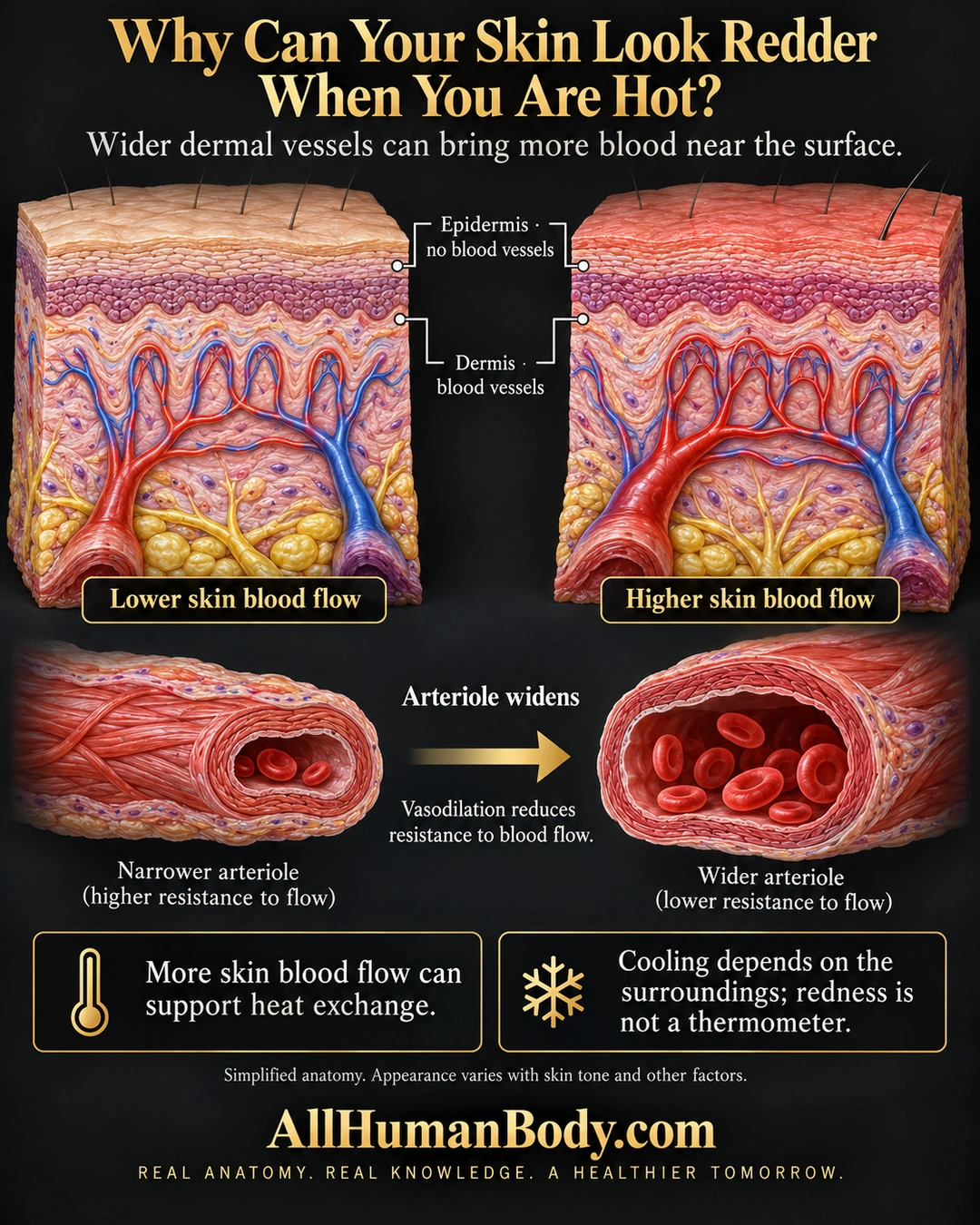
Widening dermal arterioles lowers vascular resistance under comparable conditions and can increase skin perfusion. This may make skin look redder and help heat exchange, but appearance varies and cooling depends on the surroundings.
READ THE IMAGE
What the illustration shows
English poster asking why skin can look redder when hot. Two dimensional skin cutaways compare lower and higher skin blood flow. The avascular epidermis lies above the dermis, where enlarged red and blue teaching vessels remain below its boundary. The right block has wider supplying vessels and a redder surface. Below, cutaway arterioles compare a narrow and wider lumen with red cells contained inside. Text explains that vasodilation reduces resistance, skin blood flow can support heat exchange, and cooling depends on surroundings; redness is not a thermometer. The geometry and colors are simplified, not measurements. Gold AllHumanBody.com and its full slogan appear at the bottom.
How to interpret this poster
- Redness is not a thermometer or a quantitative blood-flow scale.
- Vessel colors, widths, wall layers and skin-tone response are illustrative.
- No claim all redness is normal, all hot people look red, or more skin flow guarantees cooling; no exercise-safety advice.
- AI-assisted educational illustration; not physician certification, microscopy, a diagnosis or individualized medical advice.
- Fine annotations need enlargement; the full description provides an accessible text alternative.
- Display the full uncropped illustration; do not trim titles, legends or boundary annotations.
AI-assisted educational illustration, adapted into web-sized images without changing its composition. This is general education, not an individual diagnosis or treatment recommendation.
EVIDENCE / CONTEXT
Sources and what they support
- Anatomy and Physiology 2e: 5.3 Functions of the Integumentary System ↗
Dermal arteriolar dilation and possible exercise-associated redness; preserved lines 48–57.
- Anatomy and Physiology 2e: 20.2 Blood Flow, Blood Pressure, and Resistance ↗
Vascular smooth-muscle tone, diameter and resistance relationship.
- Heat and Cold Illness in Travelers — CDC Yellow Book ↗
Skin blood flow and environmental limits on heat exchange.